Category Archives: Climate Change

Odds of Cooking the Kids: Part 2

Yesterday, I referred to Stuart Staniford’s blog post entitled ‘Odds of Cooking the Grandkids’. (His analysis, in turn, was based on a scientific paper published in the prestigious journal the Proceedings of the National Academy of Sciences.) What shocks me most is that when Staniford talks about cooking the grandkids he means it literally:

The bottom line conclusion is that there is a small – of order 5% – risk of global warming creating a situation in which a large fraction of the planet was uninhabitable (in the sense that if you were outside for an extended period during the hottest days of the year, even in the shade with wet clothing, you would die).

I like to think of climate change risk as the likelihood of bad stuff happening to my family or myself due to global warming. Well ‘death’ certainly comes under the category of ‘bad stuff’ and a 5% probability is not negligible, and certainly far higher than the kind of probabilities we usually insure against.

However, to literally cook the grandkids, we would need to see 5 or 6 degrees Celsius of warming, and that is not likely to occur before the end of century in anything but the most dire scenarios. Easier to focus on is whether we are in danger of warming the kids to a degree that transforms their life outcomes (and potentially the old age comforts for any adult under 60).

Now we already discussed whether dangerous climate change (warming of 2 degrees above pre-industrial revolution levels) and extremely dangerous climate change (3 or 4 degrees of warming) would do just that. Simplistically, the former would likely lead to economic disruptions (see here) and the latter would add on socio-political disruptions (mass migration, revolution, war—that kind of thing–see here).

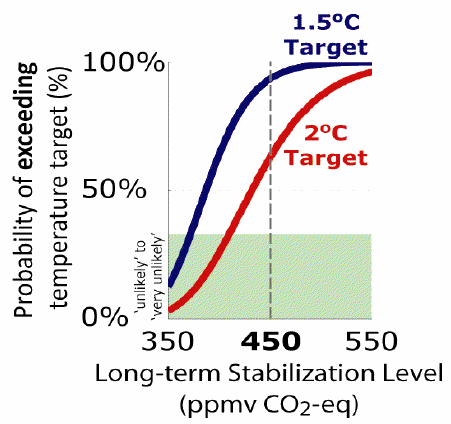
In the previous post we also noted that the international community has decided that 450 parts per million of CO2 equivalent (450 CO2-eq) is the level at which we are likely to get 2 degrees of warming. But how likely is likely?

Well this question links back to climate sensitivity to C02. In a briefing paper, the scientist led non-profit organisation Climate Analytics summarises the likelihood thus:

Stabilisation at 450 ppm CO2 equivalent would only limi warming to 2°C if the climate sensitivity to a doubling of CO2 were 3°C or lower. However, as the IPCC AR4 found, the climate sensitivity is quite uncertain, and whilst IPCC’s best estimate is 3°C there is roughly a 50:50 chance that it is actually higher. Taking into account this uncertainty, global warming may well exceed 2°C for stabilisation at 450 ppm CO2 equivalent.

The paper goes on to note that if the global community wished to play things safe and a) aim for a maximum of only 1.5 degrees of warming and b) limit the probability of this degree of warming being exceeded to one in three, then a more appropriate atmospheric CO2 -eq target would be 350 ppm (of course, we are already over 380 ppm CO2-eq). The probabilities associated with different warming targets and CO2 levels are shown below:
Incidentally, the 350 number was also reached by NASA’s Jim Hansen by a somewhat different methodology and forms the corner stone of the campaigning climate change organisation 350.org headed up by a personal hero of mine Bill McKibben.

In a landmark article in the journal Nature, Meinshausen and his co-authors then took the probabilistic approach further by assigning a carbon budget. Concentrating on the 450 CO2-eq target they asked the question:

“How much CO2 can we emit with only a 25% chance of going over the 2 degree tipping point and how much can we emit is we take the riskier option of only having a 50% option of keeping within the target?”

Using the year 2000 as a base year, the paper calculated that 1,000 Gt CO2 could be released between 2000 and 2050 such that there was only a 25% chance of missing the 2 degree target—or, put another way, a 75% chance of achieving the target. (After 2050, the paper assumed that CO2 emissions would by then be negligible and compensated for by land-use related CO2 absorption.) For the 50% figure (a more risky bet), they arrived at a larger budget of 1,440 Gt CO2.

OK, so you may now be saying “What the hell is 1,000 Gt of CO2? That number doesn’t mean anything to me!”

Well the only reason is doesn’t mean anything to you is that you are not familiar with it. You are already familiar with interest rates and foreign exchange rates, know where to find the relevant numbers, and know how to put them in context. Such knowledge makes you financially literate.

But basic climate literacy is not all that difficult. To first get a quick and dirty take on the risks we and our families face we just need basic math (addition, and perhaps a bit of division/multiplication) and a link to the right data sources. We also already know the theory: the flow of causation from carbon emissions, to atmospheric CO2 concentration to temperature. We also now have three benchmark numbers to work off: 1,000 Gt of CO2 for our budget of carbon emissions between 2000 and 2050, 450 ppm of CO2-eq for our danger level for greenhouse gases and 2 degree Celsius of warming for dangerous climate change.

The next stage is to access the CO2 emissions data. The Carbon Dioxide Information Analysis Center (CDIAC), an organisation within the US government’s Department of Energy,  maintains a database of both fossil fuel carbon emissions and land use change carbon emissions. The fossil fuel related data series goes back to 1751 and can be found here, while their land-use change related data series starts from 1850 and can be found here.

Let’s start with the land use change numbers, which CDIAC reports in tera grams (tera as in ten to the power of 12). Shifting these into giga tonnes (Gt, ten to the power of  9), we see that land use change is resulting in approximately 1.4 Gt of carbon emissions per year and for the 10 years through 2010 we would likely have seen emissions from this source of 14 Gt of carbon.

The fossil fuel related emissions have been less stable, that is on a rising trend up through 2008. They are reported by the CDIAC in millions of tonnes. For the years 2009 and 2010 we actually have preliminary emission numbers from the CDIAC here. Their latest advance numbers show a dip in emissions due to the global recession in 2009, but a jump to a new record in 2010. In total, for the 10 years through 2010 (including the two advance estimates), 77 Gt of carbon was emitted from fossil fuel sources.

Putting the fossil fuel and land use numbers together, we get an aggregate 91 Gt of carbon emissions for the decade just ended. However, the unit the CDIAC is using is carbon, while the Meinhausen’s carbon budget approach uses CO2. Deep in your memory you may recall that the atomic mass of carbon is 12 and that of oxygen 16, giving an atomic mass of 44 for the CO2 molecule. Accordingly, to move from carbon to CO2 we need to multiple by 44/12 or rather 3.667. So 77 Gt of carbon translates into roughly 282 Gt of CO2. In other words, of our carbon budget of 1,000 Gt of CO2 we’ve already used up about 28%.

As an aside, and in my humble opinion, one major reason why the educated general public has been unable to get to grips with basic climate change science has been the dog’s dinner of units and base years with which each data point is presented. The figures in no two press releases appear directly comparable, leading to confusion and ultimately disengagement from the debate.

Now let’s try and do a quick and dirty estimate of when we will use up the remaining portion of the budget. To commence with, land use change emissions have been pretty stable recently, so let us just assume they carry on at a rate of 1.4 Gt per annum. And let us take a best case estimate for fossil fuel emissions, that is, they will flat line also at 9 Gt per annum (a pretty conservative assumption since this would mean that global GDP growth slumps). Translate those numbers from carbon to CO2 and we get total emissions of 36 Gt of CO2 a year. At that run rate, we will have used up the budget by around 2030.

At this point, and after some very simple math, I hope you will get a sense of the risk. To me, it looks extremely unlikely that the world will come off fossil fuels at the rate required over the next two decades. Therefore, there is a high risk that the world will push through the 450 CO2-eq barrier, and global mean temperature will move 2 degrees above pre-indusrial revolution levels. As such climate change will loom large as an economic factor, one that generally will act as a perpetual drag on growth.

As to whether temperature will rise by 3 of 4 degrees going forward—the sort of level that will lead to the failure of sovereign states—the likelihood is certainly there and it is absolutely not alarmist to discuss it. Indeed, ignoring those possible extreme climate outcomes is a pretty reckless thing to do from a risk perspective, even at a personal and family level.

Odds of Cooking the Kids: Part 1

Apologies for the large gap since my last post; the result of me relocating from one country to another.

A recurring theme of this blog is how to assess the risk of climate change to one’s family. Stuart Staniford over at Early Warning once characterised this as the  ‘Odds of Cooking the Grandkids’. As such, his post plugs into the central theme of this blog: the badness of the potential outcomes (the cooking of the grandkids) and the fact it should be viewed in terms of probability (the odds).

To cook the grandkids you basically need to see around 6 degrees Celsius of warming. But focussing on the grandkids is putting the cart before the horse. Before we get to the stage where we cook the grandkids, we need to parboil our own kids. And the cooking process will begin when we get above 2 degrees of warming (see here) and get progressively worse at 3 to 4 degrees (here).

To extend the analogy, in the kitchen you have two main variables: 1) the intensity 0f the heat and 2) the duration for which the heat is applied. In climate change you have two principal variables as well: 1) the sensitivity of temperature change to an increase in atmospheric CO2 and 2) the amount of CO2 we pump into the atmosphere. If you are able to understand these two variables—and follow them as they evolve through time—then you will get a better idea of the odds of cooking the kids. Continue reading

Forbes, Climate Change and the Investment Process

“New NASA Data Blow Gaping Hole in Global Warming Alarmism” trumpets Forbes. So are the risks advanced by the Intergovernmental Panel on Climate Change (IPCC) all wrong? For any investment professional without an advanced degree in climatology (that is nearly all of us) it is difficult to reach our own conclusions faced with these kinds of “he said, she said” debates, but I believe it is possible.

First, a degree of skepticism is required when dealing with the climate skeptics. Not least of which is to be suspicious that any one single finding will suddenly upend an entire body of work that encompasses multiple strands. Sir Paul Nurse, the current President of the UK Royal Society, brings out this point clearly in a recent BBC Horizon documentary (I encourage everyone to watch the entire programme). Nurse states:

An important aspect of science is that it makes sense as a whole…..it is no good cherry picking one part of it….

As a medical analogy, scientists continue to discover errors in medical treatments; for example, up until recently most stomach ulcers were thought to result from poor diet or stress—only recently were bacteria found to be a dominant cause. But such discoveries do not bring down the whole structure of modern medicine. The discovery of ulcer-causing bacteria did not cause us to reject the latest treatments for cancer or heart disease.

Second, what is the counter argument to the case being put? Thankfully, the web gives you access to two superb sites that aggregate the consensus response to skeptic arguments: www.skepticalscience.com and www.realclimate.org. And as it happens, Real Climate addresses the paper underlying the Forbes article here.

The point I am making is that you should use an identical discipline to that of buying a stock. Say you find an interesting candidate to add to your portfolio on the long side. Do you a) go out and read all the analyst “buy” recommendation reports on the stock since you know in advance that they will back your initial buy bias or do you b) intentionally seek out and read the “sell” reports to unearth counterarguments that you were not aware of? If you answer was a), then I can tell you that your life in the financial industry will be nasty, brutish and short.

Third, when you receive an investment pitch, are you interested in the track record of the person pitching it to you? Now the two authors of the paper behind the Forbes article, Roy Spencer and William Braswell of the University of Alabama in Huntsville, are no Lord Monkton-type intellectual lightweights. They do, however, have a rich climate skeptic past that you can see if you punch their names into the search engine of Skepticalscience.com. In particular, Spencer is famous in climate circles for claiming in the early 1990s that satellite data on global temperatures contradicted the terrestrial temperature measurements. Indeed, if Forbes had reported on Spencer’s papers at the time, the headline would have looked something like this: “New Satellite Data Blow Gaping Hole in Global Warming Alarmism”.

Nonetheless, climate change science is an edifice built on multiple foundations as Sir Paul Nurse emphasised above. And here again we had multiple strands of research pointing to one conclusion and Roy Spencer and his partner John Christy pointing to another. Thus the most likely (but by no means certain) conclusion was that Roy Spencer was wrong. To cut a long story short, further investigation of the satellite data led to the discovery that Spencer and Christy’s analysis was wrong (you can see a discussion of the topic here). Spencer and Christy, I believe, accept that their original papers had flaws. Further, the latest paper co-authored by Spencer disputes the consensus IPCC view on the speed of warming from a different angle.

In investment terms, Spencer has a track record of coming out with big ballsy contrarian calls. Like a Henry Dent shouting that the Dow will reach 40,000 kind of call. Now Dent recently came out with a Dow 3,800 call. Could he be right? Yes. But, umm, how have his other big swings at the ball panned out to date? Well…..

Notwithstanding all the above arguments, I do not dismiss Spencer out of hand, and regularly read his posts on his blog here. I think his arguments form the benign version of the tail risk (that is the other end of the tail from the catastrophic outcomes); in other words, temperature sensitivity to CO2 is so low that global warming will be a slow-motion affair, thus giving mankind plenty of time to mitigate and adapt. However, nothing he has done to date has dissuaded me from tracking the negative tail risk. In sum, risk is probability times outcome, and it is with the truly bad outcomes that the major risk resides.

Finally, investment professionals constantly make decisions with regard to fields of investment in which they have no scientific expertise. As a portfolio manager, I bought pharmaceutical stocks but have no medical-related Phd. Comfort in those decisions came from data, either the stock price action itself or the trends in underlying metrics like prescription and sales stats.

Diving into Roy Spencer’s site is a bit like diving into the fundamental analysis behind a blockbuster drug—a level of analysis that you can’t hope to fathom without a couple of advanced degrees in the relevant field. However, the decision to buy a pharma stock is generally made at a much higher level: how is the drug clearing FDA-related approval hurdles and then how is the drug selling? Likewise, the bottom line for Spencer is to check whether global temperature trends are going up or down. Indeed, you can go directly to his site here and look at the chart (surely the first thing you do before buying a stock).  Moreover, just like with same-store sales release of a retailer, every month you will get a new data point to confirm or refute the trend. It is not that difficult.

In conclusion, the kind of analysis put forward in the Forbes article wouldn’t gain a pass mark at CFA Level 1. The article should have read: “New Data Put together by Analysts Who Were Wildly Wrong in the Past that Claims to Blow a Gaping Hole in Global Warming Alarmism Not Supported by Multiple Findings of Numerous Other Analysts with a Better Track Record (but Just in Case Let’s Track the New Data as it Arrives)”. OK, maybe something snappier. But frankly the article’s analysis was lightweight and I expect better from Forbes.

Atmospheric CO2 for July 2011

The data series showing the concentration of C02 in the atmosphere will be the most important time series tracked by this blog. I call atmospheric C02 the most important leading indicator in the world. Many thoughts to follow on this subject, but for the time being I will just chronicle the numbers as they come in (this stat out on August 9) with the bare minimum of analysis.

As of end July 2011, atmospheric concentration of CO2 stood at 392.39 parts per million (ppm), up 2.29 ppm year on year (for original data source see here).

If we start trending considerably above previous year-on-year differences, it could mean one of two things: an accelerating year-on-year rise in carbon emissions, which is bad; or the early signs of a saturation of carbon sinks (removal of CO2 out of the atmosphere), which would be very bad.

If we want to remain close to the two degree Celsius rise in temperature level (that is held up as the line in the sand for dangerous temperature rise), then the year-on-year difference should plateau and start to fall this decade. If we are to get into the world of really scary three and four degree Celsius rise, then the year-on-year number will increase as time goes by.

As a markets guy, I am glued to the short term to give me a handle on the long term (note that market players operate at levels of statistical certainty that few scientists would be comfortable with). Lots more to come on this topic.

Meanwhile, for all things CO2, I recommend you take a look at CO2now.org here.

So What Exactly Is 'Extremely Dangerous' Climate Change?

Before we get a handle on  ‘extremely dangerous’ climate change, let us start by getting an understanding of what everyday ‘dangerous climate change’ means. In the opening paragraph of the introduction to the IPCC Fourth Assessment Report we get a little enlightenment (see here):

The ultimate objective of the United Nations Framework Convention on Climate Change (UNFCCC) is to achieve the stabilization of greenhouse gas (GHG) concentrations in the atmosphere at a level that would prevent dangerous anthropogenic interference with the climate system. Such a level should be achieved within a time frame sufficient to allow ecosystems to adapt naturally to climate change, to ensure that food production is not threatened and to enable economic development to proceed in a sustainable manner.

And in the Copenhagen Accord of December 2009 we see this:

We underline that climate change is one of the greatest challenges of our time. We emphasise our strong political will to urgently combat climate change in accordance with the principle of common but differentiated responsibilities and respective capabilities. To achieve the ultimate objective of the Convention to stabilize greenhouse gas concentration in the atmosphere at a level that would prevent dangerous anthropogenic interference with the climate system, we shall, recognizing the scientific view that the increase in global temperature should be below 2 degrees Celsius, on the basis of equity and in the context of sustainable development, enhance our long-term cooperative action to combat climate change.

Thus we could define ‘dangerous climate change’ as something that threatens food production and economic development, and this in turn is expected to take place at two degrees of warming above pre-industrial temperatures. Note that we are now straying out of the life sciences and into the social sciences. Further, the direction of causation has gone from CO2 emissions, to atmospheric CO2 concentrations, to global mean temperatures, to socio-economics and geo-politics. The final step of this progression is something most scientists are loathe to make. As Gwynne Dyer writes in his book “Climate Wars”

….the modellers….wisely stay well clear of any attempt to describe the political, demographic and strategic impacts of the changes they foresee.

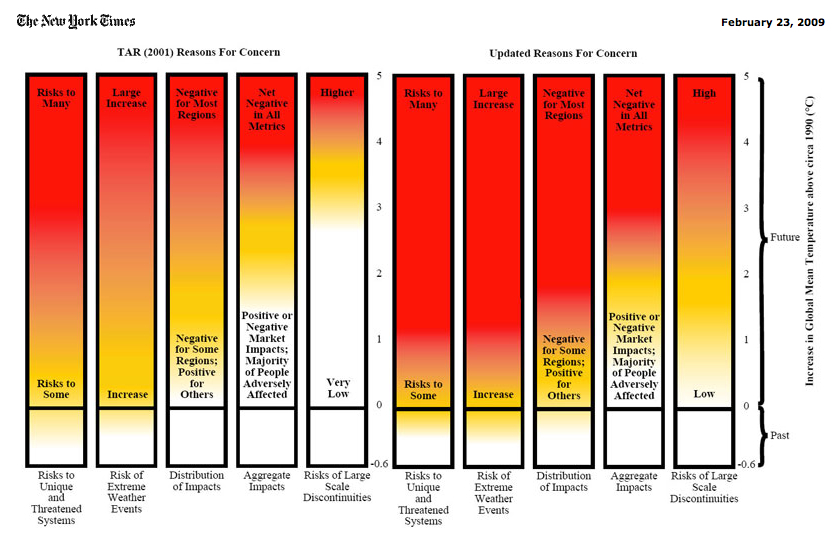
And this is why the IPCC’S famous ‘burning embers’ diagram (referred to in my last post here) uses wording that carefully avoids encroaching on the area of economics or geopolitics in any discernible way.

Nonetheless, we have a tentative grasp on the societal impacts of dangerous climate change from the IPCC (somewhat loosely defined as economic and agricultural disruptions), so let us see how far up the causation change the scientists can take us with respect to ‘extremely dangerous’ climate change.

Scientists like Kevin Anderson at the Tyndall Institute believe that even at two degrees Celsius of warming we are  in danger of seeing ‘extremely dangerous’ climate change and given the fact that we could overshoot to four degrees and beyond, the ‘extremely dangerous’ outcome appears almost inevitable.

To better understand what a world subject to such ‘extremely dangerous’ temperatures would actually look like, a conference entitled ‘4 Degrees and Beyond’ held was in Oxford in September 2009 (conference proceedings can be found here), and subsequently a series of academic papers were authored following the conference and were published in The Royal Society’s Philosophical Transactions in January 2011 (the papers can be found here). Together, this research provides a detailed list of impacts at both the sectoral and geographical level. If you want to get a feeling for the kinds or risks you and your family face, then I strongly recommended you follow the links above. But what you won’t get is any higher level macro economic, or geopolitical analysis.

While most scientists are wary of pushing past the scientific impacts and entering into the realm of geopolitics, Kevin Anderson is one of the few who does. Here is his view of what a four degree Celsius and rising world will look like:

For humanity it’s a matter of life or death. We will not make all human beings extinct as a few people with the right sort of resources may put themselves in the right parts of the world and survive. But I think it’s extremely unlikely that we wouldn’t have mass death at 4C. If you have got a population of nine billion by 2050 and you hit 4C, 5C or 6C, you might have half a billion people surviving.

At last something pretty concrete. It may or may not be true, but that is the whole point of doing a risk assessment. In other words, we need to ask the question “What is the probability associated with a tail risk of three or four degrees of warming around within our or our children’s life times, and if this came about what would be the consequences?”

While Anderson is one of the few scientists who have a view on record that stresses the potential for geo-political chaos, the military are much more forthcoming. either in publications that originate in departments of defence or military associated think tanks. Most such publications present a shopping list of potential climate change outcomes or present one central scenario that is the best estimate case. Occasionally, however, you do see a scenario-type approach, and the Age of Consequences report put out in 2007 by the US Center for Strategic & International Studies is one such example. The report outlines three scenarios: first, a 1.3 degree Celsius rise in temperature by 2040 which is called the expected scenario; second, a so called severe scenario of 2.6 degrees of warming by 2040; and, third, a catastrophic scenario of 5.6 degrees of warming by 2100. Given our risk time horizon, let’s see what the ‘severe’ scenario has in store for us:

In the case of severe climate change, corresponding to an average increase in global temperature of 2.6°C by 2040, massive non- linear events in the global environment give rise to massive nonlinear societal events. In this scenario …. nations around the world will be overwhelmed by the scale of change and pernicious challenges, such as pandemic disease. The internal cohesion of nations will be under great stress, including in the United States, both as a result of a dramatic rise in migration and changes in agricultural patterns and water availability. The flooding of coastal communities around the world, especially in the Netherlands, the United States, South Asia, and China, has the potential to challenge regional and even national identities. Armed conflict between nations over resources, such as the Nile and its tributaries, is likely and nuclear war is possible. The social consequences range from increased religious fervor to outright chaos. In this scenario, climate change provokes a permanent shift in the relationship of humankind to nature.

From the above, we can get a tentative feel as to how bad things could get. So, as a working definition, I propose that ‘extremely dangerous’ climate change be taken to mean a transformation of the natural environment that starts to re-arrange societies in a non-linear manner. Further, such a rearrangement will have negative implications for the wealth and health of individuals and families in not only developing countries but also developed countries.

So given the complexity of the issue, how can an individual assess this climate change risk?

Well, the world is a complex place and we already have to make decisions in the face of uncertainty and incomplete information, so what else is new? Actually, in comparison, say, with the decision to marry, I think it is far easier to assess the risk of global warming. For a start, we have a number of facts that can move us quite far up the causation curve  as we move from carbon emissions, to atmospheric C02 concentrations, to global mean temperatures—and then finally to the much more difficult-to assess socio-economic and geopolitical consequences. So as more data comes in, we will have a progressively better idea of how hot things will get. We will then have to take a stab at the economics and politics; but if you have ever been involved in the financial markets, you will have had to do that every day regardless.

In sum, climate change is tough, but so is an assessment of the future risk and return when buying 10,000 dollars worth of shares in Apple Computer or Google. Further, climate change is a high stakes game from a risk perspective: if the value of your holdings in Google crashes, it may be painful for your wealth. If climate change comes in at the negative end of the distribution, it threatens countless lives—maybe including you and your family’s. That is why I think it deserves attention from any thinking person who considers the future.

Defining the Tail Risk

When looking at risk, financial industry professionals will generally start at the tail; in other words, those unlikely but highly hazardous outcomes that reside at the ends of the distribution of all possible outcomes.  In simple terms, if you invest in stocks, bonds or derivatives, then what is the likelihood of a really bad market move taking place—one that will at best stop you sleeping at night or at worst get you fired.  To think about these things is a precondition for long-term survival in the financial industry, and it is certainly not alarmist.

Unfortunately, few people in the financial industry (who are trained to deal with the concept of risk), let alone the general public, take this method of thinking over to climate change—a lack of foresight that could be highly detrimental to their financial and even physical health.

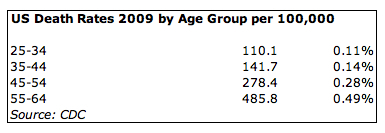
But at what probability does an outcome, and associated consequence, become significant enough to act upon? The life insurance industry gives us some idea. The United States Centre for Disease Control (CDC) puts out a publication called the National Vital Statistics Reports in which it aggregates and analyses mortality data for the United States. In their latest report dated March 16, 2011 they analyse the 2009 data set (most up-to-date figures) and you can find mortality rates by age in Table 1. An extract is given here:

Critically, the life insurance industry is an industry of tail risk. The average American in their late 20s has only a 0.1% chance of dying in any given year and those in their late 50s 0.5%. Yet the latest figures from the life insurance industry’s think tank LIMRA show that 70% of US households have some type of life insurance (of which 44% are individual policies). For those households with children, the numbers are even high: 81% for Generation Y’ers rising to 91% for Baby Boomers.The industry has been in a bit of a panic recently because overall life insurance ownership has been on a gradually declining trend over the longer term, but the fact is that the majority of Americans understand the long-tailed risks of a major breadwinner in the family dying and actually do something about it. In sum, faced with the tail risk of death, adults buy life insurance to manage the risk, especially those people who have children.

Before we look at the tail risk of climate change, it is important to note that life insurance does not hedge against the risk of death: if you die, you are still dead regardless as to whether you own life insurance. What you are really insuring against is not your own death but the sustainability of your family’s prospects after your death. The realisation is that if you die without life insurance, your family will have a degraded life path. In the case of your children, this may, for example, mean reduced educational opportunities that will have negative consequences for their entire life. So actually the act of buying life insurance shows a high degree of concern for the quite distant future as not only are you thinking about a time horizon covering the insurance policy in question but also an even more distant time horizon that encompasses your family’s well being much further into the future after you have gone.

So let’s take a family with children and have a look at the tail risk of climate change. Well, if you have children, then their working lives will likely encompass the 2020s to 2060s, and their life expectancy will likely take them to the end of the century. What is the climate-related tail risk they face over that time period? The answer appears to be a far higher risk than that associated with the loss of a bread-winning parent during childhood. A paper by Richard Betts et al in the UK Royal Society’s flagship journal (that can be found here) spells it out:

The evidence available from new simulations with the HadCM3 GCM and the MAGICC SCM, along with existing results presented in the IPCC AR4, suggests that the A1FI emissions scenario would lead to a rise in global mean temperature of between approximately 3◦C and 7◦C by the 2090s relative to pre-industrial, with best estimates being around 5◦C. Our best estimate is that a temperature rise of 4◦C would be reached in the 2070s, and if carbon-cycle feedbacks are strong, then 4◦C could be reached in the early 2060s—this latter projection appears to be consistent with the upper end of the IPCC’s likely range of warming for the A1FI scenario.

A1FI is the high carbon emissions scenario prepared for the Intergovernmental Panel on Climate Change (IPCC) Fourth Assessment Report (AR4), which is also the emissions trajectory we are currently following owning to the general failure of carbon emission mitigation efforts made by governments around the globe to date. A description of the scenarios can be found here.

At the time of the Copenhagen Accord in 2009, the international community made a commitment to ‘hold the increase in global temperature below 2 degrees Celsius’ from pre-industrial revolution levels (we are up around 0.8 degrees Celsius now). Further, that two degree Celsius degree line is already deemed by mark the border between ‘dangerous climate change’ and ‘extremely dangerous climate change’ (see the Anderson and Bows paper at the Royal Society link above). The IPCC’s famous burning embers diagrams (updated chart below taken from the NYT here) adds some detail to the likely impacts. In short, we will rapidly progress up to the top of the bars shown below (click for larger image).

In sum, as the world temperature likely rises above the two degree Celsius level in most of our life times and probably moves to four degrees and beyond in our children’s life times based on the current emissions trajectories, we will all experience ‘extremely dangerous climate change’. The idea of ‘extremely dangerous climate change’ within the framework of risk is something I will leave to the next post. Suffice as to say, at a four degree global surface temperature mean warming, we will see the global land mean temperature rise by five to six degrees, a six to eight degrees rise in China, an eight to 10 degree rise in Central Europe and a 10 to 12 degree rise in New York (see here). With these kinds of changes, the planet our parents were born into will not be the same as the planet our children mature into.

Extremely dangerous climate change is, however, a risk that we cannot insure against, rather it is something that we can only respond to through mitigation, adaption or suffering. But first we have to recognise the reality for what it is.

Mitigate, Adapt or Suffer

Thomas Carlyle termed economics “the dismal science” but if you understand the conclusions of a paper entitled “Climate Change; The Evidence and Our Options”  by the eminent glaciologist Lonnie Thomson then you would surely agree that the study of anthropogenic (human-induced) global warming (AGW)  deserves the title better.

Thomson’s paper is important because it gives you a window into the mind of what most scientists truly believe about the climate change outlook if you chat to them over a beer or a coffee at the end of a long day, something you would rarely gauge if you focus on their academic writings. And what do they really think?

Climatologists, like other scientists, tend to be a stolid group. We are not given to theatrical rantings about falling skies. Most of us are far more comfortable in our laboratories or gathering data in the field than we are giving interviews to journalists or speaking before Congressional committees. Why then are climatologists speaking out about the dangers of global warming? The answer is that virtually all of us are now convinced that global warming poses a clear and present danger to civilization.

The message could not be more clearer in terms of the overall outlook, but what does this mean in terms of the life paths of individuals? In the concluding paragraph of the paper, Thomson spells it out:

Sooner or later, we will all deal with global warming. The only question is how much we will mitigate, adapt and suffer.

The premise of this blog is that ‘mitigation, adaption and suffering’ can be summed up in one word: risk. And risk is something that every financial professional (and indeed all individuals) deals with every day. Risk is the reality that the outcomes associated with our actions are subject to uncertainty, and attached to each potential outcome are gains and losses. The non-fringe scientific community has clearly stated that climate change is a reality (for example here). As such, it now poses major risks to our actions—whether buying a house, saving and investing, or educating our children. So, while climate change science contains uncertainties, it also makes the life outcomes of both ourselves and our families far more uncertain as well. In short, it poses a monumental risk.

Faced, with such a risk we have two choices: manage it or ignore it. The temptation to pretend the risk isn’t there is large because it is easy to feel impotent in the face of a planetary phenomenon. But as Peter Bernstein, the American financial historian and scholar of risk, puts it:

….outcomes are uncertain, but we have some control over what is going to happen or at least some control over the consequences of what does happen. That is what risk management is all about.

His highlighting of the difference between outcomes and consequences translates into the difference between mitigation (reduction of greenhouse gas emissions) and adaption in a climate change context. The goal of this blog is to encourage everyone to see climate change as a major risk to their well-being, and a risk that should be managed through mitigation and adaption. To do neither is to invite the third response in Thomson’s troika: to suffer.