Category Archives: Uncategorized

Data Watch: UAH Global Mean Temperature March 2013 Release

The University of Alabama-Huntsville (UAH) global average lower tropospheric temperature anomaly for March 2013 has been released via the web site of Dr Roy Spencer (one of the founders of the programme that produces this temperature time series). The anomaly refers to the difference between the current temperature reading and the average reading for the period 1981 to 2010.

March 2013: Anomaly +0.18 degrees Celsius

This is the eighth warmest March temperature recorded since the satellite record was started in December 1978 (35 March observations). The warmest March to date over this period was March 2010, with an anomaly of +0.58 degrees Celsius.

As background, five major global temperature time series are collated: three land-based and two satellite-based. The most high profile satellite-based series is put together by UAH and covers the period from December 1978 to the present. Like all these time series, the data is presented as an anomaly (difference) from the average, with the average in this case being the 30-year period from 1981 to 2010.

The official link to the data at UAH can be found here, but most months we get a sneak preview of the release via the climatologist Dr Roy Spencer at his blog.Spencer, and his colleague John Christy at UAH, are noted climate skeptics. They are also highly qualified climate scientists, who believe that natural climate variability accounts for most of recent warming. If they are correct, then we should see some flattening or even reversal of the upward trend within the UAH temperature time series. To date, we haven’t (click for larger image):

UAH Global Temp Mar 2013 copy

One of the initial reasons for publicising this satellite-based data series was due to concerns over the accuracy of terrestrial-based measurements (worries over the urban heat island effect and other factors). The satellite data series have now been going long enough to compare the output directly with the surface-based measurements. All the time series are now accepted as telling the same story (for a fuller mathematical treatment of this, see Tamino’s post at the Open Mind blog here). Note that the anomalies produced by different organisations are not directly comparable since they have different base periods. Accordingly, to compare them directly, you need to normalise each one by adjusting them to a common base period.

I would hope that if the chart keeps showing a line rising up to the right—and old records keep getting broken—then Spencer and Christy will admit that their hypothesis is wrong. Unfortunately, my gut feeling is that they will take their opposition to the idea of significant anthropogenic global warming to the grave. The physicist Max Planck once said

A new scientific truth does not triumph by convincing its opponents and making them see the light, but rather because its opponents eventually die, and a new generation grows up that is familiar with it.

This is frequently paraphrased, rather cynically, as “science advances one funeral at a time”. It is unfortunate, however, that we do not have the time to let opposition to concrete action to prevent climate change die off in a decade or two. By then, dangerous climate change will likely already be locked in.
Links for the Week Ending 30th March

  • Justin Gillis in the New York Times has an interesting article on backstop technology (although he doesn’t actually use the term), with particular emphasis on the Bill Gates’ funded new nuclear technology start-up Terra Ferma. If you aren’t familiar with the term ‘backstop technology’, it refers to a transformational technology that allows a society to transcend a particular problem such as resource scarcity or pollution (the catalyst for which is often a sharp movement in market prices). Obviously, there has been no “sharp change in market prices” for CO2 (the externality problem), but there are other problems with backstop technology as well. For example, we only hear about the successes (in finance this is the survivor bias). Many areas in technology have only seen glacial advances (battery storage) or none at all (fusion) despite a pressing need. The blogger Green Mycelium, who I have only just discovered, has a good post on the problems with backstop technology with respect to climate change here
  •  The Telegraph rightly lauds global capitalism’s greatest success, poverty reduction, here. The article mostly references the latest edition of the United Nation’s Human Development Report 2013 (full report here, summary here). It’s a tough read for the anti-globalization movement—which is why I only buy into parts of the anti-globalization rhetoric. My problem is more with the premise that past successes necessarily translate to future ones (the reason for parting company with Matt Ridley’s ‘rational optimism‘). Green Mycelium quotes Nassim Taleb’s Thanksgiving turkey who believes that life is going pretty well until the fateful day. The analogy is also apt for poverty reduction. If we reach 4 degrees Celsius of warming, the past successes will disappear like the cherry blossoms I see today outside my Tokyo window in the face of wind and rain.
  • Yves Smith at Naked Capitalism can be uneven but “Why Does No One Speak of America’s Oligarchs” was a wonderfully contrarian post. She has a very valid point. Keeping in mind that Obama is somewhere to the right of Richard Nixon in terms of economic policy, the super wealthy of the U.S. have had a mounting influence on the political process (via a plethora of political action committees, lobbyists, single issue think tanks, dodgy research institutes and more—read Oreskes and Conway’s “Merchants of Doubt”), trickle down has been non-existent for the best part of two decades and the financial sector has demonstrably operated under the principal “heads I win, tails you lose”. If that isn’t oligarchism, what is?
  • There is so much misinformation and downright crap written about the costs of renewables  (by the likes of Dieter Helm) that is has become the accepted wisdom, on both the left as well as the right, that aggressive implementation is utopian or worse. A good piece in The New York Times by Elisabeth Rosenthal gives renewables a ‘rare as hen’s teeth’ fair hearing. And the wonderful David Roberts at Grist tells us why this is important.
  • I am in Tokyo this week (suitably carbon offset) tidying up my Japanese affairs, so posts may be a bit sparse for a week or so. Apologies.

Links for Week Ending 23rd March

  • Catherine Mulbrandon at Visualizing Economics has some great graphics showing the rapid slowdown in U.S. wage growth in recent decades (found via Barry Ritholtz blog The Big Picture).
  • Well, well, well. The Economist Magazine taking resource depletion fears seriously. Who would have thought it. And here is the NBER academic paper by David Jacks they built the article around.
  • And we are off! According to the Japan-hosted IARC-JAXA Information System (IJIS) sea ice extent data series, which can be viewed here, Arctic sea ice extent peaked on 15th March. There is a very good summary of what happened last year and what to expect this year here, and I blogged on tracking the coming ice melt season a week or so ago. The million dollar question: how many years has this canary in the climate change coal mine got left?
  • I have always enjoyed Gail the Actuary’s posts at The Oil Drum, even if I disagree with a lot of what she says. She also posts at her own blog Our Finite World. This week she has an interesting piece picking at the underbelly of renewable economics. I am not entirely convinced; these kinds of exercise always ignore the fact that renewables are coming down their cost curves due to learning-by-doing economies. They also fail to take into account the externalities associated with climate change. Yes, renewable investment is a hugely costly enterprise. So what. Extremely dangerous climate change is also a hugely costly enterprise. This calls to mind Churchill’s adage: “It is not enough that we do our best; sometimes we must do what is required.”
  • The EIA has some nice charts and brief analysis showing Japan’s sharply rising fossil fuel usage post the Tohoku earthquake. Not good carbon emission-wise.

Links for Week Ending 16th March

Apologies for the weekly links being late. I have been preoccupied reading U.K. flood-related reports, so I have not had time to read much else.

  • On my ‘to do’ list is to report a global monthly oil production statistic. In the meantime, Stuart Staniford at the Early Warning blog reports regularly on this topic. His latest post with the February numbers is here
  • A week late, nonetheless, look at Calculated Risk’s monthly comments and graph on the U.S. employment report. Another thing on my ‘to do’ list.
  • You know that there is some great writing out there on the internet, but how to find it? I strongly recommend “The Browser“. I don’t quite know how to describe it: an aggregator and filter of intelligent writing? It brings serendipity to the internet (one of the virtues of print journalism). Warning. The Browser will severely impair your social interactions with the rest of humanity. Just too damn addictive.
  • And via The Browser, I found an interesting series of reports by Tim Morgan on the death of growth here.
  • While Tim Morgan’s reports give a pretty bleak outlook for growth, The Economist argues that that there is a lot of new economic value being created within the internet that is not being captured by GDP statistics (here).
  • I flagged in a previous ‘links’ a new study of the ‘hockey stick’ analysis of global temperatures going back to the end of the last ice age. The New Scientist has a good article covering this paper.
  • For those interested in Japan, post-growth economies, or both, then I recommend looking at some of the posts of Spike Japan. Unfortunately, Richard Hendy, the man behind Spike Japan, has just put up his last post. One of my favourites of his from the past is this one on Kinugawa Onsen, since I knew it in its heyday and have also witnessed its decline over the years. The Guardian did a lovely article on Japan’s provincial decay and Spike Japan a few years back. While Hendy’s postings have recently become rather random in topic, at their best in the past they showed that a blog post combining photos and prose could be a sophisticated—and refreshingly new—literary vehicle in its own right. However, I still hanker for a book, so here is hoping he hasn’t disappeared off the literary landscape forever.

Rachel Carson, DDT and Another Urban Myth

Another Cafe Scientifique meeting, another urban myth. Strange, since the level of discourse at these talks is very good. The audience is made up of engineers, doctors, technicians, IT techies of various persuasions and other “skeptical” types in the best sense of the word, all of a certain age. Being Henley-on-Thames, that age is at the upper end, but none the worse for that; having been around the block a few times gives you a certain perspective on the issues of the day, especially if you have a questioning mind.

The talk itself was excellent, delivered by Dr. David Hughes from Syngenta and titled “Organic Food and Farming : Global Saviour or a Case of the Emperor’s New Clothes”. His thesis deserves a blog post of itself, but for today I will take a minor detour and respond in detail to a statement from one of the audience. And the proposition in question? The banning of DDT, championed by Rachel Carson in “Silent Spring”, has killed 5 to 6 million people through allowing the spread of malaria.

A few questions later I had the chance to stand up and refute the claim. But replying on the fly to an off-topic issue requires an ability to recall sources that I don’t have. But I did remember that Oreskes and Conway in their superb book “Merchants of Doubt” had debunked this meme based on the fact that resistance to DTT led to the decline in its use not—not an eco-campaign by Carson and her followers. And then Hughes countered that DTT was still being used today. Well, yes. Alas I was not fast enough to point out the contradiction: the ban of DDT had led to millions of death, but it wasn’t actually banned?

Actually, I doubt whether Hughes at the time had a well-formed view of Rachel Carson and DTT at all. But the questioner had fashioned Carson as anti-science. A case of the enemy of my enemy is my friend. But sometimes this just isn’t true.

Back at home, I re-read Oreskes and Conway’s Chapter 7 entitled “Denial Rides Again: The Revisionist Attack on Rachel Carson”. Here we learn that President Kennedy turned to the President’s Science Advisory Committee (PSAC) to guide him on DDT in 1962. The PSAC’s advise was to restrain the use of DDT. Ten years on it was under a Republican president, Richard Nixon, that DDT was actually banned in the U.S.

But Oreskes and Conway’s critical point is this:

…. the most important reason that eradication was that mosquitos were developing resistance. In the United States, DDT use peaked in 1959—thirteen years before the ban—because it was already starting to fail.

And this pattern was repeated abroad. Between 1948 and 1963, the application of DTT worked like a charm in Sri Lanka. However, malarial cases then ticked up again and by 1968 DDT was becoming ineffective. Nonetheless, the country’s health authorities persevered, but no improvement was seen even with larger applications. Eventually they gave up. But this was years after the United States ban, and not because of the U.S. lead: they gave up because DDT stopped working.

Nonetheless, a number of right-wing foundations such as the Competitive Enterprise Institute and the Heartland Institute have continued with shrill claims that the EPA’s banning of DDT has killed millions of Africans, Asians and Latin Americans, and Rachel Carson has blood on her hands. It just isn’t true.

Links for Week Ending 9th March

  • Despite the title of this blog, I view myself as a psychological optimistic. For me, however, rational pessimism is the logical evaluation of life outcomes. Through allowing facts to shape one’s view of the future, you can exert some degree of control over it, or at least not suffer unpleasant surprises. A study in Germany puts some meat on the bones of my hypothesis.
  • A paper out in Science this week is likely to reignite the hockey stick controversy. While we have ice core temperature records going back around 800,000 years, they are relatively broad brush. More detailed temperature records can be constructed using a variety of scientific techniques. The new paper, the most comprehensive to date, takes the detailed record back 11,300 years. Mother Jones has a good synopsis here. It highlights the extraordinary compression of the current climate change time frame compared with the past.
  • I aim to post on this topic next week, but Texas University’s Bureau of Economic Geography has an important study out on the Texas Barnett shale. The Wall Street Journal has a hugely misleading interpretation of the study here. A lot more to say on this.
  • Yves Smith at Naked Capitalism has reposted a couple of very interesting posts that overlap with the themes of this blog. James Boyce at Triple Crisis argues that the current Obama administration has missed a huge opportunity to portray a carbon tax as a positive redistribution or tax cut for the general public—I agree.
  • More controversial (at least for me) is Yves’ contention when commenting on a post by Jonathan Harris that “the only way to get aggressive enough pro-environment measures implemented is to develop an environmental program that is pro growth or at least not inimical to growth”. Unfortunately, I don’t think we will be able to have our cake and eat it (that is effective environmental policies that are pro-growth). But remember that the alternative is to carry on with existing anti-environmental policies that are pro-collapse.

Links for Week Ending 2nd March

  • I have been acquainted with the work of Richard Thaler, an expert in behaviorial finance, for many years. Market participants have always recognised the importance of psychology in moving stock and bond prices, but Thaler’s two books “The Winner’s Curse” and “Quasi-Rational Economics” put some theoretical underpinning behind these concepts. A recent book co-authored by Thaler called “Nudge: Improving  Decisions on Health, Wealth and Happiness” broadened the application of his research into behavioral  psychology to every aspect of human decision-making, not just those related to the markets. The book is well worth a read, but what is even more fascinating is that the British coalition government—not noted for its creative policy making—has actually set up a unit to implement the ideas contained in “Nudge”. The Telegraph has a wonderful article detailing the unit’s work and achievements.
  • Recently came across an important book by Kari Marie Norgaard called “Living in Denial: Climate Change, Emotions and Everyday Life”. Norgaard delves deep into themes that  I have posted on before in connection with George Marshall’s blog. You can find links to Norgaard’s climate change related work here and such acute observations as this: “….people actually work to avoid acknowledging disturbing information in order to avoid emotions of fear, guilt, and helplessness, follow cultural norms, and maintain positive conceptions of individual and national identity. As a result of this kind of denial, people describe a sense of ‘knowing and not knowing’ about climate change, of having information but not thinking about it in their everyday lives.”
  • The Economist has an interesting article on social networks that includes work conducted by Boleslaw Szymanski of the Rensselaer Polytechnic Institute in New York. A previous paper by Szymanski and colleagues suggest that if a committed minority can reach 10% of the population, general opinion will ‘tip’ to align itself with that minatory, the suffragette and civil rights movements being classic examples. This provides some hope that if organisations such as 350.org reach sufficient momentum then their thinking can become the new norm.
  • Ugo Bardi’s blog Cassandra’s Legacy takes a look at network politics in the wake of the Italian electoral results. The combination of a move toward post-growth economies in the OECD plus the network capabilities of the new media appears to be tearing up the political map. We live in interesting, if somewhat scary, times.
  • In a similar vein, BBC Radio 4’s programme Analysis looks at how the vulgar Keynesian attitudes of the left are being challenged by political philosophers who argue that it is time to move on to some 21st style thinking. Podcast is here.

Travelling for a Week

I am in Berlin for a week with my family, so will not be posting for a few days. Apologies.

Links for Week Ending 9th February

  • While this blog was in hibernation last year, the Climate Vulnerability  Monitor 2012 report was published by DARA. The report attempts to measures the costs of climate change and fossil fuel production through to the year 2030. The report is somewhat opaque in that it is very difficult to find the assumptions on which DARA’s projections are based. Nonetheless, any attempt to predict the future costs of climate change should be encouraged. The climate change damage function—under which our existing economic growth model of “get dirty and clean up” is based—definitely needs a reality check. See my posts on this topic here and here
  • An excellent article here in Slate entitled “The Myth of Saudi America” skewers the Kool Aid surrounding shale.
  • The technology-replacing-labour debate continues to rage. This at Gregor.US.
  • One thing that keeps me awake at night is the fear that earth’s carbon sinks get saturated. If this should happen, the annual rise in atmospheric CO2 would rise sharply even with static fossil fuel carbon emissions. On the land sink side, the mainstream consensus is that the world’s forests will respond to higher levels of CO2 by growing, and therefore locking up carbon, more rapidly. A couple of papers suggest this won’t happen. A basic tenet of economics is diminishing returns to scale; that is, if you increase one input but keep the others static then the rate of growth in output will decline. It seems the same logic applies to the biosphere. If you increase carbon, but hold nitrogen and phosphorus static, then you will also run into diminishing returns. So your land-based carbon sink becomes increasingly impaired. See here and here.

New Risk Indicator: NSIDC Greenland Ice Sheet Melt Extent

All my career, I have been steeped in data and probably have an unhealthy ‘data dependency’. Moreover, I have a penchant for high-fequency data; that is, the daily or monthly numbers.

When it comes to climate, this could be viewed as an unhealthy fetish. For example, the World Meteorological Organisation defines climate as average weather over a 30-year period. That is all well and good if climate is so called stationary—in other words, its mean and variability isn’t changing through time. Obviously, this is no longer the case as we saw with Arctic sea ice extent last summer.

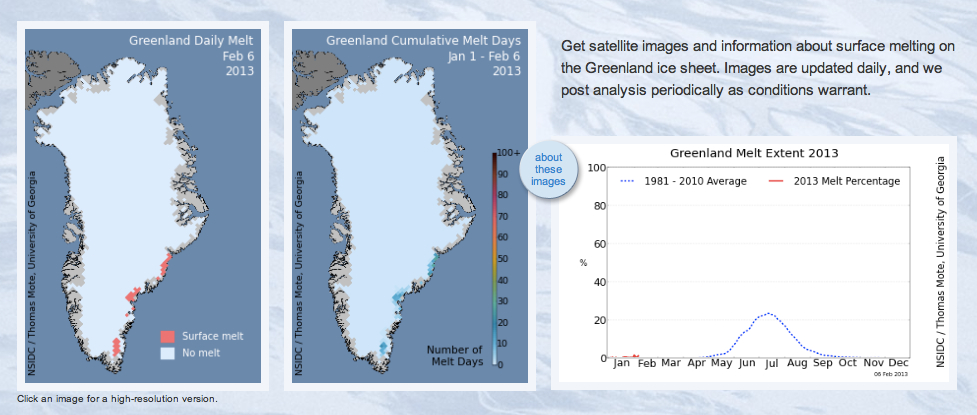
The National Snow and Ice Data Center (NSIDC) has now provided us with a new daily updated high-frequency time series, this time on Greenland melt extent, complete with daily images that can be found here. Click on the image below to expand.

Greenland Daily Melt jpg

The 2012 melt season was unprecedented, with 97% of the island showing melt at one stage in July. A review of the year 2012 for Greenland by the NSICD can be found here. The critical question going forward is whether 2012 was a true anomaly or a harbinger of the new normal.

A similar argument was voiced some years ago over the 2007 Arctic sea ice extent retreat, with most scientists at the time urging caution over calling a trend break and suggesting that 2007 could have been a product of an unusual confluence of weather factors. After the 2012 sea ice extent retreat, which smashed the 2007 record, few would now argue against the trend being truly broken (with Arctic sea ice extent now in a state of collapse). I fear we may see a repeat performance with Greenland ice melt over the next few years.