Tag Archives: climate change

Forbes, Climate Change and the Investment Process

“New NASA Data Blow Gaping Hole in Global Warming Alarmism” trumpets Forbes. So are the risks advanced by the Intergovernmental Panel on Climate Change (IPCC) all wrong? For any investment professional without an advanced degree in climatology (that is nearly all of us) it is difficult to reach our own conclusions faced with these kinds of “he said, she said” debates, but I believe it is possible.

First, a degree of skepticism is required when dealing with the climate skeptics. Not least of which is to be suspicious that any one single finding will suddenly upend an entire body of work that encompasses multiple strands. Sir Paul Nurse, the current President of the UK Royal Society, brings out this point clearly in a recent BBC Horizon documentary (I encourage everyone to watch the entire programme). Nurse states:

An important aspect of science is that it makes sense as a whole…..it is no good cherry picking one part of it….

As a medical analogy, scientists continue to discover errors in medical treatments; for example, up until recently most stomach ulcers were thought to result from poor diet or stress—only recently were bacteria found to be a dominant cause. But such discoveries do not bring down the whole structure of modern medicine. The discovery of ulcer-causing bacteria did not cause us to reject the latest treatments for cancer or heart disease.

Second, what is the counter argument to the case being put? Thankfully, the web gives you access to two superb sites that aggregate the consensus response to skeptic arguments: www.skepticalscience.com and www.realclimate.org. And as it happens, Real Climate addresses the paper underlying the Forbes article here.

The point I am making is that you should use an identical discipline to that of buying a stock. Say you find an interesting candidate to add to your portfolio on the long side. Do you a) go out and read all the analyst “buy” recommendation reports on the stock since you know in advance that they will back your initial buy bias or do you b) intentionally seek out and read the “sell” reports to unearth counterarguments that you were not aware of? If you answer was a), then I can tell you that your life in the financial industry will be nasty, brutish and short.

Third, when you receive an investment pitch, are you interested in the track record of the person pitching it to you? Now the two authors of the paper behind the Forbes article, Roy Spencer and William Braswell of the University of Alabama in Huntsville, are no Lord Monkton-type intellectual lightweights. They do, however, have a rich climate skeptic past that you can see if you punch their names into the search engine of Skepticalscience.com. In particular, Spencer is famous in climate circles for claiming in the early 1990s that satellite data on global temperatures contradicted the terrestrial temperature measurements. Indeed, if Forbes had reported on Spencer’s papers at the time, the headline would have looked something like this: “New Satellite Data Blow Gaping Hole in Global Warming Alarmism”.

Nonetheless, climate change science is an edifice built on multiple foundations as Sir Paul Nurse emphasised above. And here again we had multiple strands of research pointing to one conclusion and Roy Spencer and his partner John Christy pointing to another. Thus the most likely (but by no means certain) conclusion was that Roy Spencer was wrong. To cut a long story short, further investigation of the satellite data led to the discovery that Spencer and Christy’s analysis was wrong (you can see a discussion of the topic here). Spencer and Christy, I believe, accept that their original papers had flaws. Further, the latest paper co-authored by Spencer disputes the consensus IPCC view on the speed of warming from a different angle.

In investment terms, Spencer has a track record of coming out with big ballsy contrarian calls. Like a Henry Dent shouting that the Dow will reach 40,000 kind of call. Now Dent recently came out with a Dow 3,800 call. Could he be right? Yes. But, umm, how have his other big swings at the ball panned out to date? Well…..

Notwithstanding all the above arguments, I do not dismiss Spencer out of hand, and regularly read his posts on his blog here. I think his arguments form the benign version of the tail risk (that is the other end of the tail from the catastrophic outcomes); in other words, temperature sensitivity to CO2 is so low that global warming will be a slow-motion affair, thus giving mankind plenty of time to mitigate and adapt. However, nothing he has done to date has dissuaded me from tracking the negative tail risk. In sum, risk is probability times outcome, and it is with the truly bad outcomes that the major risk resides.

Finally, investment professionals constantly make decisions with regard to fields of investment in which they have no scientific expertise. As a portfolio manager, I bought pharmaceutical stocks but have no medical-related Phd. Comfort in those decisions came from data, either the stock price action itself or the trends in underlying metrics like prescription and sales stats.

Diving into Roy Spencer’s site is a bit like diving into the fundamental analysis behind a blockbuster drug—a level of analysis that you can’t hope to fathom without a couple of advanced degrees in the relevant field. However, the decision to buy a pharma stock is generally made at a much higher level: how is the drug clearing FDA-related approval hurdles and then how is the drug selling? Likewise, the bottom line for Spencer is to check whether global temperature trends are going up or down. Indeed, you can go directly to his site here and look at the chart (surely the first thing you do before buying a stock).  Moreover, just like with same-store sales release of a retailer, every month you will get a new data point to confirm or refute the trend. It is not that difficult.

In conclusion, the kind of analysis put forward in the Forbes article wouldn’t gain a pass mark at CFA Level 1. The article should have read: “New Data Put together by Analysts Who Were Wildly Wrong in the Past that Claims to Blow a Gaping Hole in Global Warming Alarmism Not Supported by Multiple Findings of Numerous Other Analysts with a Better Track Record (but Just in Case Let’s Track the New Data as it Arrives)”. OK, maybe something snappier. But frankly the article’s analysis was lightweight and I expect better from Forbes.
Jeremy Grantham and Climate Change

I am sometimes amazed by how climate change has become almost a taboo issue in certain circles of the investment community. For example, John Mauldin, who writes Thoughts from the Frontline, probably the most-widely circulated and read financial newsletter in the world, barely touches on the issue. Is he a skeptic? My sense is ‘yes’ based on his musing on volcanoes in his 2011 New Year piece, although it is difficult to tell.

Yet regardless of his own inclination,  my suspicion is that John has decided to ignore climate change for fear of upsetting his readership base, given the political polarisation that the issues produces. Paraphrasing Oscar Wilde, climate change has become the investment topic that dares not speak its name. It is therefore refreshing to find at least one high profile investment manager who is not afraid to take a very public stand on the issue: Jeremy Grantham.

In the GMO Quarterly Letter written in July 2010, Grantham came out with one of most succinct explanations of global warming for investment professionals I have seen under the title “Everything You Need to Know about Global Warming in 5 Minutes”. It is worth spending 5 minutes of your time to read it through:

1) The amount of carbon dioxide (CO2) in the atmosphere, after at least several thousand years of being quite constant, started to rise with the advent of the Industrial Revolution. It has increased by 40% and is rising each year. This is certain and straight forward.

2) One of the properties of CO2 is that it creates a greenhouse effect and, other things being equal, causes the temperature to rise. This is just physics.

3) Several other factors, like changes in solar output, have major influences on climate over millennia, but these effects are known, are observable, and have been allowed for in current models. Critically, there have been no important changes in these other factors over the last 100 years.

4) The doubts arise when it comes to the interaction of CO2 with other variables in a complicated system, especially water vapor. It is impossible to be sure whether the temperature will rise slowly or rapidly. But, the past can be measured. The temperature has indeed steadily risen and is well within the boundaries predicted for the man-made effect. But the forecasts still range very widely, from a harmless negligible rise to a potentially disastrous +6 degrees Fahrenheit or higher within this century. The main danger of the CO2 interaction with water vapor is the high probability that it will cause a great increase in severe precipitation episodes.

5) Skeptics argue that this wide range of uncertainty lowers the need to act: “Why spend money when you’re not certain?” But since the penalties rise hyperbolically at the tail, a wider range implies a greater risk (and a greater expected value of the costs). This is logically and mathematically rigorous and yet is still argued.

6) Pascal asks the question: What is the expected value of a very small chance of an infinite loss? And, he answers, “Infinite.” In this example, what is the cost of lowering CO2 output and having the long-term effect of increasing CO2 turn out to be nominal? The cost appears to be equal to foregoing, once in your life, six months’ to one year’s global growth – 2% to 4%, or less. The benefits, even with no warming, include: energy independence from the Middle East; more jobs, since wind and solar power and increased efficiency are more labor-intensive than another coal-fired power plant; less pollution of streams and air; and an early leadership role for the U.S. in industries that will inevitably become important. Conversely, what are the costs of not acting on prevention when the results turn out to be serious: costs that may dwarf those for prevention; and probable political destabilization from droughts, famine, mass migrations, and even war. And, to Pascal’s real point, what might be the cost at the very extreme end of the distribution: definitely life changing, possibly life threatening.

7) The biggest cost of all from global warming is likely to be the accumulated loss of biodiversity. This features nowhere in economic cost-benefit analysis because, not surprisingly, it is hard to put a price on that which is priceless. 

8.) A special word on the right-leaning think tanks: As libertarians, they abhor the need for government spending or even governmental leadership, which in their opinion is best left to private enterprise. In general, this may be an excellent idea. But global warming is a classic tragedy of the commons – seeking your own individual advantage, for once, does not lead to the common good, and the problem desperately needs government leadership and regulation. Sensing this, these think tanks have allowed their drive for desirable policy to trump science. Not a good idea.

9) Also, I should make a brief note to my own group – die-hard contrarians. Dear fellow contrarians, I know the majority is usually wrong in the behavioral jungle of the stock market. And heaven knows I have seen the soft scientists who lead finance theory attempt to bully their way to a uniform acceptance of the bankrupt theory of rational expectations and market efficiency. But climate warming involves hard science. The two most prestigious bastions of hard science are the National Academy in the U.S. and the Royal Society in the U.K., to which Isaac Newton and the rest of that huge 18th century cohort of brilliant scientists belonged. The presidents of both societies wrote a note recently, emphasizing the seriousness of the climate problem and that it was man-made. (See the attachment to last quarter’s Letter.) Both societies have also made full reports on behalf of their membership stating the same. Do we believe the whole elite of science is in a conspiracy? At some point in the development of a scientific truth, contrarians risk becoming flat earthers.

10) Conspiracy theorists claim to believe that global warming is a carefully constructed hoax driven by scientists desperate for … what? Being needled by nonscientific newspaper reports, by blogs, and by right-wing politicians and think tanks? Most hard scientists hate themselves or their colleagues for being in the news. Being a climate scientist spokesman has already become a hindrance to an academic career, including tenure. I have a much simpler but plausible “conspiracy theory”: that fossil energy companies, driven by the need to protect hundreds of billions of dollars of profits, encourage obfuscation of the inconvenient scientific results.

11) Why are we arguing the issue? Challenging vested interests as powerful as the oil and coal lobbies was never going to be easy. Scientists are not naturally aggressive defenders of arguments. In short, they are conservatives by training: never, ever risk overstating your ideas. The skeptics are far, far more determined and expert propagandists to boot. They are also well-funded. That smoking caused cancer was obfuscated deliberately and effectively for 20 years at a cost of hundreds of thousands of extra deaths. We know that for certain now, yet those who caused this fatal delay have never been held accountable. The profits of the oil and coal industry make tobacco’s resources look like a rounding error. In one notable case, the obfuscators of global warming actually use one MIT professor who also defended tobacco! The obfuscators’ simple and direct motivation – making money in the near term, which anyone can relate to – combined with their resources and, as it turns out, propaganda talents, have meant that we are arguing the science long after it has been nailed down. I, for one, admire them for their P.R. skills, while wondering, as always: “Have they no grandchildren?”

12) Almost no one wants to change. The long-established status quo is very comfortable, and we are used to its deficiencies. But for this problem we must change. This is never easy.

13) Almost everyone wants to hear good news. They want to believe that dangerous global warming is a hoax. They, therefore, desperately want to believe the skeptics. This is a problem for all of us.

And Grantham has not been shy of putting his money where his mouth is—not least through funding the Grantham Institute for Climate Change at Imperial College and the Grantham Research Institute on Climate Change and the Environment at the London School of Economics.

The New York Times has just published an article entitled “Can Jeremy Grantham Profit from Ecological Mayhem” that I hope will introduce Grantham’s views to a wider audience. The title of the article is somewhat deceptive to the degree that Grantham’s charitable actions aim to prevent ecological mayhem. But what is new in the article is Grantham’s proposal that climate change should be recast as a resource issue to gain some political traction. In his own words:

“Global warming is bad news. Finite resources is investment advice.”

Personally, I believe that climate change can be sold as a financial threat from a variety of angles.  To the question “Have they no grandchildren?”, I think the answer is “Yes they do”. And the grandchildren will take a variety of hits. Some via climate-induced resource limitations bearing down on economic growth, and some through direct hits via sea level rise and extreme weather events. In the final analysis, those ignorant of global warming will see their wealth, and wealth of their families, transferred to those who are informed.

Defining the Tail Risk

When looking at risk, financial industry professionals will generally start at the tail; in other words, those unlikely but highly hazardous outcomes that reside at the ends of the distribution of all possible outcomes.  In simple terms, if you invest in stocks, bonds or derivatives, then what is the likelihood of a really bad market move taking place—one that will at best stop you sleeping at night or at worst get you fired.  To think about these things is a precondition for long-term survival in the financial industry, and it is certainly not alarmist.

Unfortunately, few people in the financial industry (who are trained to deal with the concept of risk), let alone the general public, take this method of thinking over to climate change—a lack of foresight that could be highly detrimental to their financial and even physical health.

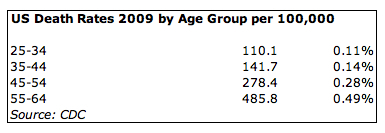
But at what probability does an outcome, and associated consequence, become significant enough to act upon? The life insurance industry gives us some idea. The United States Centre for Disease Control (CDC) puts out a publication called the National Vital Statistics Reports in which it aggregates and analyses mortality data for the United States. In their latest report dated March 16, 2011 they analyse the 2009 data set (most up-to-date figures) and you can find mortality rates by age in Table 1. An extract is given here:

Critically, the life insurance industry is an industry of tail risk. The average American in their late 20s has only a 0.1% chance of dying in any given year and those in their late 50s 0.5%. Yet the latest figures from the life insurance industry’s think tank LIMRA show that 70% of US households have some type of life insurance (of which 44% are individual policies). For those households with children, the numbers are even high: 81% for Generation Y’ers rising to 91% for Baby Boomers.The industry has been in a bit of a panic recently because overall life insurance ownership has been on a gradually declining trend over the longer term, but the fact is that the majority of Americans understand the long-tailed risks of a major breadwinner in the family dying and actually do something about it. In sum, faced with the tail risk of death, adults buy life insurance to manage the risk, especially those people who have children.

Before we look at the tail risk of climate change, it is important to note that life insurance does not hedge against the risk of death: if you die, you are still dead regardless as to whether you own life insurance. What you are really insuring against is not your own death but the sustainability of your family’s prospects after your death. The realisation is that if you die without life insurance, your family will have a degraded life path. In the case of your children, this may, for example, mean reduced educational opportunities that will have negative consequences for their entire life. So actually the act of buying life insurance shows a high degree of concern for the quite distant future as not only are you thinking about a time horizon covering the insurance policy in question but also an even more distant time horizon that encompasses your family’s well being much further into the future after you have gone.

So let’s take a family with children and have a look at the tail risk of climate change. Well, if you have children, then their working lives will likely encompass the 2020s to 2060s, and their life expectancy will likely take them to the end of the century. What is the climate-related tail risk they face over that time period? The answer appears to be a far higher risk than that associated with the loss of a bread-winning parent during childhood. A paper by Richard Betts et al in the UK Royal Society’s flagship journal (that can be found here) spells it out:

The evidence available from new simulations with the HadCM3 GCM and the MAGICC SCM, along with existing results presented in the IPCC AR4, suggests that the A1FI emissions scenario would lead to a rise in global mean temperature of between approximately 3◦C and 7◦C by the 2090s relative to pre-industrial, with best estimates being around 5◦C. Our best estimate is that a temperature rise of 4◦C would be reached in the 2070s, and if carbon-cycle feedbacks are strong, then 4◦C could be reached in the early 2060s—this latter projection appears to be consistent with the upper end of the IPCC’s likely range of warming for the A1FI scenario.

A1FI is the high carbon emissions scenario prepared for the Intergovernmental Panel on Climate Change (IPCC) Fourth Assessment Report (AR4), which is also the emissions trajectory we are currently following owning to the general failure of carbon emission mitigation efforts made by governments around the globe to date. A description of the scenarios can be found here.

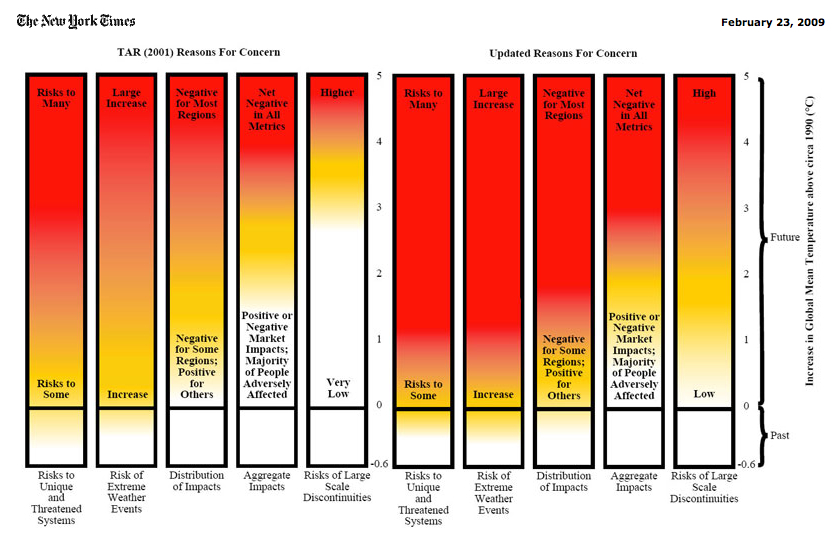
At the time of the Copenhagen Accord in 2009, the international community made a commitment to ‘hold the increase in global temperature below 2 degrees Celsius’ from pre-industrial revolution levels (we are up around 0.8 degrees Celsius now). Further, that two degree Celsius degree line is already deemed by mark the border between ‘dangerous climate change’ and ‘extremely dangerous climate change’ (see the Anderson and Bows paper at the Royal Society link above). The IPCC’s famous burning embers diagrams (updated chart below taken from the NYT here) adds some detail to the likely impacts. In short, we will rapidly progress up to the top of the bars shown below (click for larger image).

In sum, as the world temperature likely rises above the two degree Celsius level in most of our life times and probably moves to four degrees and beyond in our children’s life times based on the current emissions trajectories, we will all experience ‘extremely dangerous climate change’. The idea of ‘extremely dangerous climate change’ within the framework of risk is something I will leave to the next post. Suffice as to say, at a four degree global surface temperature mean warming, we will see the global land mean temperature rise by five to six degrees, a six to eight degrees rise in China, an eight to 10 degree rise in Central Europe and a 10 to 12 degree rise in New York (see here). With these kinds of changes, the planet our parents were born into will not be the same as the planet our children mature into.

Extremely dangerous climate change is, however, a risk that we cannot insure against, rather it is something that we can only respond to through mitigation, adaption or suffering. But first we have to recognise the reality for what it is.

Mitigate, Adapt or Suffer

Thomas Carlyle termed economics “the dismal science” but if you understand the conclusions of a paper entitled “Climate Change; The Evidence and Our Options”  by the eminent glaciologist Lonnie Thomson then you would surely agree that the study of anthropogenic (human-induced) global warming (AGW)  deserves the title better.

Thomson’s paper is important because it gives you a window into the mind of what most scientists truly believe about the climate change outlook if you chat to them over a beer or a coffee at the end of a long day, something you would rarely gauge if you focus on their academic writings. And what do they really think?

Climatologists, like other scientists, tend to be a stolid group. We are not given to theatrical rantings about falling skies. Most of us are far more comfortable in our laboratories or gathering data in the field than we are giving interviews to journalists or speaking before Congressional committees. Why then are climatologists speaking out about the dangers of global warming? The answer is that virtually all of us are now convinced that global warming poses a clear and present danger to civilization.

The message could not be more clearer in terms of the overall outlook, but what does this mean in terms of the life paths of individuals? In the concluding paragraph of the paper, Thomson spells it out:

Sooner or later, we will all deal with global warming. The only question is how much we will mitigate, adapt and suffer.

The premise of this blog is that ‘mitigation, adaption and suffering’ can be summed up in one word: risk. And risk is something that every financial professional (and indeed all individuals) deals with every day. Risk is the reality that the outcomes associated with our actions are subject to uncertainty, and attached to each potential outcome are gains and losses. The non-fringe scientific community has clearly stated that climate change is a reality (for example here). As such, it now poses major risks to our actions—whether buying a house, saving and investing, or educating our children. So, while climate change science contains uncertainties, it also makes the life outcomes of both ourselves and our families far more uncertain as well. In short, it poses a monumental risk.

Faced, with such a risk we have two choices: manage it or ignore it. The temptation to pretend the risk isn’t there is large because it is easy to feel impotent in the face of a planetary phenomenon. But as Peter Bernstein, the American financial historian and scholar of risk, puts it:

….outcomes are uncertain, but we have some control over what is going to happen or at least some control over the consequences of what does happen. That is what risk management is all about.

His highlighting of the difference between outcomes and consequences translates into the difference between mitigation (reduction of greenhouse gas emissions) and adaption in a climate change context. The goal of this blog is to encourage everyone to see climate change as a major risk to their well-being, and a risk that should be managed through mitigation and adaption. To do neither is to invite the third response in Thomson’s troika: to suffer.