Category Archives: Climate Change

Data Watch: Atmospheric CO2 October 2013

With the northern hemisphere having moved into fall, the annual cyclical upswing in atmospheric CO2 has begun. Key numbers relating to the National Oceanic and Atmospheric Administration (NOAA)’s release of the October 2013 mean monthly CO2 concentration are as follows:

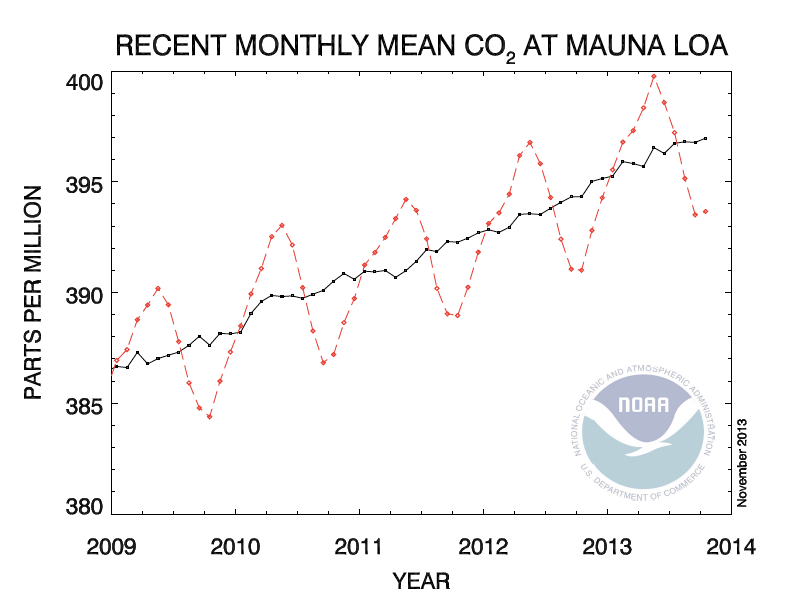
  • October 2013 = 396.66 ppm, +2.55 ppm year-on-year
  • Twelve Month Average = 396.1 ppm, +2.69 ppm year-on-year
  • Twelve month average over pre–industrial level = +41.5%

Atmospheric CO2 concentration is the world’s leading risk indicator. Every month, the National Oceanic and Atmospheric Administration (NOAA), a U.S. government federal agency, releases data on the concentration of atmospheric CO2 as measured by the Mauna Loa Observatory in Hawaii. The official NOAA CO2 data source can be found here.

This is the longest continuous monthly measurement of CO2 and dates back to March 1958, when 315.71 parts per million (ppm) of CO2 was recorded. The Intergovernmental Panel on Climate Change (IPCC) uses the year 1750 as the pre-industrialisation reference point, at which date the atmospheric concentration of CO2 was approximately 280 ppm according to ice core measurements.

Atmospheric CO2 displays annual seasonality: concentrations decline from the spring during the growing phase of terrestrial vegetation and rise in the autumn as vegetation dies and decomposes. The cycle is dominated by the northern hemisphere growing season since the northern hemisphere contains over 65% of the globe’s land mass. The cyclical pattern can be seen in the following chart (red line). The black line is the adjustment for seasonality.

Monthly CO2 Mean jpeg

Continue reading

Finding a Narrative for Climate Change

One of the hottest political topics in the UK at the minute is the cost to heat a house. Each sequential price hike by the Big Six Energy Suppliers in the UK has been met by claim and counter claim over who to blame. Within the debate, both renewables and green taxes have been pilloried by the right for forcing the poor in general, and pensioners in particular, into fuel poverty.

The left, meanwhile, has been noticeable for its silence in defending the ‘green agenda’. A low carbon policy was originally introduced and supported by all three main parties (from left to right) to mitigate climate change, but almost no-one (there are few brave exceptions) wants to champion this cause any more for fear of having the blood of frozen pensioners on their hands.

George Marshall, the insightful author of the Climate Change Denial blog, has a great post looking at the psychology of the debate. The debate, to him, has unfortunately been fitted into the standard narrative, which looks like this:

1.       Enemy + Intention → Harm to victims

2.      Hero + Intention     →  Defeats enemy and restores status quo

The left narrative has been this:

1.       Enemy (Big Business) + intention (self enrichment) → harm (high energy costs) to victims (vulnerable fuel poor)

2.      Hero (Labour party) + intention (social justice) → defeat (price freeze) and restores status quo (standard of living)

Meanwhile, the editorials of the right-wing press give us this:

1. Enemy (Environmental extremism) + intention (ideological zealotry) → harm (green taxes/suffering) to victims (vulnerable)

Continue reading

Data Watch: UAH Global Mean Temperature September 2013 Release

Dr Roy Spencer was quick off the mark this month, releasing the University of Alabama-Huntsville (UAH) global average lower tropospheric temperature anomaly for September 2013 on October 3rd.

The anomaly refers to the difference between the current temperature reading and the average reading for the period 1981 to 2010 as per satellite readings.

September 2013: Anomaly +0.37 degrees Celsius

This is the joint 3rd warmest September temperature recorded since the satellite record was started in December 1978 (34 May observations). The warmest September to date over this period was in 2010, with an anomaly of +0.45 degrees Celsius.

As background, five major global temperature time series are collated: three land-based and two satellite-based. The most high profile satellite-based series is put together by UAH and covers the period from December 1978 to the present. Like all these time series, the data is presented as an anomaly (difference) from the average, with the average in this case being the 30-year period from 1981 to 2010. UAH data is the earliest to be released each month.

The official link to the data at UAH can be found here, but most months we get a sneak preview of the release via the climatologist Dr Roy Spencer at his blog.

Spencer, and his colleague John Christy at UAH, are noted climate skeptics. They are also highly qualified climate scientists, who believe that natural climate variability accounts for most of recent warming. If they are correct, then we should see some flattening or even reversal of the upward trend within the UAH temperature time series. To date, we haven’t (click for larger image).

UAH Sep 13 Global Mean Temp jpeg

That said, we also haven’t seen an exponential increase in temperature, which would be required for us to reach the more pessimistic temperature projections for end of century. However, the data series is currently too short to rule out such rises in the future.

One of the initial reasons for publicising this satellite-based data series was due to concerns over the accuracy of terrestrial-based measurements (worries over the urban heat island effect and other factors). The satellite data series have now been going long enough to compare the output directly with the surface-based measurements. All the time series are now accepted as telling the same story (for a fuller mathematical treatment of this, see Tamino’s post at the Open Mind blog here).

Note that the anomalies produced by different organisations are not directly comparable since they have different base periods. Accordingly, to compare them directly, you need to normalise each one by adjusting them to a common base period.

The New IPCC Report and Climate Change Fatigue

Six years ago, the release of the Fourth Assessment Report (AR4) of the Intergovernmental Panel on Climate Change (IPCC) caused a considerable stir. I suspect that the publication of the Fifth Assessment Report (AR5), with the first instalment coming this week, will be met with a yawn.

What has changed? I would cite four main factors: 1) the Great Recession, 2) the coordinated and well-financed campaign of climate scepticism, 3) the hiatus in temperature rise and, last but not least, 4) climate change fatigue. I further suspect that even if 1) through 3) had not occurred, 4) alone would have been sufficient to break the momentum of any action to mitigate climate change.

So why can’t we keep our concentration in the face of what must be the greatest threat faced by humanity in the last 10,000 years? Perhaps because the lag between cause and effect, which in the case of climate change is measured in decades rather than years, is just too big.

In the past, I believed that life insurance offered some hope as a role model for evaluating long-horizon risks since the industry is built on individuals evaluating outcomes decades into the future. But in the case of life insurance, individuals can take a rough stab at the distribution of future risk by looking at the distribution of current risk.

A twenty-something woman with young children knows that there is an outside chance that she (or her partner) could die due to a heart attack, stroke or cancer in her thirties or forties. Why? Because out of the few hundred friends and acquaintances that she has come into contact with over the years, she probably knows, either directly or indirectly, more than one person who has died young. In short, life insurance mells well with an individual’s personal life narrative.

But climate change doesn’t. The risk is abstract to the extent that it has no connection with the life experience of most people. Even the burning embers diagram of the Third Assessment Report (TAR) of 2001 does a poor job of communicating risk (and even this was excluded from AR4 for political reasons as you can read here), since it is just a representation of broad categories of risk and not based on experiences that individuals can internalise:

Burning Embers jpeg

Therefore, while the decadal unit of measurement is most appropriate for measuring the extent and effects of anthropogenic global warming (AGW), it appears too long for social and political action to coalesce. Yet AGW is moving at lightening speed when compared with natural climate change.

The climate scientist Stefan Rahmstorf, writing in the scientist-led blog Real Climate, highlights a recent paper by Marcott et al in Science that reconstructs the global temperature record back over the last 11,000 years. This period, termed the Holocene, encompasses the years since the last glacial period ended, which is broadly commensurate with the rise of human civilisation.

Marcott jpeg

As you can see, we were merrily moving in slow motion toward a new ice age when we started to burn fossil fuels. Rahmstorf then kindly provides us with a chart that adds the back story of temperature during the last ice age plus the IPCC’s central estimate of temperature out to 2100 based on the most likely fossil fuel emission trajectory. The step change is obvious, but is still not fast enough to impact on the future expectations of voters.

Global Temperature Since Ice Age jpeg

With no urge to mitigate emissions visible within the broader population, we appear to be reduced to praying a) that climate sensitivity to a CO2 will come in at the low end of estimates, and b) that this will give us sufficient time for a backstop non fossil-fuel energy technology to be developed and scaled up before extremely dangerous climate change is locked in.

This is a pure, high-stakes gamble: if we don’t get lucky with sensitivity and technology, we are left with a horrendous pay-off in terms of negative climate change effects. Unfortunately, no means of conveying this threat in a way that meshes with the life narratives of ordinary individuals appears to exist.

Links for the Week Ending 15 September

Apologies for the paucity of posts. Kids are back at school; this may portend a bit more stability and hopefully some more frequent posting. Meanwhile:

  • Dana Nuccitelli writing in The Guardian explains why the hiatus in climate change is nothing more than, well, a hiatus.
  • The demise of The Oil Drum (TOD) is certainly unwelcome, but there are still a lot of people writing intelligent things about resource depletion. Stuart Staniford at Early Warning is one such person, and he has just written a very perceptive obituary for TOD. The economist Professor Jim Hamilton offers his own thoughts here.
  • It looks like Arctic sea ice extent bottomed out at 5 million square kilometres on 12th September, up substantially from last year’s minimum of 3.5 million. Geoffrey Lean, a rare light of reason on climate change issues in The Telegraph, points out that the 2013 melt is still far beneath the average of the last 3 decades. He also gives a sensible explanation of what is going on in the Antarctic as well. It’s a credit to The Telegraph that the climate skeptic juggernaut hasn’t removed all science-based reporting of global warming issues from its pages, unlike the remainder of the right-of-centre press in the UK.
  • And in The New York Times, the professor of physics and astronomy Adam Frank discusses the rebound in anti-science thought over the last few decades in an op-ed piece.
  • I am not sure if I agree with this polemic on “Bull Shit Jobs” by the radical anthropologist David Graeber, but it is a lovely read and has been attracting a lot of attention.
  • James Kwak and Simon Johnson write the often enlightening blog The Baseline Scenario. But last week James had a longer piece out in The Atlantic that gives a very thoughtful five-year retrospective on the Lehman shock that is well worth a look.

Data Watch: UAH Global Mean Temperature August 2013 Release

On September 10th, Dr Roy Spencer released the University of Alabama-Huntsville (UAH) global average lower tropospheric temperature anomaly for August 2013 on September 10th.

The anomaly refers to the difference between the current temperature reading and the average reading for the period 1981 to 2010 as per satellite readings.

August 2013: Anomaly +0.16 degrees Celsius

This is the 11th warmest August temperature recorded since the satellite record was started in December 1978 (34 May observations). The warmest August to date over this period was in 1998 (1998 being the super El Niño year), with an anomaly of +0.44 degrees Celsius.

As background, five major global temperature time series are collated: three land-based and two satellite-based. The most high profile satellite-based series is put together by UAH and covers the period from December 1978 to the present. Like all these time series, the data is presented as an anomaly (difference) from the average, with the average in this case being the 30-year period from 1981 to 2010. UAH data is the earliest to be released each month.

The official link to the data at UAH can be found here, but most months we get a sneak preview of the release via the climatologist Dr Roy Spencer at his blog.

Spencer, and his colleague John Christy at UAH, are noted climate skeptics. They are also highly qualified climate scientists, who believe that natural climate variability accounts for most of recent warming. If they are correct, then we should see some flattening or even reversal of the upward trend within the UAH temperature time series. To date, we haven’t (click for larger image).

That said, we also haven’t seen an exponential increase in temperature, which would be required for us to reach the more pessimistic temperature projections for end of century. However, the data series is currently too short to rule out such rises in the future.

UAH August 2013 Global Mean Temp jpeg

One of the initial reasons for publicising this satellite-based data series was due to concerns over the accuracy of terrestrial-based measurements (worries over the urban heat island effect and other factors). The satellite data series have now been going long enough to compare the output directly with the surface-based measurements. All the time series are now accepted as telling the same story (for a fuller mathematical treatment of this, see Tamino’s post at the Open Mind blog here).

Note that the anomalies produced by different organisations are not directly comparable since they have different base periods. Accordingly, to compare them directly, you need to normalise each one by adjusting them to a common base period.

Life in a Time of Hiatus and the Off-Grid Movement

Humans aren’t very good at risk. Or rather they are good as long as the future looks a lot like the recent past. In economics, this way of looking toward the future is called “adaptive expectations“, where we change the way we look at the world only when an event comes along that jars with our original working hypothesis of how we thought things work.

For a time, the more sophisticated idea of “rational expectations” ruled the roost in economic circles (and in 1995 the economist Robert Lucas picked up a Nobel prize for his work on this idea). Lucas’ idea was that individuals discounted all known information (not just empirical evidence from the past) so accordingly their expectations over future economic variables should show no discernible bias. Partially on the back of this belief, Lucas made the following statement to the American Economic Association in 2003:

The central problem of depression-prevention has been solved, for all practical purposes, and has in fact been solved for many decades.

The statement contained two components of Lucas’ libertarian philosophy: 1) past recessions came about as a result of governments messing up and 2) private-sector actors act rationally and efficiently if left alone. And then along came the popping of countless irrational bubbles in 2009 and the subsequent Great Recession—out of which we are still struggling to emerge.

What has this got to do with the themes of this blog? Well, if we assume that the expectations of individuals are formed in an adaptive manner, then on the big questions of climate change and resource depletion, secular shifts and step changes will cause populations to consistently make bad decisions. People will cling to the past until their lives are turned upside down.

In other words, if Mark Twain was wrong, and history doesn’t repeat itself or rhyme, then we humans appear to be in trouble;  we are preprogrammed to look for rhymes and find them even when they don’t exist. We all have our life narratives—the work we do, where we live, the lives we wish ourselves and our kids to lead—and we don’t like it when this narrative is questioned.

Confirmation bias is rife in this way of thinking. If a piece of information comes along that supports the narrative, it is emphasised; if it contradicts the narrative, it is discounted. Nonetheless, if a new piece of information hits with sufficient force, it won’t be completely ignored. Or alternatively, a little bit of discomfort if continuously felt will cause us to shift our position.

Climate change, being the wicked problem that it is, fulfils neither of these conditions. The hot years of 1998 and 2009 were just not hot enough to permanently shift the narrative. And the hot years are sufficiently infrequent to allow us to forget. Mother Nature hasn’t helped by putting the globe into a La Nina-dominated phase of the ENSO cycle, thus masking the upward trend in temperature over the last few years.

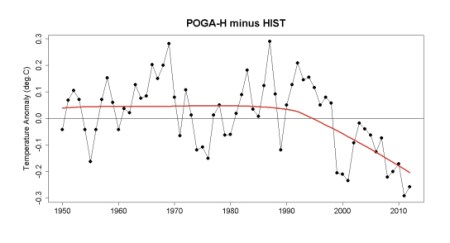
The statistician Tamino, in  his excellent Open Mind blog, analyses this phenomenon in a recent post (with much of this work building on an article in Nature by Kosaka and Xie in Nature). In his words:

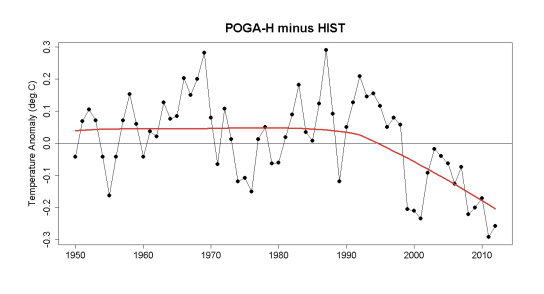
The influence is clear: a pronounced recent ENSO-induced cooling which has cancelled the continued global warming due to man-made CO2, leading to the “hiatus” in the increase of global temperature.

And he includes a chart that shows how much the ENSO cycle is currently subtracting from the overall warming trend:
ENSO Effect on Temperature jpeg

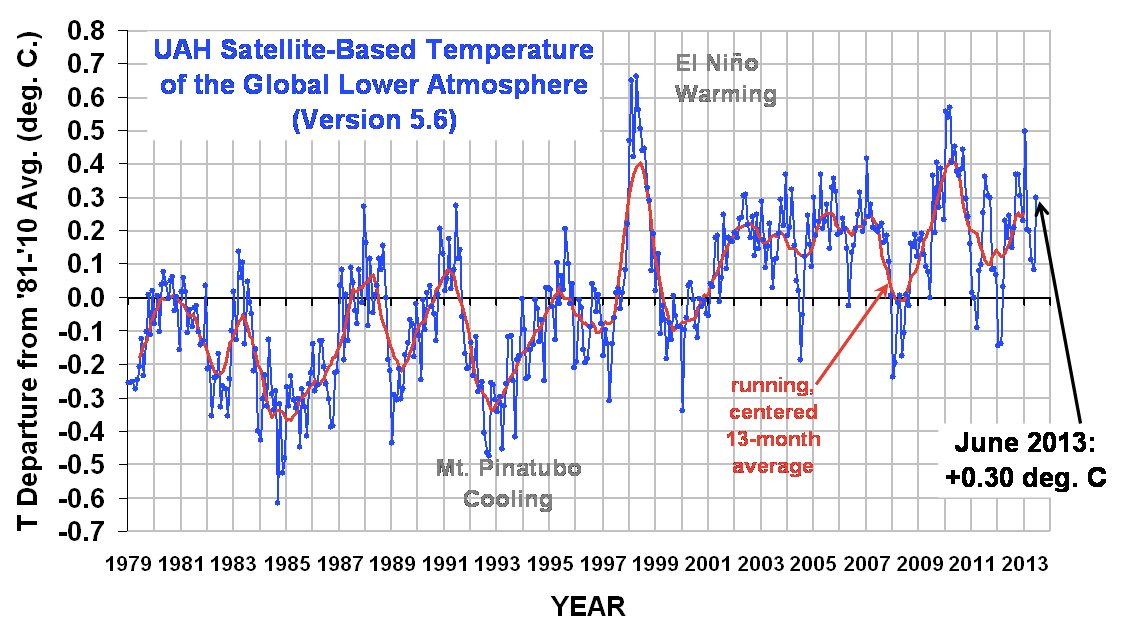
Nonetheless, despite the fact we are living in a hiatus period of slow temperature rise, the maximum temperature records are still coming thick and fast. For a state of play, see here. My old home of Japan, for example, posted a new record of 41 degrees Celsius this summer, and new highs also came in Slovenia, Austria and Greenland. When the next strong El Nino rolls round, I expect this records page to explode. In the meantime, however, people are just bored with the unspectacular gradual saw-tooth warming path as encapsulated in Dr Roy Spencer satellite temperature anomaly chart:

UAH Global Mean Temps July 2013 jpeg

This sawtooth is typical of a stochastic process with a trend. Climate change may punch you in the face one year, but it is highly unlikely to punch you in the face two years in a row. Accordingly, all those symptoms of climate change also have a tendency to fade in and out of consciousness year by year. So in 2012, we had an extraordinary collapse in Arctic sea ice extent. And this year?
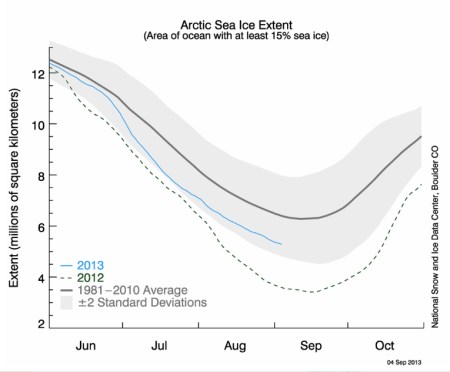
Arctic Sea Ice Extent 2013 jpeg

Of course, the downward trajectory is still intact. The average for September 2013 looks like coming in  at around 5 million square kilometres, which would put it slap bang on trend.

Aveage Monthly Arctic Sea Ice Extent September jpeg

Actually, I think the media was already bored with sea ice extent. Coverage during the shocking collapse last year was patchy at best. Sea ice extent decline can be seen as the canary in the coal mine for climate change, but few actually care that the canary is dying. In 2012, the Financial Times and Wall Street Journal devoted far more space to polar shipping route and oil and gas drilling opportunities arising from receding Arctic sea ice than the greater existential threat the phenomenon of retreating ice represented in itself.

But what about the ‘in your face’ extreme weather events that bring climate change home. When Hurricane Sandy hit at the end of October 2012, for a time climate skeptics were put on the back foot (even though scientists are loathe to attribute any one weather event to climate change). Mayor Michael Bloomberg actually cited Hurricane Sandy and climate change as a catalyst for him supporting Obama in the presidential election (here).

But weather is a fickle friend for those occupying the ramparts and calling for action over climate change, with, for example, this year’s hurricane season proving a spectacular bust; indeed, Bloomberg reports that there have been no Atlantic hurricanes reported as of 4 September. There is a while yet until the end of the hurricane season, but in reality the probability of a few Katrina or Sandy-type hurricanes hitting in quick succession—something that would make an impact on the broader populations adaptive manner of forming expectations—is low.

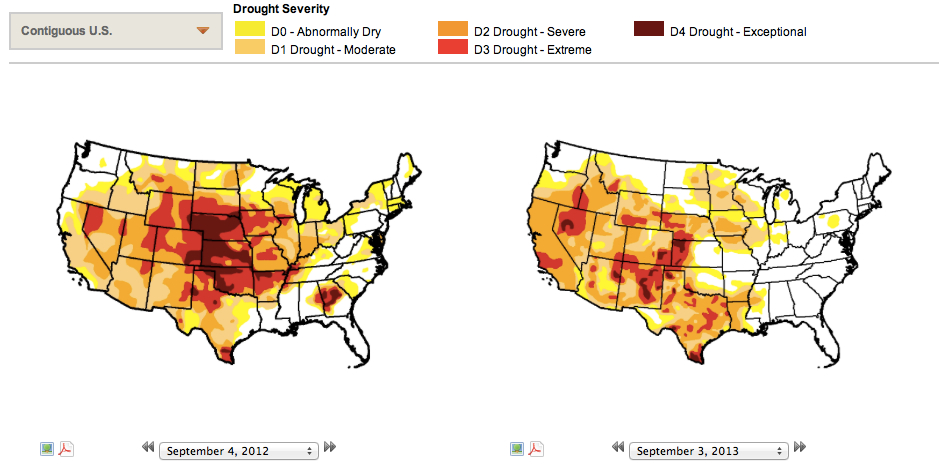
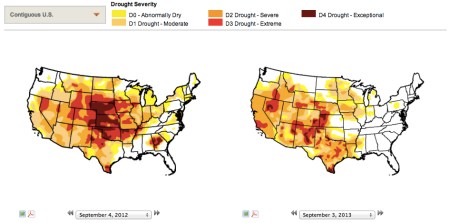
The same applies to deluge and drought. Both the U.K. and U.S. continue to experience ‘weird weather’. But the record droughts have broken and record floods have receded, and life has moved on. For example, last year the U.S. was gripped with severe drought and this year is still bad—but not quite so bad (click for larger image, chart source here):
Drought Severity US jpeg

Ironically, the resource depletion debate has also followed a similar trajectory. The media has grown bored and skeptics have declared victory. As is typical with such controversies, much of the sturm und drang centres around establishing a straw man in the opposing camp to attack. God forbid we go back to the original sources and read what the influential peak oil theorists of the modern era actually said. For example, here is a high profile article written by  Colin Campbell and Jean H. Laherrere  back in March 1998 for Scientific American. This is what they said:

The world is not running out of oil – at least not yet. What our society does face, and soon, is the end of the abundant and cheap oil on which all industrial nations depend.

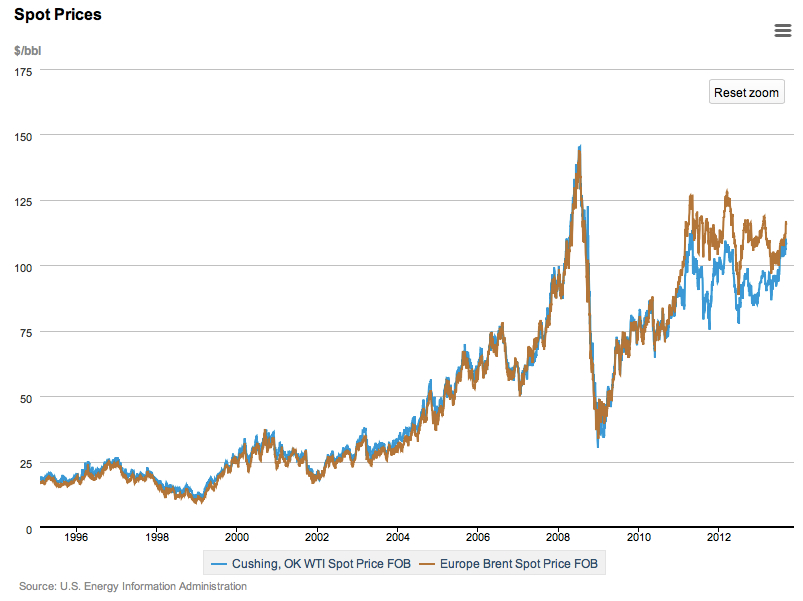
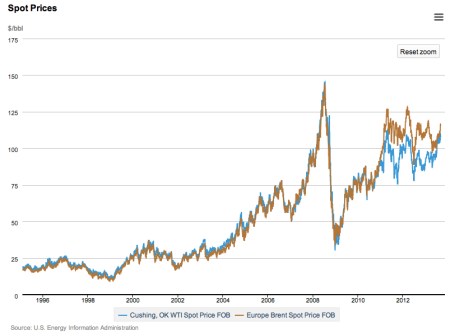
And what was the price of oil when they wrote this article? The annual average cost of crude in the U.S. in 1998 was $11 barrel (see the EIA numbers here). In short, Campbell and Laherrere came out with a big, bold call on rising oil prices in March 1998, and they were absolutely right.
Spot Oil Prices jpeg

Moreover, from the graph above it is difficult to detect any softening of the oil price in recent years. Not to worry, the media tells us that  peak oil is dead, slayed by the white knight of fracking technology. And Daniel Yergin, the high-profile cornucopian who appears to have free rein to write op-ed articles in the Wall Street Journal at will, dances on its dead body. But who has been closer to the truth over the last two decades, Campbell and Laherrere or Yergin? Well here are Yergin’s predictions (taken from a great post at Stuart Staniford’s Early Warning blog):

Daniel Yergin jpeg

Ironically, the only time he was bullish on the oil price was just prior to when the global economy plummeted into the Great Recession (in respect of which high oil prices played no small part). Nonetheless, while the upward trend in oil prices remain intact, we are not currently breaking to new records. At the same time, economic actors are doing just enough in terms of substitution and efficiency that the pain is tolerable. That is, until oil prices break substantially higher some time in the future, so tipping us into a new recession.

For those individuals and organisations that call for a proactive and forward-looking response to global warming and resource depletion, the tendency for humans to stick to their existing life narratives unless violently bashed over the head has proved a challenge, particularly in a period of hiatus. Here is a part of Transition Network‘s mission statement:

Transition Network supports community-led responses 
to climate change and shrinking supplies of cheap energy, building resilience and happiness.

But if most of your audience doesn’t believe that climate change or energy availability is changing sufficiently to impact their lives, then they won’t be receptive to making their lives more sustainable and resilient (and in the process help ensure their children and grandchildren don’t come to live on a planet that has radically changed).

I feel the frustration. A few years ago, I could engage with the agnostic over climate change (the fundamentalist climate skeptics have always been a lost cause). But now most don’t want to know. The Great Recession coupled with the hiatus have led people to return to their comfortable old life narratives.

So what is to be done? I think the way is twofold. First, work with the believers in enhancing sustainability and resilience wherever possible.

Second, and perhaps more controversially, use the off-grid movement as a Trojan Horse to advance sustainability and resilience. Ironically, technology and the information revolution have brought aspects of off-grid living to ever larger segments of the population. And the appeal of the off-grid way of life runs across the political spectrum to encompass a multitude of ways of thinking including:

  • Environmentalism
  • Post-consumerism
  • Down-sizing
  • Survivalism
  • Libertarianism

Over the summer break, I read two books by Nick Rosen, “How to Live Off-Grid” and “Off the Grid” (the former concentrating on the U.K. experience, the latter the U.S.). Rosen is a lukewarm environmentalist. His motive for moving off-grid is more philosophical:

Some of the cosiest-sounding places in the world are off-grid. And I detected that as well as this physical sense of off-grid, there also seemed to be another meaning  – an off-grid attitude that you could take into the local park or your own back yard, a sense of feeling at ease in the world. of reclaiming your independence and individuality. A practical, freewheeling kind of self-sufficiency.

To me, off-grid is synonymous with empowerment. Surprisingly, although technology had created a system of global hyper-capitalism that extols specialisation, supply chain management, outsourcing and the rest, it could allow us to disengage and then deal with the market in our own terms. If you don’t have to worry about the bottom segments of Maslow’s hierarchy of needs (the physiological needs of food, water, temperature control and so on), then you have a better chance to flourish in the higher segments. I will return to this theme in the future.

Data Watch: UAH Global Mean Temperature July 2013 Release

Dr Roy Spencer has been very fast out the block this month, releasing the University of Alabama-Huntsville (UAH) global average lower tropospheric temperature anomaly for July 2013 on August 2nd.

The anomaly refers to the difference between the current temperature reading and the average reading for the period 1981 to 2010 as per satellite readings.

July 2013: Anomaly +0.17 degrees Celsius

This is the 9th warmest July temperature recorded since the satellite record was started in December 1978 (34 May observations). The warmest July to date over this period was July 1998 (1998 being the super El Niño year), with an anomaly of +0.44 degrees Celsius.

As background, five major global temperature time series are collated: three land-based and two satellite-based. The most high profile satellite-based series is put together by UAH and covers the period from December 1978 to the present. Like all these time series, the data is presented as an anomaly (difference) from the average, with the average in this case being the 30-year period from 1981 to 2010. UAH data is the earliest to be released each month.

The official link to the data at UAH can be found here, but most months we get a sneak preview of the release via the climatologist Dr Roy Spencer at his blog.

Spencer, and his colleague John Christy at UAH, are noted climate skeptics. They are also highly qualified climate scientists, who believe that natural climate variability accounts for most of recent warming. If they are correct, then we should see some flattening or even reversal of the upward trend within the UAH temperature time series. To date, we haven’t (click for larger image).

That said, we also haven’t seen an exponential increase in temperature, which would be required for us to reach the more pessimistic temperature projections for end of century. However, the data series is currently too short to rule out such rises in the future.

UAH Global Mean Temps July 2013 jpeg

One of the initial reasons for publicising this satellite-based data series was due to concerns over the accuracy of terrestrial-based measurements (worries over the urban heat island effect and other factors). The satellite data series have now been going long enough to compare the output directly with the surface-based measurements. All the time series are now accepted as telling the same story (for a fuller mathematical treatment of this, see Tamino’s post at the Open Mind blog here).

Note that the anomalies produced by different organisations are not directly comparable since they have different base periods. Accordingly, to compare them directly, you need to normalise each one by adjusting them to a common base period.

Links for the Week Ending 21st July

  • Lots of commentary on whether the bankruptcy of Detroit is emblematic of a post-industrial, post-growth world, or just an exception. This blog post by Juan Cole (via Stuart Staniford’s Early Warning) delves far deeper than most.
  • And from a very different perspective, Raghuram Rajan, who wrote the wonderful book Fault Lines, continues to ask some probing questions as to why we continue to need financial repression by the the central banks to underpin what little growth we have—and where this could all lead.
  • Forbes has been gleefully dancing on the grave of The Oil Drum (here). Of course, they fail to reference the fact that oil prices have remained remarkably high despite a significant slowdown in global growth and that all Daniel Yergin’s predictions (Yergin being the cheerleader for the cornucopians) have been wrong. Like climate change, resource depletion in the form of peak oil is something people have grown bored with. Unfortunately, just because you get bored with something, it doesn’t mean it goes away (as a final post in The Oil Drum points out).
  • Having brought up climate change, it is worth directing you to the World Meteorological Office (WMO)’s state of play for the decade 2001-2010. No sign of climate change going away here. And we have had a record turnaround in this year’s snow and ice melt after a slow start. At this time of year, I check Arctic sea ice extent daily (here) to see how our dying canary is doing.
  • Meanwhile, the wilfully ignorant continue to buy real estate in Miami, which is likely to be the first major advanced city to be lost to climate change. An excellent article in Rolling Stone details the city’s fate here. And no, just because this is likely to happen decades in the future doesn’t mean current prices won’t be impacted. We just need a couple of climate-induced hurricane hits to change the valuation metric from free hold to lease hold as the market suddenly realises that all real estate in the city will ultimately be worth zero at some future date.

Data Watch: UAH Global Mean Temperature June 2013 Release

The University of Alabama-Huntsville (UAH) global average lower tropospheric temperature anomaly for June 2013 was released via the web site of Dr Roy Spencer (one of the founders of the programme that produces this temperature time series) on June 9th. The anomaly refers to the difference between the current temperature reading and the average reading for the period 1981 to 2010.

June 2013: Anomaly +0.30 degrees Celsius

This is the 4th warmest June temperature recorded since the satellite record was started in December 1978 (34 May observations). The warmest June to date over this period was June 1998 (1998 being the super El Niño year), with an anomaly of +0.51 degrees Celsius.

As background, five major global temperature time series are collated: three land-based and two satellite-based. The most high profile satellite-based series is put together by UAH and covers the period from December 1978 to the present. Like all these time series, the data is presented as an anomaly (difference) from the average, with the average in this case being the 30-year period from 1981 to 2010.

The official link to the data at UAH can be found here, but most months we get a sneak preview of the release via the climatologist Dr Roy Spencer at his blog.

Spencer, and his colleague John Christy at UAH, are noted climate skeptics. They are also highly qualified climate scientists, who believe that natural climate variability accounts for most of recent warming. If they are correct, then we should see some flattening or even reversal of the upward trend within the UAH temperature time series. To date, we haven’t (click for larger image):

UAH June 2013 Anomaly jpeg

One of the initial reasons for publicising this satellite-based data series was due to concerns over the accuracy of terrestrial-based measurements (worries over the urban heat island effect and other factors). The satellite data series have now been going long enough to compare the output directly with the surface-based measurements. All the time series are now accepted as telling the same story (for a fuller mathematical treatment of this, see Tamino’s post at the Open Mind blog here). Note that the anomalies produced by different organisations are not directly comparable since they have different base periods. Accordingly, to compare them directly, you need to normalise each one by adjusting them to a common base period.