Category Archives: Uncategorized

Links for the Week Ending 9th June

  • One of my favourite commentators on energy markets is Robert Rapier from R Squared. His latest post is on the outlook for the oil price over the coming year. In particular, he urges caution on those who expect oil to now enter a full-fledged bear market. Currently, new oil production has to replace both the 4 to 5 million barrels per day lost per annum due to depletion at existing fields plus cover increasing demand from developing nations. This is not an environment conducive to the building of enough spare capacity to push oil prices down significantly.
  • The IMF has issued an ex-post evaluation of its policy decisions with respect to its involvement in the 2010 and 2012 debt bailouts (here). Personally, I think the decision to force the state to take over private sector debt was a mistake. The debtors should have been allowed to default, and then the state backstop creditors that posed systemic risks. Instead, the austerity being forced on Greece to service the bloated public debt has created a zombie economy.
  • One climate scientist I follow quite closely is Oxford’s Myles Allen, who has been at the centre of the carbon budget approach to climate change. Carbon budgets allow us to estimate how much fossil fuel we can burn before we tip into dangerous climate change. The trillion tonne indicator, which is inspired by his work, can be found here. Nonetheless, in recent days Allen has been popping up in the UK press pushing carbon capture and storage (CCS) as a panacea for our climate change challenge (see here and here). I really don’t see the logic. How on earth are we going to institute an obligatory global CCS programme for an untried technology when the world has been incapable of agreeing on either a carbon tax, or a working cap and trade programme, or a comprehensive push toward renewables. In other words, he suggests we move from fostering renewable energy generation, which rests on established technologies, to promoting CCS, which is totally unproven on a commercial scale. Bizarre.
  • A few years ago, Ugo Bardi (a Chemistry Professor who blogs at Cassandra’s Legacy) wrote a fabulous book called “The Limits to Growth Revisited“. The book punctuated a lot of myths surrounding the original “Limits to Growth” report to the Club of Rome published in the early 1970s. Bardi now has a new report out, also for the Club of Rome, called “Plundering the Planet“.
  • Via Barry Ritholtz’s The Big Picture, John Mauldin has a good piece on Abenomics. I don’t always agree with Mauldin, but in this case I think his analysis gets to the core of Japan’s economic problems: demographics. I recently wrote of this theme myself (starting here) as I see Japan as the post-growth path finder for much of the developed world.
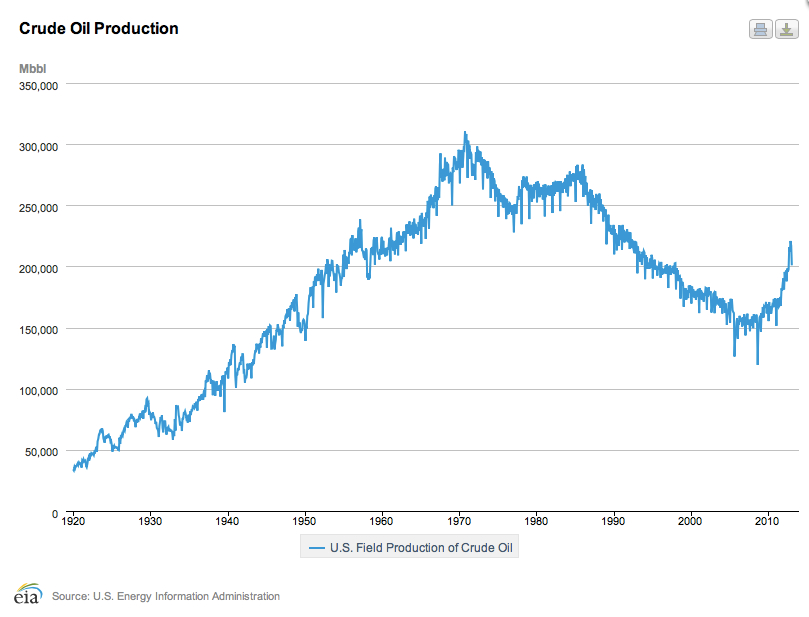
Data Watch: US and Global Crude Oil Monthly Production for March 2013

On May 30th, the U.S. government agency The Energy Information Administration (EIA) announced provisional crude oil production figures for March 2013. Key points:

  • March crude oil production 220.8 million barrels, equivalent to 7.1 million barrels per day
  • Change over March 2012 on a barrel-per-day basis: +13.0% y/y
  • March total crude oil plus natural gas liquids 297.6 million barrels, equivalent to 9.6 bpd

As can be seen from the chart below (click for larger image, link to original data here), the fracking of tight oil formations in the U.S. has made a significant impact on U.S. crude production. The critical question is whether the current large year-on-year percentage growth rates in oil production can be sustained (click for larger image). The year-on-year increase in production peaked in October 2013 at 18.2% (compared with 13.0% for March 2013).

U.S. Crude Oil Production jpeg

Given crude oil is a globally traded commodity, U.S. production numbers need to be placed in the context of world supply and demand. In its latest Oil Market Report, the International Energy Agency (IEA) recorded global ‘all liquids’ production as averaging 90.9 million bpd in Q1 2013, flat over the same period the previous year.

For April 2013, global supply was 91.3 million bpd , up slightly over the figure of 90.8 million bpd in March 2013. The May 2013 Oil Market Report can be found here.

World Oil Monthly Supply jpeg

Full quarterly IEA world supply-and-demand figures, including Q3 2013 estimates, can be found here.

Links for Week Ending 2nd June

  • Harvard’s Martin Weitzman, one of the world’s leading economists, has written extensively on climate change related risk. Here is an article he recently did for PBS outlining the risks we face. This is the concluding paragraph: “Admittedly, almost all of the relevant probabilities in this kind of rough analysis are uncomfortably indeterminate. But that is the nature of the beast here and shouldn’t be an excuse for inaction. The bottom line is that if we continue on a business-as-usual trajectory, then there is some non-trivial probability of a catastrophic climate outcome materializing at some future time. Prudence would seem to dictate taking action to cut back greenhouse gas emissions significantly. If we don’t start buying into this insurance policy soon, the human race could end up being very sorry should a future climate catastrophe rear its ugly head.”
  • On a more positive note, Teslar Motors, the electric car maker, appears to be on a roll, with a very positive financial results announcement and a soaring share price. Daniel Gross asks whether we are at the electric car tipping point at The Daily Beast. And via The Browser, the superiority of plug versus pump.
  • Meanwhile, solar photovoltaic systems appear to be getting closer to its own tipping point: the point where they can compete directly with fossil fuels without subsidies. The benchmark annual report tracking this trend in the U.S. is the Berkeley Lab’s “Tracking the Sun”, which you can find here. Unlike with Tesla, the solar price collapse has been a disaster for the profitability of the industry (and thus its ability to finance ongoing R&D), but there are some tentative signs of revenue improvement here as well.
  • Nonetheless, Weatherdem has a nice set of graphics that puts the renewables roll-out into context. Unfortunately, the scale of investment required is still breath-taking.
  • Every month, the European unemployment stats are published by Eurostat and every month they get worse. Extraordinary that there has not been more social unrest.
  • The annual update of the OECD’s Better Life Index (BLI) came out on 27th May. The BLI was launched in 2011, so we only have three years of data. However, the collapse in perceived life satisfaction in the southern tier European countries has been staggering. Portugal is at the bottom of the table with a score of one out of 10, followed by Greece (1.3) and Turkey (2.0). I was surprised that Turkey was near the bottom of the table given the economic boom it has been experiencing.I guess this accounts for the recent riots.

Links for the Week Ending May 26th

  • Via The Browser, I came across a very good article on the differing post-crisis outcomes of the U.S. and European economies in The New Yorker by John Cassidy (and in the process became newly acquainted with the term ordoliberalism). As an aside, Cassidy is author of “How Markets Fail: The Logic of Economic Calamities”, one of the better books analysing the makings of the Great Recession. In the New Yorker article, Cassidy blames austerity in Europe and lauds the quasi-Keynesian fiscal and monetary policies in the U.S. Personally, I think Europe’s woes are equally due to the straightjacket that is the euro (which has prevented the periphery more easily adjusting to the credit crisis shock) and an intrinsically lower potential growth rate owing to demographics and a tighter energy resource constraint.
  • And while we are on the question of austerity and debt, Reinhart and Roghoff have mounted a blistering attack on Paul Krugman in the form of an open letter. I think there is a genuine sense of hurt here since Krugman in the past recognised their academic credentials and integrity before declaring open warfare over the past few months. And here is Krugman’s rejoinder.
  • Of course, economists rarely agree on anything. For example, Iceland has been held up as the poster child of a successful adjustment in the wake of the credit crisis. But this is just not true, according to Jon Danielsson of the London School of Economics (via Naked Capitalism).
  • In three weeks time, I am off to Greece as part of a political tour organised by the former New York Times journalist Nicholas Wood. I hope the trip will spawn a series of the on-the-ground blog posts, but in the meantime I am reading Yanis Varoufakis insightful blog on Greece’s travails.
  • Enough of economics. Here is Martin Wolf following up last week’s Financial Times article on the critical issue of climate change.
  • And last but not least, the most important publication of the last week or so is an academic paper in Nature Geoscience by Otto et al. Unfortunately, it is behind a paywall, but a good synopsis can be found here. The paper argues that the climate sensitivity to a doubling of CO2 is somewhat below that advanced in the last assessment report of the Intergovernmental Panel on Climate Change (IPCC) published in 2007. This is undoubtedly good news, but not quite as good as many would believe. I intend to blog on this soon.

Links for the Week Ending May 19th

  • The central theme of this blog is that global economic growth will likely fall over the long term due to climate change, resource depletion, demographics, declining technology driven productivity gains and falling demand as technology concentrates earnings and wealth into an ever-shrinking winner’s enclosure. Fed Governor Ben Bernanke just presented the opposing argument against some (but not all) of my concerns in a commencement speech entitled “Economic Prospect for the Long Term” here.
  • Amory Lovins of the Rocky Mountain Institute has written a beautiful take-down in The Atlantic of all those who argue that renewable electricity provision is a utopian dream (price, intermittency, lack of transportability, blah, blah, blah). The article is actually a response to Charles Mann’s previous article in the same magazine titled “What If We Never Run Out of Oil?”, the gist of which has found much favour in the financial press, especially The Wall Street Journal. Germany will provide a battleground for this particular argument. Renewable energy pessimists point to the uptick in coal production there, while renewable optimists see this is a short-term blip on an otherwise smooth progress toward a renewables-dominated electricity future. I intend to post about this controversy going forward.
  • New pipeline capacity means that the days of West Texas Intermediate (WTI) crude being at a substantial discount to Brent crude oil are ending. Accordingly, Brent, which is now used as the global benchmark reference rate, will more closely determine gasoline prices in the U.S. For details on what is happening in the U.S. see this Reuters article by Robert Campbell here.
  • One of The Financial Times big beasts, Martin Wolf, gave climate change risk a well-earned airing on Wednesday. The FT, to its credit, sometimes treats the problem of global warming with the seriousness it deserves, unlike The Wall Street Journal in the U.S.
  • And staying with climate change, there has been a bit of ‘has it, or hasn’t’ with respect to the reporting over whether average daily atmospheric CO2 concentration had passed the 400 parts per million (ppm) level. The U.S. National Oceanic and Atmospheric Administration (NOAA), which operates the Mauna Loa Observatory that collects the benchmark data in Hawaii, originally reported 9 May as the day the world exceeded 400 ppm based on Coordinated Universal Time (UCT), better known to Brits as Greenwich Mean Time (GMT). The Scripps Institution of Oceanography, which publishes the daily data here, uses Hawaiian local time, and ended up recording the 400 pm mark a number of days later. Regardless, this record is now officially established and it is not a good one for humanity.

Links for the Week Ending 12th May

  • Most of the articles dealing with Niall Ferguson’s comments on Keynes are light weight and not worth the bother of reading, but this article in American Prospect via The Browser goes a little deeper. And if you want to give the subject even more respect, then I highly recommend a paper by David Blanchflower, former member of the Bank of England’s Monetary Policy Committee, who wrote an insightful and important paper in 2004 called “Money, Sex and Happiness: An Empirical Study”. Economics, sex and happiness may appear strange bedfellows (pun, of course, intended), but they really aren’t.
  • A few weeks back, The Economist did a piece on climate sensitivity that got a lot of things right but also a lot of things wrong. Nonetheless, I thought Skeptical Science’s original riposte by Dana Nuccitelli lacked subtlety since it questioned why The Economist was looking a climate science at all. Given that The Economist is, in effect, the house magazine of the English-speaking global corporate, financial and political elite, I would think its coverage of the subject should be welcomed. Further, Nuccitelli didn’t realize that The Economist‘s deputy editor, Emma Duncan, has been covering the subject for decades—and in a far more serious and sympathetic manner than almost all the rest of the Anglo-Saxon business press. Anyway, Nuccitelli has followed up with a much better article: a climate sensitivity 101 for The Guardian. Well worth a read.
  • Staying with The Economist, last week’s issue had a long article titled “Generation Jobless” on global youth unemployment.  While the author did touch on the impact that disruptive technology was having on the job market, it still gave top billing to a) lack of growth, b) job cartels and c) poor links between education and work. Personally, I think they have the problem the wrong way around. Technology and resource constraints are the reason for a lack of growth, particularly in advanced countries, so governments have to create labour policies that take low growth as a given. Further, as The Economist points out,  “new technology is unleashing a storm of “disruptive innovation” which is forcing firms to rethink their operations from the ground up. Companies are constantly redesigning work—for example they are separating routine tasks (which can be automated or contracted out) from skilled jobs. They are also constantly redesigning themselves by “upsizing”, “downsizing” and “contracting out”. Against this background, I believe the state will have to take a far more interventionist path with regard to employment, otherwise all hell will eventually break loose.
  • The social geographer Danny Dorling has a wonderful article in this week’s New Statesman (part of a special on Britain’s ruling elite) running the numbers on the changing concentration of wealth in the U.K, but unfortunately it is not available online. However, Dorling’s past articles, lectures and papers are available at his University of Sheffield web page here and include some cracking data visualisation graphics; for example, here and here. Meanwhile, Simon Kuper in The Financial Times dissects the French elite here.
  • And The Observer charts the rise and rise of London, the home of the global elite, as it continues to detach itself from the rest of the U.K.

Links for the Week Ending 5th May

  • Every month, I report the monthly average atmospheric Co2 concentration (for example here)—what I term the most important risk indicator in the world. On current trends, the monthly aveage number should pass the symbolic 400 parts per million threshold in 2014. The daily reading (as measured at Mauna Loa in Hawaii), however, has the possibility of recording the 400 number this month. In this connection, a new web site (called The Keeling Curve) has been launched by the Scripps Institution of Oceanography at UC San Diego to keep track of the daily number and can be found here.
  • The MIT Technology Review has a interesting article by Jason Pontin titled “Why We Can’t Solve Big Problems”. In contrast with the Apollo programme, which showed the “transcendent power of technology”, the article asks why there is a “paucity of real innovations”. The answer, according to the article, lies with public and political willingness to tackle the big problems, efficient institutions with which to deploy technology and an understanding of whether a problem is actually rooted in technology as opposed to some other economic, sociological or political cause.
  • Stuart Staniford at Early Warning has takes a look this week at  oil supply and demand up until 2025. His conclusion is that there is a 25 million barrel per day shortfall, which basically means that price is going up and/or economic growth is going down.
  • I am always surprised how little most educated people know of the science of well-being and happiness. The field has seen an explosion of activity over the last few decades encompassing both psychology and economics, yet we only see an occasional article popping up in the serious press. The New York Times, however, had an excellent article last week on the psychology professor Dr Sonja Lyubomirsky, one of the founders of Positive Psychology (although she distances herself from the positive psychologist label these days). To me, concepts such as “hedonic adaption” should be part of the basic stock of knowledge of every thinking person.
  • BBC Radio 4’s programme “The Reunion” brings together some of the founders of the Centre for Alternative Technology in Machynlleth, Wales. What comes through is lots of pride in the pioneering work on sustainability and resilience back in the 1970s and frustration that so little has actually been achieved in changing society.

Links for the Week Ending 28th April (Rather Late)

  • The Transition Network now has a newspaper up and running called The Transition Free Press. In the inaugural issue, you can find an interesting interview (conducted by Transition founder Rob Hopkins) with Kevin Anderson, one of the most politically active U.K. climate scientists. Anderson basically argues that everything has to change if we are to have any hope of limiting the damage from rising temperatures. You can read the full interview here
  • My favourite ‘thinking man or woman’s’ hedge fund manager, Jeremy Grantham, has a new quarterly letter out on the race between technology and resource depletion—one of the central concerns of this blog. You can find it here. And a thought-provoking commentary on the letter by FT blogger Izabella Kaminska, together with some links relating to Grantham’s ideas, is here.
  • Following the Excel spreadsheet furore, Reinhart and Rogoff mounted a solid defence of their work in this op-ed piece in The New York Times. In particular, they stressed that they have always recognised a two-way causation from debt to growth and growth to debt. Personally, I see the modern problem as very much being a lack of growth causing ballooning debt, rather than the converse, but accept that there is an element of the reverse causation.
  • In the wake of the R&R debate, there has also been a flurry of articles on the U.K.’s massive debt in the 1800s, which did not impede growth. If you want a good primer on the historical background, I recommend this piece by Professor Robert Neild from the Royal Economic Society web site.
  • Again in the FT, we saw a sympathetic commentary on Spain’s jobless titled “Stuck on the Sidelines” last Thursday. I struggle to see how these unemployed people can be put back to work in the current global economic environment. Further, for how long can the state afford to pay people like Mr Perdones, one of the unemployed profiled in the article, €1,200 per month? But if they don’t pay (won’t pay, can’t pay), I fear all hell will break loose.
  • On the same theme, The Economist has a special section on global joblessness, pointing out that 290 million of the planet’s youth, almost a quarter, are neither working nor studying. As usual for The Economist, it ends on an upbeat note: “Policymakers know what to do to diminish the problem—ignite growth, break down cartels and build bridges between education and work.” Hardly new. Plus the body of the article explains how technology is making such job creation solutions ever-less effective.
  • Naked Capitalism has a cross post by Alejandro Nadal on the degree to which technical change is driving increased global inequality. Nadal argues that the standard neoclassical responses to the growth slow-down have also played a major part in concentrating income and wealth. This echoes Raghuram Rajan, who argued in “Fault Lines” that the Fed caused the 2006/07 bubble in a vain attempt to prop up broad-based demand. Personally, I believe such critiques of monetary policy are very rarely aired. Aggressive QE bids up assets, but it is the richer segments of society that hold such assets. In other words, such aggressive monetary policy is premised on ‘trickle down’ economics, which patently is not working.

Links for Week Ending 21st April

  • On my book shelf is Francis Fukuyama’s 1992 book “The End of History and the Last Man”. The book came out of a long essay for The National Interest in 1989 (that you can find here), the central argument being that we were witnessing (at the time) the “unabashed victory of economic and political liberalism”. To Fukuyama, the ideology of political liberalism established the foundations for what he calls “The Wall Street Journal school of deterministic materialism”. And the success of deterministic materialism, in turn, allowed political liberalism to become more entrenched and then spread even further around the world. Ironically, the economic travails of the three countries that did most to give birth to political liberalism—France, the U.K. and the U.S.—has brought the study of political economy back from the dead. So history lives! An example of this reborn genre is Brad de Long’s post here.
  • And political economy lies at the core of George Orwell’s writings, whether journalism or novels.  The editor of The New Statesman, Jason Cowley asks in The Financial Times (here) why we haven’t produced another writer of Orwell’s stature who can write explicitly political novels or journalism that deepen the national debate. Indeed, why are there no writers who can deal with the death throes of The Wall Street Journal school of deterministic materialism in an intelligent manner?
  • On a parallel topic, the same edition of the FT (one of the few newspapers to have got better over the last 10 years) has an article by Martin Sandbu reviewing a series of books on the “Occupy” movement. Sandbu takes issue with the movement’s decision not to propose a political agenda. I agree. Occupy‘s stance reminds me of the Judian People’s Front in Monty Python’s film “The Life of Brian” who commit suicide in front of the Romans as a political statement. The Romans just shrugged at the eccentricity of this act and carried on as normal, much as the bankers have done with Occupy’s general assemblies, working groups and the “people’s microphone”.
  • More on Thatcher’s track record: This is an insightful article by George Eaton in The New Statesman looking at public spending. And in the same edition of the magazine, Kiran Moodley has a go at the myth of Britain as a failed state prior to Thatcher taking charge (something I have already blogged about here). Why do I think this topic is important? Because Thatcher’s death in the U.K. has led to calls for a return of Thatcherism to counter the country’s growth woes. The logic appears to go as follows: since Thatcher’s actions worked for one growth crisis in the 1970s, why not try her ideas with another one—i.e. now? This is wrong on so many levels: 1) there wasn’t actually a growth crisis in the 1970s, 2) Britain’s reinvention in the 1980s and 90s was partially made on the back of Northsea oil, which has almost now all gone and 3) if deregulation, tax cuts, privatisation and the neutering of the unions haven’t allowed us to maintain 2% or so economic growth, why on earth would doing more of the same have any effect?
  • A couple of years ago, the economists Reinhart and Rogoff came out with a very influential paper showing the relationship between debt and growth for a country’s economy. The original paper (here; it also morphed into a book, here) was interesting not only for its conclusion (when government debt gets to 90% of GDP, a country is basically stuffed) but also its historical detective work—they constructed a database containing thousands of debt crises going back centuries. Moreover, from a policy perspective, the paper appeared to provide an empirical justification for austerity. Now it seems that they got their sums wrong. This is the paper by Herndon, Ash and Pollin that called them out here. And here is Reinhart and Rogoff’s rebuttal in The Wall Street Journal. Since then, everyone and their mother in economics-land has entered the fray (go on Economist’s View to see the fun). Krugman, who loves a good fight, has gone in with his boots flying as usual (here). Personally, I don’t think either more debt or more austerity will restart growth.

Links for Week Ending 14th April

  • Ugo Bardi’s blog has a post on Jorgen Randers’ and his book 2052. Randers was one of the original authors of the much misquoted 1972 book “The Limits to Growth” (see my post here). He appears to have gone through all the DABDA stages to reach a resigned acceptance of a pessimistic future. And I thought I could be gloomy. 
  • But then again not as gloomy as his co-author Dennis Meadows: here.
  • As someone who used to lurk at the bottom of the hedge fund food chain, it has always been a psychological boost to know that there are some persons at the apex of the food chain who share my concerns over the threat posed by climate change. One such person is Jeremy Grantham, Chief Strategist of GMO, who has never been afraid to put the investment game into a proper perspective. At its most basic, this means asking the question: “What is the point of out-performing your benchmark over many years (and amassing gazillions of dollars) if your children have a significant likelihood of frying?” (To me, not asking this question, is the moral equivalent of the concentration camp commandant who leads his own kids into the gas chamber.) Read Grantham’s interview here in The Guardian.
  • Cyprus is important because it shows the precarious nature of the power relationship between the state and its citizens in a globalized economy. Governments have, for many reasons, often decided to appropriate the wealth of individuals, but in the modern era this has been usually done by stealth; in other words, by inflation or progressive taxation. But in this particular case, one day you woke up to find that what was yours was theirs. And even that which remained yours (under the €100,000 deposit insurance limit), has become stuck within one geographical zone due to capital controls. Look and learn. A good starting point is Pawel Morski’s blog “It’s Not That Simple” to show you how the smart money knew many months ago that the writing was on the wall for a blatant money grab of the trusting money’s wealth.
  • I’ve already blogged (here) that Thatcher’s growth record was mixed, and here is another look at the data suggesting that the productivity record was also patchy (here). And another slice of the data here. And Krugman putting Thatcher’s record up against the dreaded French here. In all of this, we are in a world of counterfactuals. What Thatcher did (which I certainly would not deny) is make the labour market more flexible. I can see the legacy of this everyday in my home town of Henley, with its United Nations of youth staffing its pubs and cafes (with Brits very much in the minority). But was this an unstoppable trend due to globalization anyway? And could we have got from A to B a different way? Tough one to tell.
  • If, like me, you enjoying grazing over the writings of left and right with the hope that your preconceptions will be challenged, then I recommend Owen Jones’ book “Chavs: The Demonization of the Working Class“. Given the existential crisis within neoliberalism since the 2007/08 credit crunch, Owen asks why the left has failed to respond with a coherent alternative (here). Why indeed?