Category Archives: Climate Change

Data Watch: UAH Global Mean Temperature February 2013 Release

The University of Alabama-Huntsville (UAH) global average lower tropospheric temperature anomaly for February 2013 has been released via the web site of Dr Roy Spencer (one of the founders of the programme that produces this temperature time series). The anomaly refers to the difference between the current temperature reading and the average reading for the period 1981 to 2010.

February 2013: Anomaly +0.18 degrees Celsius

This is the eighth warmest February temperature recorded since the satellite record was started in December 1978 (35 February observations). The warmest February to date over this period was February 1998, with an anomaly of +0.65 degrees Celsius. Continue reading

Permafrost, Chimpanzees, the Savanna and Risk

In my  weekend links, I highlighted a new study published in Science. It is behind a pay wall, but has been well covered by Climate Central and Climate Progress. The study provides us with a good excuse to revisit the whole topic of climate risk.

The paper in question is an empirical study of past permafrost thaw at different temperatures. To summarise the conclusion, stalactite and stalagmite growth in Siberian caves suggests that significant permafrost thaw took place 400,000 years ago when the global mean temperature was around 1.5 degrees Celsius higher than it is today. This level of specificity is new, and is important for not being model based. Incidentally, we have an accurate temperature record going back around 800,000 years through the study of ice cores.

When such studies come through, I think it always useful to place them within a risk component analysis framework. As a reminder, risk is best defined as probability times effect—or  more specifically probability times net harmful effect. It is also worth recalling that we should not get sidetracked by the accusation that such studies lack certainty. The human condition is one of decision-making under uncertainty. As individuals, the only real certainty we have in our lives is death.

Keeping these points in mind, climate change can be viewed as a chain of risk components, each of which has its own probability distribution. We move from emissions, through atmospheric concentrations (the study of the airborne fraction that I blogged about here), to climate sensitivity, until finally we arrive at the net harmful effects on both individuals and societies.

Continue reading

Canada: The Laid-Back Uncle Who Joined the Tea Party

So what happened to Canada? I have followed the country’s politics only intermittently over the  years (despite being an international relations and politics junky and having relatives there). The Quebec secessionist movement was a newsmaker in my youth, but since that time I have seen Canada as like a rather laid-back (but a little bit boring) good-intentioned uncle, contrasting sharply with the schizophrenic one across the border.

Canada? To outsiders the country is the home of an efficiently functioning health service, sensible gun control, a well-regulated financial system and decent public education that covers the vast majority of its citizens. A veritable Switzerland set at the top of North America.

But then we come to climate change—and Mr and Mrs Common Sense metamorphosize into Sarah Palin-loving red necks screaming ‘drill baby drill’. How much of this can be put down solely to the lead of the government headed by Stephen Harper? Wikiepedia gives the gory details. And this article, via Skeptical Science, shows how the government’s tone has soured the usually sensible Canadian organs of state.

But what of the man or woman in the Canadian street? Have they been sneaking out the house surreptitiously to join a Tea Party-type gathering down the road? Continue reading

World GDP: No Slowdown—Yet

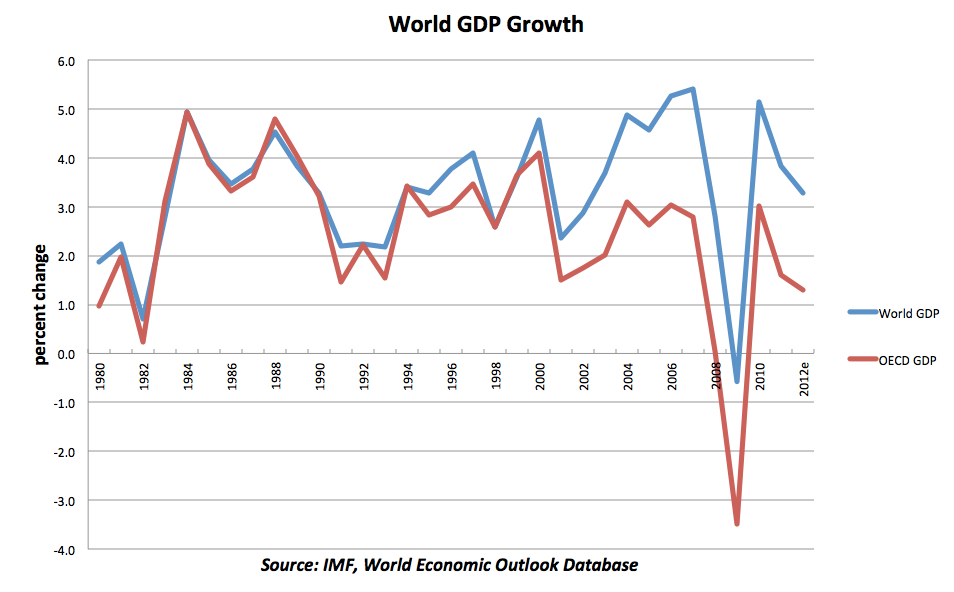
This blog broadly looks at three factors that could usher us into a post-growth world: climate change, resource depletion and diminishing returns to technology. Nonetheless, top-level data suggest that we have yet to arrive in this post-growth world.

As can be seen in the chart below (click for larger image), global GDP has been robust in recent decades, notwithstanding the slump in 2009. Advanced economy growth appears to be exhibiting a modest downward trend, but from an empirical standpoint it is too early to draw any firm conclusions.

World GDP jpeg

Continue reading

Links for Week Ending 23rd February

  • The Forward on Climate Rally organised by 350.org attracted 40,000 people on 17 February and received wide publicity. This prompted a lively discussion as to whether direct protests make a difference to potential climate change outcomes or not. I think I fall into the camp of David Roberts at Grist who believes that street activism has a strong part to play in countering climate change. An excellent piece by him arguing against the more wonkish incrementalist approach of the NYT’s Andrew Revkin is here, and a follow-up piece on where the movement should go post the Keystone XL pipeline decision is here. The U.S. climate change movement now appears to have last gained some grass roots activist momentum in the U.S. I wish the same were true in the U.K.
  • Stuart Staniford has an update on “All Liquids” volume output  and OECD consumption trends at his Early Warning blog. Output appears to have been on a bumpy plateau for about a year now.  Not surprisingly, oil prices have been creeping up again. As I always say, if the cornucopian belief in technology is to be proved right, and previously inaccessible hydrocarbons can be easily unlocked, we need to see rising oil volumes and falling prices. We are currently seeing flat volumes and flat to rising prices.
  • Given what is happening in the oil markets, I recommend peak oil observers keep abreast of the work of Michael Kumhof, a senior economic modeller at the IMF. I previously blogged on the IMF’s incorporation of geological constraints into its forecasts here. To get a direct insight into Kumhof’s work, take a look at an easily accessible 20-minute presentation he gave here. A more technical IMF paper covering these issues was published in October 2012 here.
  • Via Barry Ritholtz’s The Big Picture, this article in the English edition of Le Monde diplomatique charts the surge in financial investment into agriculture. The article is a bit messy in its arguments but the key, and I think basically correct, point is that more and more people will be shut out of food markets via price. Everyone should think hard about how they can hedge against this.
  • Another horrible and depressing paper about permafrost thaw from Climate Central. This is one of the ‘known unknowns’ that we are gradually ‘knowing’ a lot more about. And it is not good.

Climate Change: I Didn’t Do It My Way

When new acquaintances learn of my interest in climate change, most try to change the subject; but when they learn that I used to be very active in financial markets, they often become engaged in the conversation and ask  questions on economics or investment. Why should the reaction be so different?

For such people, the logic with respect to financial markets appears to go something like this: “I have no idea if this guy is full of bullshit or not, but he seems to know something about investment so let’s find out what he has to say.” But for global warming I find the following reaction: “I have no idea if this guy is full of bullshit or not, but he seems to know something about climate change so let’s find a way to change the conversation because it is making me feel uncomfortable.”

I have always been fascinated about the psychology behind financial markets, a field of study that was given the economics profession seal of approval when Daniel Kahneman won the Nobel Memorial Prize in Economics in 2002 (for the best business/economics book of 2012 read his Thinking Fast and Slow). Psychology helps explain why individuals, or groups of individuals, frequently act in certain ways that is different from the profit-maximising model underpinning neo-classical economics.

Similarly, my suspicion has been that psychology lies behind the reason why climate change has failed to engage the general public, even though they should be engaged for reasons of self-interest if nothing else.

The other day I stumbled across the blog of George Marshall, the founder of the charity Climate Outreach Information Network (COIN) who has been developing the same line of thinking for far longer than myself. The introduction to his blog contains a question:

This blog explores the topic of the psychology of climate change denial – with observations and anecdotes about our weird and disturbed response to the problem. It seeks to answer a question that has puzzled me for years: why, when the evidence is so strong, and so many agree that this is our greatest problem, are we doing so little about climate change?

I encourage you to go through some of Marshall’s posts. They are not only insightful in trying to understand the apathy, indifference and denial that surrounds climate change but also sympathetic to the soft denialists (the vast majority of the population).

I will just pick up one theme that runs through the blog: narrative. Continue reading

Links for Week Ending 16th February

  • Professor Jim Hamilton is one of the few economists to give peak oil considerations a proper hearing. Moreover, as one of the world’s leading econometricians and author of the popular text book “Time Series Analysis” he cannot be accused of not knowing his numbers. This last week he has posted twice on oil (here and here) on his blog Econbrowser that he co-authors with Menzie Chin. Frequently, in any discussion of resource depletion, the standard economics response is that ‘price begets supply’. Hamilton points out that such logic only extends so far for an exhaustible resource
  • Dana Nuccitelli has a good post at Skeptical Science entitled “A Glimpse at Our Possible Future Climate, Best to Worst“. It delves into two of the major climate risk parameters: climate sensitivity and emission paths. Other major determinants of climate risk are changes in the carbon cycle, methane release and the extent of climate-related economic impacts themselves. And that is just the ‘known knowns’ and the ‘known unknowns’.
  • Veteran observer of the Chinese economy Michael Pettis has long argued that China’s supercharged growth rate is unsustainable. Here and here are recent restatements of his belief that we face a great re-balancing. This has major implications for both climate change-related CO2 emissions trajectories and resource depletion rates.
  • The Washington Post asks why monetary policy no longer works and economies fail to grow around the world. Personally, I think the answer is no longer solely to be found in the study of monetary and fiscal policy. Jeremy Grantham, the ever-thoughtful Chief Investment Strategist at GMO is squarely in my camp, with his firm predicating strategy on a U.S. long-term growth rate of 1.5%. Against this background his analogy is “of the Fed beating a donkey (the 1% growing economy) for not being a horse (Bernanke’s 3% growing economy)”. Read his last GMO letter on decelerating growth and the impact on investment here.
  • Grantham references an article by Chris Brightman of Research Affiliates which pegs long-term U.S. growth rates at 1% due to trends in population, employment and productivity. If true, and we then add in the impact of resource depletion and climate change over the next two decades (the pivot decades for me), we could easily be looking at a no-growth U.S. economy by 2030-2040.

Data Watch: Sea Level Rise

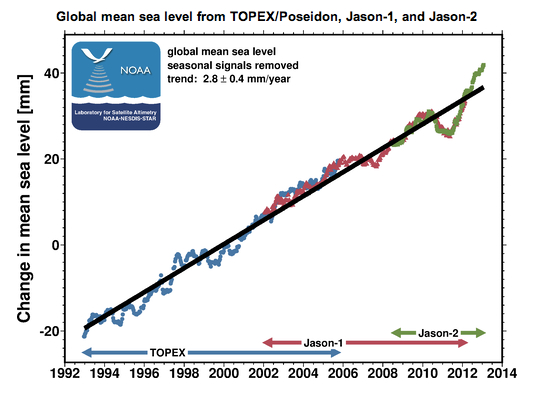
Who would have thought that sea level would exhibit volatility? Latest data from the U.S. government agency the National Oceanic and Atmospheric Administration (NOAA) to mid-January shows sea level rise pushing to the top of its twenty-year trend line. But only a little more than a year ago sea level exhibited a significant drop of 5 mm (and the “climate skeptic” blogosphere was alight with the claim that sea level rise had stopped). The drop was related to a sudden transition from El Nino to La Nina conditions which dumped an unprecedented amount of water on land. An explanation by NASA of this phenomenon is here.

A good backgrounder on sea level rise can be found at Real Climate (here and here) by Stefan Rahmstorf, one of the world’s foremost experts on sea level.

The major sea level time series all show sea level rising at roughly 3 mm per annum linear rate over the past two decades.

NOAA Sea Level  jpg

In order for us to experience the more pessimistic sea level rise outcomes of 1 to 2 metres by end of century (see for example here), the rate of rise will need to break out of its linear 3 mm per annum trend in the not too distant future. High rates of sea level rise have the potential to cause massive economic disruption, so a careful tracking of any change in trend is a critical component in gauging climate risk. Continue reading

The Unbearable Logic of the Kaya Identity

The ‘trillionth tonne’ of carbon is a  powerful risk indicator (I previously blogged about it here). As the Oxford University hosted web site trillionthtonne.org shows, we have used up around 567 billion tonne of our one trillion tonne carbon budget:

trilliontonne.org jpg

So that leaves 433 billion tonnes. If we go over the budget, we likely commit the planet to 2 degrees Celsius of warming above pre-industrial revolution levels. That level of warming is viewed as commensurate with dangerous climate change since it will produce a range of impacts extremely negative for mankind. How quickly we will grind through that 433 billion tonnes is the topic of this post.

The U.S. government agency the Carbon Dioxide Information Analysis Center (CDIAC) publishes a time series of emissions from fossil-fuel burning, cement manufacture and gas flaring going back to 1751 here and for land-use change emissions here. This is the benchmark record of human-induced emissions for most academic studies.

The recent estimate for fossil-fuel and cement related emissions for the year 2011 is 9.5 billion tonnes and can be found on the CDIAC site here. Land-use change emissions are updated less frequently but have been running at around 1.0 billion tonnes per annum (also available on the CDIAC site).

For 2012, the Global Carbon Project, a collaboration between various universities and scientific institutions  from around the world, estimates that fossil fuel emissions (including those associated with cement production) rose by 2.7% in 2012 to reach 9.7 billion tonnes. Put those two numbers together, and we are placing around 10.7 billions tonnes of carbon into the atmosphere. So if we then divide our remaining 433 billion budget by 10.7 billion tonnes of yearly output, we have 40 years before we likely commit ourselves to a world of dangerous climate change.

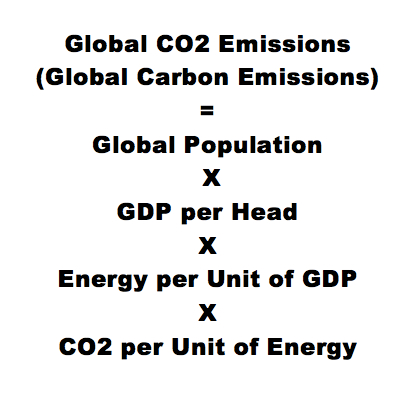
That is the good news (sort of) since 40 years is quite a long time. The bad news is that carbon emissions are not static, but are expanding every year. Further, that increase is a product of some  very powerful forces that are captured in an identity created by Japanese energy economist Yoichi Kaya. The identity breaks down the rise in global carbon emissions into four major components as can be seen below:

Kaya Identity jpg

Continue reading

New Risk Indicator: NSIDC Greenland Ice Sheet Melt Extent (Update)

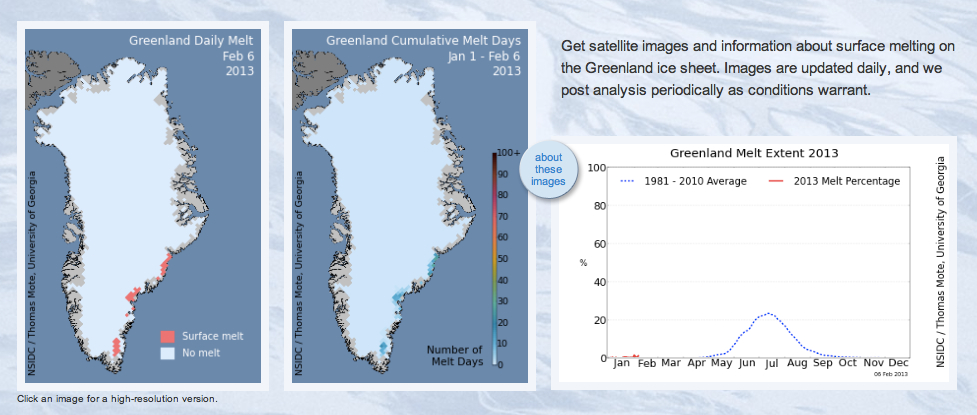
Yesterday, I profiled a new risk indicator put out by the National Snow and Ice Data Center (NSIDC). The NSIDC is providing us with a new daily updated high-frequency time series, this time on Greenland melt extent, complete with daily images that can be found here. Click on the image below to expand.

Greenland Daily Melt jpg

The 2012 melt season was unprecedented, with 97% of the island showing melt at one stage in July. To yesterday’s post I just wanted to add an image which brings out just how exceptional the 2012 season actually was (click for larger image), which I took from the NSIDC site. The blue dotted line gives the average melt extent over the 1981 to 2010 average. Added to what we saw with Arctic sea ice extent last summer and northern hemisphere snow cover, the Greenland melt situation shows the degree of structural change we are seeing with  respect to Arctic and northern latitude climate.

Greenland Melt Extent 2012 jpg

A review of the year 2012 for Greenland by the NSICD can be found here. The critical question going forward is whether 2012 was a true anomaly or a harbinger of the new normal.

A similar argument was voiced some years ago over the 2007 Arctic sea ice extent retreat, with most scientists at the time urging caution over calling a trend break and suggesting that 2007 could have been a product of an unusual confluence of weather factors. After the 2012 sea ice extent retreat, which smashed the 2007 record, few would now argue against the trend being truly broken (with Arctic sea ice extent now in a state of collapse). I fear we may see a repeat performance with Greenland ice melt over the next few years.