Category Archives: Climate Change

Data Watch: Atmospheric CO2 January 2013

Atmospheric CO2 concentration is the world’s leading risk indicator. Every month, the National Oceanic and Atmospheric Administration (NOAA), a U.S. government federal agency, releases data on the concentration of atmospheric CO2 as measured by the Mauna Loa Observatory in Hawaii. The official NOAA CO2 data source can be found here.

This is the longest continuous monthly measurement of CO2 and dates back to March 1958, when 315.70 parts per million (ppm) of CO2 was recorded.

The Intergovernmental Panel on Climate Change (IPCC) uses the year 1750 as the pre-industrialisation reference point, at which date the atmospheric concentration of CO2 was approximately 280 ppm according to ice core measurements.

Key numbers relating to NOAA’s February 5th release of January 2013 mean CO2 concentration are as follows:

  • January 2013 = 395.65 ppm, +2.41 ppm year-on-year
  • Twelve Month Average = 394.01 ppm, +2.24 ppm year-on-year
  • Twelve month average over pre–industrial level = +40.7%

Decadal CO2 Change jpg

Continue reading

Data Watch: UAH Global Mean Temperature Jan 2013 Release

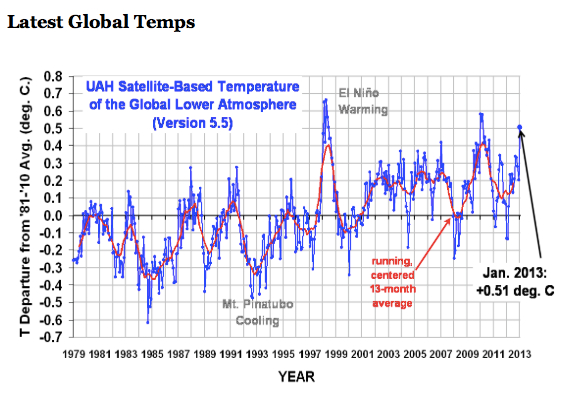
The University of Alabama-Huntsville (UAH) global average lower tropospheric temperature anomaly for January 2013 has been released via the web site of Dr Roy Spencer.

January 2013: Anomaly +0.51 degrees Celsius

This is the second warmest January temperature recorded since the satellite record was started in December 1978. The warmest January to date over this period was January 2010, with an anomaly of +0.59 degrees Celsius.

As background, five major global temperature time series are collated: three land-based and two satellite-based. The most high profile satellite-based series is put together by UAH and covers the period from December 1978 to the present. Like all these time series, the data is presented as an anomaly (difference) from the average, with the average in this case being the 30-year period from 1981 to 2010.

The official link to the data at UAH can be found here, but most months we get a sneak preview of the release via the climatologist Dr Roy Spencer at his blog.Spencer, and his colleague John Christy at UAH, are noted climate skeptics. They are also highly qualified climate scientists, who believe that natural climate variability accounts for most of recent warming. If they are correct, then we should see some flattening or even reversal of the upward trend within the UAH temperature time series. To date, we haven’t (click for larger image):

Latest Global Temps Jan 2013 jpg

Continue reading

The Trillionth Tonne

Communicating climate risk to non-specialists is not easy. Nonetheless, I think it is possible. In my own personal journey to understanding the risks my family and myself face, I have found that  getting to grips with the idea of a carbon budget has been vital. So I have a great deal of gratitude to those scientists who have thought long and hard about how to highlight the link between carbon and temperature change.

The carbon budget concept first found a wider audience in the journal Nature with the publication of two papers led by Myles Allen et al here, and Meinshausen et al here. A less technical commentary piece entitled “The Exit Strategy” also accompanied these two papers and is an absolute must-read for any thinking person.

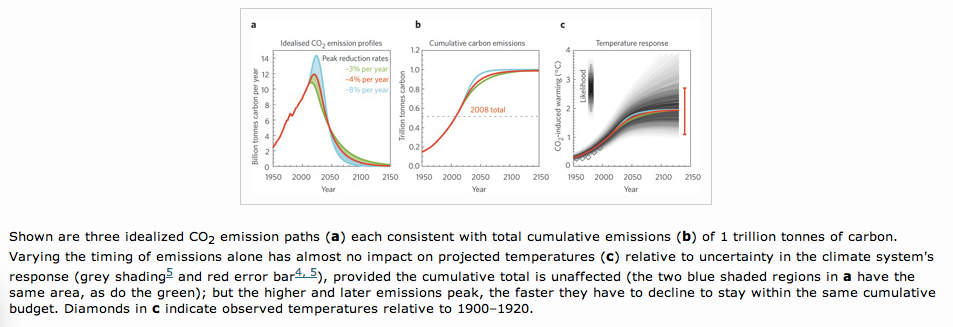
The central tenet behind these papers is that only a limited amount of fossil-fuel carbon can burnt and turn into CO2 before we are committed to warming the earth by 2 degrees Celsius. Given our current state of knowledge, Myles Allen and his colleagues also suggest that our current carbon budget is one trillion tonnes (or rather this is their best estimate of what can be released). The time path over which that trillion tonnes of carbon is emitted has almost no bearing on the level of actual warming due to the lags of temperature change to CO2 and the fact that CO2 resides in the atmosphere for so long (click for larger image).

CO2 Emissions Paths jpg
Note that they tackle the question of climate sensitivity to CO2 somewhat differently from the approach taken by the Intergovernmental Panel on Climate Change (IPCC) . In short, the IPCC defines climate sensitivity as the rise in global mean temperature based on a doubling of atmospheric CO2 from pre-industrial levels. The preferred metric of Allen and his colleagues is how much global mean temperature rises per one trillion tonnes of carbon.

Helpfully, Oxford University hosts a web site based on this methodology telling us how far we are along the way to burning that trillionth tonne. The answer is here:

Trillionth Tonne jpg

Continue reading

Links for Week Ending 2nd February

  • This blog covers two subjects that have the potential to morph into existential threats to civilisation if various factors align. The two in question are climate change and resource depletion. Unfortunately, any consideration of existential threats have been viewed as the province of cranks for the last few decades—or at least of fiction authors with a taste for the dystopian. Now at last the topic is getting some respect with the establishment of the Centre for the Study of Existential Risk at Cambridge, England. The NYT has a good introduction here, and CSER’s web site is here (note the impressive line-up of founders and advisors—no cranks!). 
  • To the Financial Times’ credit, the dark side of the shale gas revolution is given some sympathetic coverage; for example, these articles on shale gas flaring here and here. This contrasts sharply with the Wall Street Journal, whose mantra appears to be “drill baby drill”.
  • Photographing Climate Change in the New Yorker show cases a committed few. I am reminded of Bill McKibben’s lament “where are the goddamn operas“. The artistic community often appears missing in action when it comes to climate change, despite the fact that global warming poses a monumental threat to mankind’s artistic endeavour.
  • The New York Times has a lovely article on “The Preppers Next Door“.
  • A thoughtful post by David Altig from the Federal Reserve Bank of Atlanta at his Macroblog on Robert Gordon’s ‘end of growth’ hypothesis.
  • Climate change was directly addressed in President Obama’s inauguration speech (what a contrast with the Presidential debates). But what could really change? Here is the somewhat gloomy view of Harvard’s Robert Stavins.

The Irony of ‘Alarmists’ Who Err on the Side of Least Drama

Try searching the headlines of Anthony Watts’ WUWT blog for the words “alarmist” or “alarmism” over the past year and you will get 17 hits. The words are never clearly defined but imply that climate scientist claims are exaggerated and thus unworthy of merit.

Fortunately, a literature review by Brysse et al has recently been released that looks into whether this is true (the original is here and Skeptical Science also provides a good summary here).

Restated, the question is whether the scientific community, for which the Intergovernmental Panel on Climate Change (IPCC) can be used as a proxy, has made exaggerated predictions. For a full answer to this question, please read the original article or the Skeptical Science post. In summary, the article’s conclusion is that the IPCC has been too cautious in its predictions with respect to sea level rise, Arctic sea ice extent retreat, snow cover reduction, the rise in carbon emissions and ice sheet melt. Hurricane intensity and global mean temperature rise have been in line with predictions.

The most interesting part of the article deals with why scientists have had a tendency to be conservative in their predictions—what the study calls to ‘err on the side of least drama (ESLD)’. In their words: Continue reading

The Wealth of Households and Existential Threats

Among the plethora of statistics put out by governments around the world, numbers on household wealth are relatively rare. The Office for National Statistics (ONS) in the U.K., however, is an exception through its publication of a detailed household wealth survey. Moreover, the survey size is such that we are able to get a sense of the household wealth of the British nation as a whole.

The lessons that can be drawn from this survey are not limited to the U.K. In short, the survey highlights the link between economic growth and individual wealth worldwide.

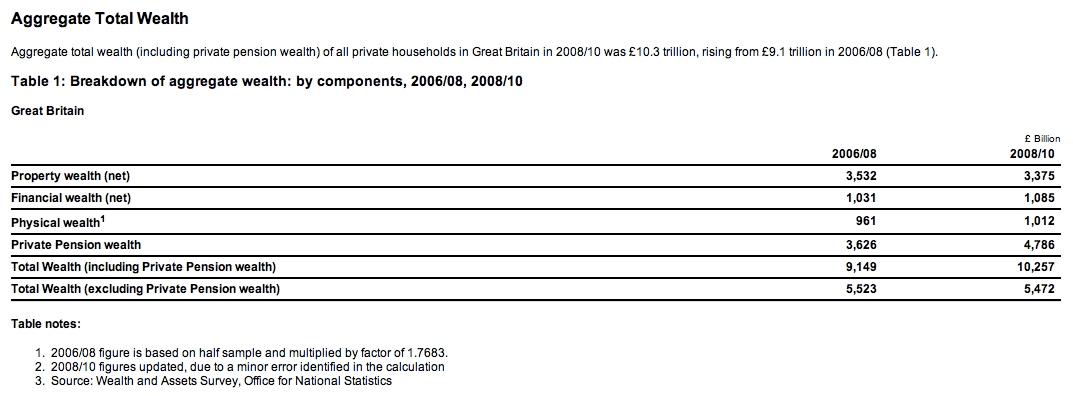
And here is the result. Aggregate total household wealth in the U.K. was £10.3 trillion (click for larger image, original report can be found here) for the most recent survey period.

Aggregate Total Wealth jpg

Interestingly, the greatest component of household wealth today is pensions rather than property (click for larger image).

Breakdown of Aggregate Wealth jpg

Risk, Sensitivity and Sifting the Studies

Global warming? How bad could it get? Of course, with all of us being knowledgable about risk, we understand that this is really a question of probability multiplied by effect (that, in turn, means probable-but-quite-bad stuff happening all the way through to possible-but-bloody-awful stuff happening).

But lets chunk that up into three manageable variables: 1) how much CO2 we are throwing up into the atmosphere, 2) how much warming that CO2 is creating, and 3) how much damage the warming is causing.

This gives anyone of a “skeptical” disposition  three lines of attack: 1) dispute the trajectory of fossil fuel emissions, 2) uncover academic papers that suggest a low climate temperature sensitivity to CO2 or 3) welcome the warmer world as being beneficial to mankind.

Out of the primeval swamp that is the blogosphere, a Darwinian struggle has led to two sites emerging triumphant (one on either side of the Atlantic) as the alpha male climate “skeptic” clearing houses. From the U.S., we have Watts Up With That, and from the U.K. Bishop’s Hill. If you read any article bashing climate change, it is a good bet that the columnist or journalist sourced it from one of these two.

Not surprising, therefore, that both blogs have jumped on an as-yet-unpublished study by Norwegian researchers stating that climate sensitivity to a doubling of CO2 is as low as 1.9 °C (see here and here).

As a non-scientist but a student of risk, I suggest a three-step approach to any claim that here is little or no risk from climate change, and I use the Norwegian study as an example of this process. Continue reading

Climate Change: the Private Sector at the Barricades

I am not a naturally pessimist person (despite the title of my blog). But when it comes to climate change, I often have a sense that mankind is sleep-walking toward a holocaust of its own making. Any optimism? Well, at the risk of clutching at straws, I am heartened by the fact that elements of the private sector have joined the fray.

So we see this call to arms, for example, in Pricewaterhouse Coopers (PWC)’s most recent Low Carbon Economy Index (LCEI) report entitled “Two late for 2 degrees?” which came out in November 2012:

Business leaders have been asking for clarity in political ambition on climate change. Now one thing is clear: businesses, governments and communities across the world need to plan for a warming world – not just 2°C, but 4°C, or even 6°C.

The vast majority of my career has been spent in the private sector: a resume peppered with representatives of capitalism red in tooth and claw: Dun & Bradstreet, Sumitomo Bank, Nomura Securities, Deutsche Bank and Henderson/Gartmore Asset Management.

For the employees of this type of global company, climate change rarely penetrates the consciousness. Continue reading

Links for Week Ending 26th of January

  • The San Francisco Chronicle has a must-read article for anyone exposed to low-lying U.S. real estate (here). 
  • On my bookshelf is a wonderfully written book by science historian and physicist Spencer Weart called the Discovery of Global Warming. Via The Big Picture, I find that The American Institute of Physics is hosting a user-friendly hypertext accompaniment to the book that tells you everything you need to know about the discovery of global warming.
  • Bjorn Lomborg is in the news again with an Op-Ed piece at the Wall Street Journal. Climate Science Watch does the debunking here. Lomborg, like Matt Ridley, appears to have open access to the Wall Street Journal’s pages. If you come to his writings with no background in the subject nor knowledge of primary sources, he appears persuasive. I must admit to having given a copy of “The Skeptical Environmentalist” to my mother as a Christmas present many years ago (before I saw the error of my ways). His arguments contain one part truthfulness, to one part falsehood to one part misrepresentation. At the end of the day, you have to rely on what mainstream climate scientists say about Lomborg’s views—which is that much of what Lomborg says is plain wrong.
  • I recently came across the Weatherdem blog. My type of blog: solid, concrete analysis coupled with a call to action. I am currently trying to get my head around the IPCC’s new Representative Concentrations Pathways (RCPs)—the CO2 emission projections commensurate with a certain level of greenhouse gas warming; Weatherdem has a good post explaining the emission paths here.
  • The two Bretton Woods institutions have been missing in action when it comes to climate change. Fortunately, one now “gets it”. The World Bank’s “Turn Down the Heat” report released in November 2012 is a watershed. Even more encouraging is that the president of the World Bank Jim Young Kim has thrown his authority behind the awareness raising. This article by him in the Washington Post could not be more clear. And it’s personal: ‘My wife and I have two sons, ages 12 and 3. When they grow old, this could be the world they inherit. That thought alone makes me want to be part of a global movement that acts now.” Bravo. Now if only the IMF could get on board (it’s current coverage of climate risk is desultory).

Bob Dudley of BP and Denial

Last week saw the publication of BP’s Energy Outlook 2030. This is one of the troika of reports that peer into the future world of energy (and, therefore, carbon emission and concentration trajectories). The other two major forecasts are the Annual Energy Outlook issued by the U.S. Energy Information Administration (EIA) and the World Energy Outlook put out by the International Energy Agency (IEA).

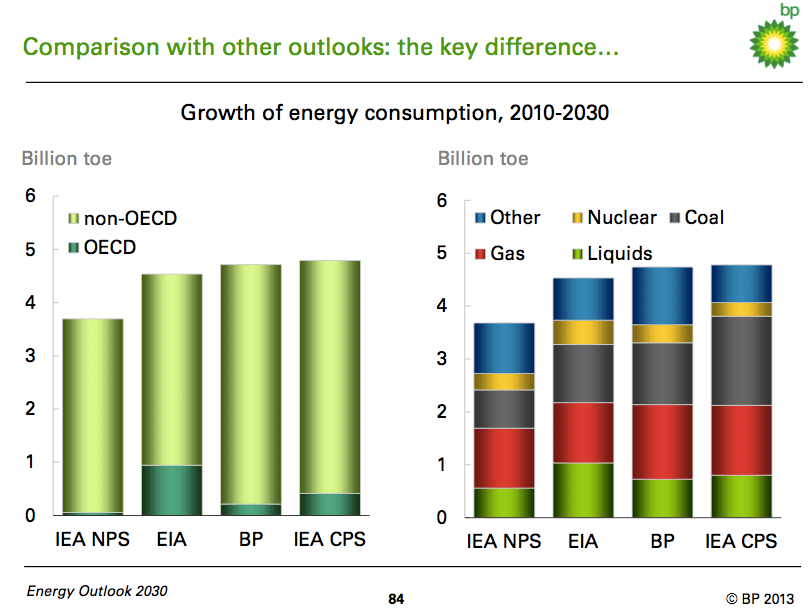
Through reading these reports, you can benchmark your thoughts as to how the world’s climate will evolve in the decades to come. All three report make depressing reading for anyone vaguely acquainted with the potential impacts from high rates of global warming. BP’s Energy Outlook provides a handy reference chart putting the central energy consumption forecast of all three organisations side by side (click for larger image):

BP Growth in Energy Consumption copy

The IEA provides two forecasts: a New Policies Scenario (NPS) that assumes governments will translate vague fossil fuel emission mitigation commitments to actual concrete policies, and a Current Policies Scenario (CPS) that is basically business as usual. The abbreviation ‘toe’ refers to tonnes of oil equivalent.

For BP, the roughly 4.5 billion toe rise in energy consumption from 2011 to 2030 is about 36% in percentage terms. Further, the increase is dominated by fossil fuels as can be seen the chart below (click for larger image):

BP Energy Consumption Outlook jpg

What key message does BP’s CEO Bob Dudley want to communicate within his introduction to the report: Continue reading