Category Archives: Peak Oil

Data Watch: US and Global Crude Oil Monthly Production November Releases

On November 27th, the U.S. government agency The Energy Information Administration (EIA) announced provisional U.S. crude oil production figures for September 2013. Key points:

  • September crude oil production was 233.8 million barrels, equivalent to 7.8 million barrels per day (bpd)
  • Change over September 2012 on a barrel-per-day basis: +18.6% y/y
  • September total crude oil plus natural gas liquids reached 315.0 million barrels, equivalent to 10.5 bpd

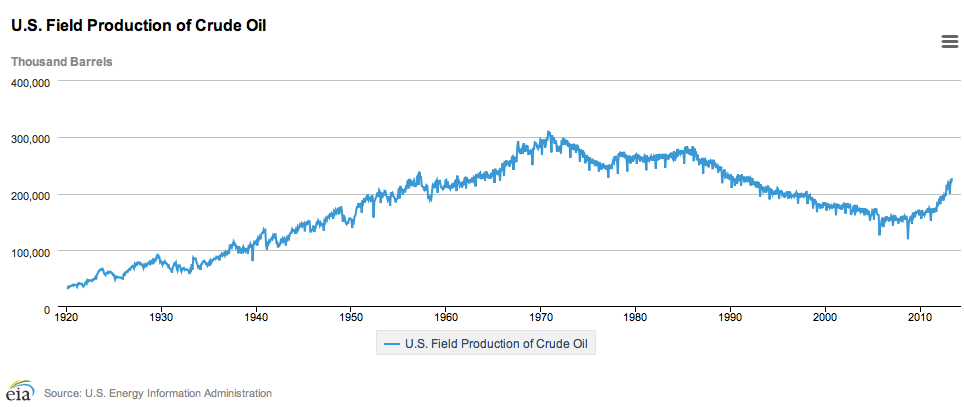
As can be seen from the chart below (click for larger image, link to original data here), the fracking of tight oil formations in the U.S. has made a major impact on U.S. crude production over the last few years. The critical question is whether the current large year-on-year percentage growth rates in oil production can be sustained. On the current trajectory, the US is set see production pass its peak of the 1970s.
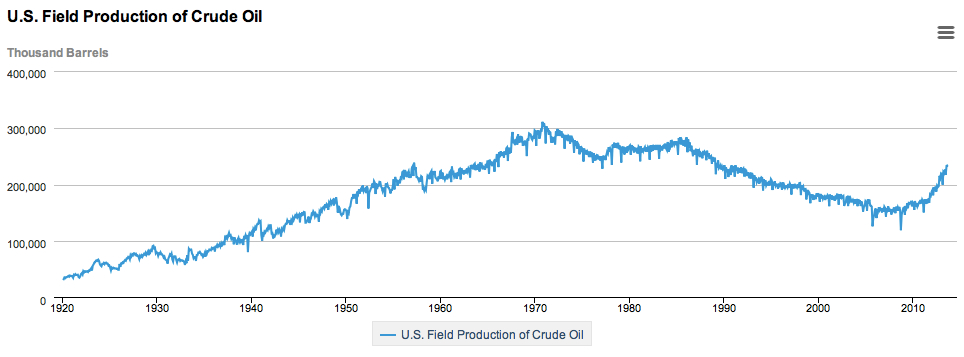
US Field Production of Crude Oil jpeg

Growth rates for both crude oil production by itself and crude plus natural gas liquids remain robust, continuing to track in the high teens. The situation for oil is in marked contrast to that of U.S. natural gas, where production growth has stopped.

The differentiator here is price. Both tight gas and tight oil are expensive to produce compared with the conventional alternatives. Accordingly, production investment requires a high product price to remain feasible. U.S. natural gas prices are down roughly by half from their average level in the 2005 to 2008 period (removing the temporary 2008 spike). By contrast, the price of West Texas Intermediate, the U.S. benchmark oil price, remains near all-time highs (again excluding the very short-term 2008 spike).

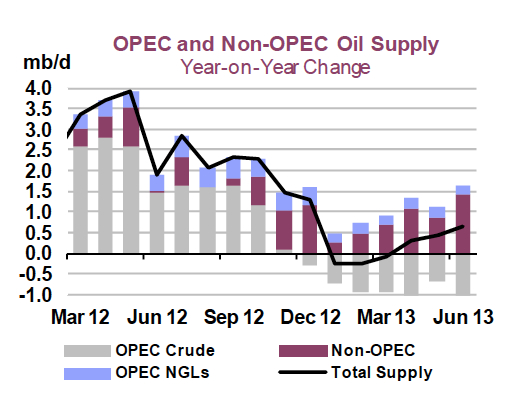
Given crude oil is a globally traded commodity, U.S. production numbers need to be placed in the context of world supply and demand. In its latest Oil Market Report dated 14 November 2013, the International Energy Agency (IEA) recorded global ‘all liquids’ production of 91.8 million bpd for October 2013.

OPEC and Non-OPEC Oil Supply jpeg

Full quarterly IEA world supply-and-demand figures, including Q3 2013 supply estimates, can be found here.

Prices have eased in recent weeks after the threat of a military strike against Syria was removed. Moreover, the detente between the US and Iran has also opened up the prospect of more Iranian crude coming on to global markets in 2014.

The Red Queen, Rigs and Shale Gas

“Well, in our country,” said Alice, still panting a little, “you’d generally get to somewhere else — if you run very fast for a long time, as we’ve been doing.”

“A slow sort of country!” said the Queen. “Now, here, you see, it takes all the running you can do, to keep in the same place. If you want to get somewhere else, you must run at least twice as fast as that!” 

Lewis Carroll’s “Through the Looking Glass” captures the challenges of shale gas production well: technology must advance ever faster purely in order for production to stand still. Why? Because you are for ever depleting relatively easy-to-exploit resources and replacing them with ever more difficult-to-exploit resources. Yet the US government’s Energy Information Agency says we will run faster. Here is their long-term forecast from the Annual Energy Outlook 2013.

Nat Gas Production 2040 jpeg

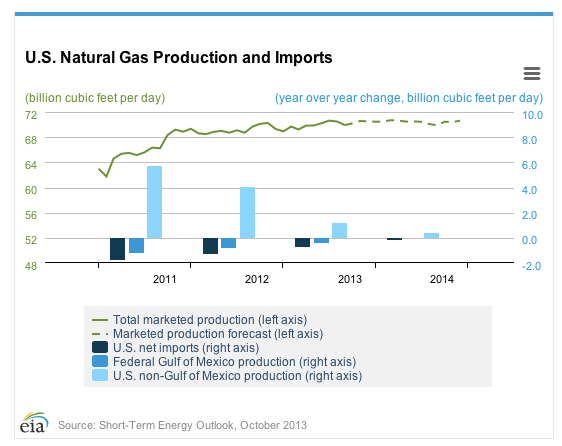
But notice that  the EIA sees production moving sideways for a few years. From their Short-Term Outlook:

US Natural Gas Production Oct 13 jpeg

I’ve reproduced these charts before, but a couple of weeks ago the EIA produced a fascinating report (composed of charts but no text) showing production of new and legacy shale gas wells. It also covered tight oil but I wish to leave that discussion to another time. Now the shale gas producing areas have entered the business lexicon if you ever read the financial press, but as an aide-memoire here they are geographically (click for larger image): Continue reading

Data Watch: US and Global Crude Oil Monthly Production

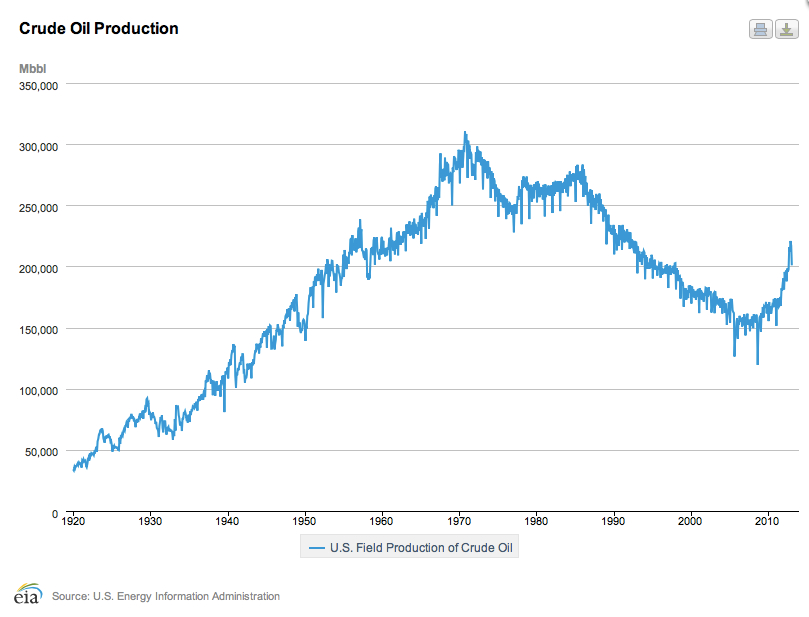
On July 30th, the U.S. government agency The Energy Information Administration (EIA) announced provisional U.S. crude oil production figures for May 2013. Key points:

  • May crude oil production was 226.8 million barrels, equivalent to 7.3 million barrels per day (bpd)
  • Change over May 2012 on a barrel-per-day basis: +15.4% y/y
  • May total crude oil plus natural gas liquids 303.6 million barrels, equivalent to 9.8 bpd

As can be seen from the chart below (click for larger image, link to original data here), the fracking of tight oil formations in the U.S. has made a major impact on U.S. crude production. The critical question is whether the current large year-on-year percentage growth rates in oil production can be sustained.

US Field Production of Crude Oil to May 2013 jpeg

The year-on-year increase in production peaked in October 2012 at 18.2%, but currently year-on-year oil production gains remain robust, with mid-teen growth rates being recorded. The situation for oil is in marked contrast to that of U.S. natural gas, where production growth has stopped.

The differentiator here is price. Both tight gas and tight oil are expensive to produce compared with the conventional alternatives. Accordingly, production investment requires a high product price to remain feasible. U.S. natural gas prices are down roughly by half from their average level in the 2005 to 2008 period (removing the temporary 2008 spike). By contrast, the price of West Texas Intermediate, the U.S. benchmark oil price, remains near all-time highs (again excluding the very short-term 2008 spike).

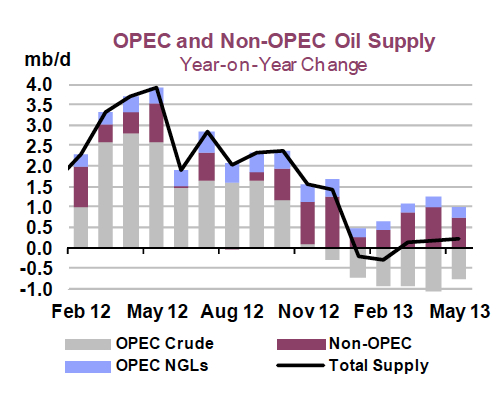
Given crude oil is a globally traded commodity, U.S. production numbers need to be placed in the context of world supply and demand. In its latest Oil Market Report dated 11 July 2013, the International Energy Agency (IEA) recorded global ‘all liquids’ production of 91.2 million bpd for June 2013, down 0.3 million pbd from the previous month.

IEA Oil Supply June 2013 jpeg

Full quarterly IEA world supply-and-demand figures, including Q2 2013 estimates, can be found here. The preliminary estimate for Q2 2013, shows a 0.5% rise over Q2 2012. The lacklustre increase in supply accounts for why world oil prices remain strong despite a slowdown in global GDP growth.

Data Watch: US Natural Gas Monthly Production May 2013

The U.S. government agency The Energy Information Administration (EIA) issues data on U.S. natural gas production, including shale gas, on a monthly basis with a lag of roughly two months. The latest data release was made on July 31 and covers the period up until end May 2013.

Data is reported in billion cubic feet (bcf). Key points:

  • May 2013 natural gas dry production: 2,051 bcf, plus 0.8% year-on-year
  • Average monthly production for the 12 months to May 2013: 2,006 bcf, +1.9% over the same period the previous year

Since the end of 2011, the rate of production increase has rapidly decreased (click chart below for larger image) and on current trend should go negative over the next few months.

US Dry Gas Production May 2013 jpeg

Much recent media attention has centred on a so-called shale-gas revolution in the United States and, in particular, the ability of shale gas to boost overall volume of natural gas production. Many claims are made with respect to the prospective expansion in shale gas production in the coming years including the following:
  • Shale gas will provide a low-cost source of natural gas, and thus cheap energy, for decades to come. This, in turn, will boost the competitiveness of the U.S. economy.
  • The U.S. will move toward an era of energy self-sufficiency, which will help buttress the country’s geopolitical security.
  • The scale of shale gas production will be sufficient to allow the U.S. to commence natural gas exports, thus transforming energy markets outside of the U.S. such as those in Europe.
  • Increased natural gas production in the U.S. will mitigate carbon emissions through displacing coal and so reduce the risk of dangerous climate change.

I have blogged extensively on these claims (some repeated by President Obama) here, here, here and here.

For these claims to be substantiated, significant year-on-year rises in U.S. natural  gas production will be required over an extended period. Through tracking monthly production of natural gas, a non-specialist can confirm or refute whether large rises in natural gas production are being achieved and, therefore, whether the claims associated with a shale-gas revolution are credible. In short, the monthly numbers allow you to evaluate the hype. Monthly data are currently not showing any material increase in production.

Links for the Week Ending 21st July

  • Lots of commentary on whether the bankruptcy of Detroit is emblematic of a post-industrial, post-growth world, or just an exception. This blog post by Juan Cole (via Stuart Staniford’s Early Warning) delves far deeper than most.
  • And from a very different perspective, Raghuram Rajan, who wrote the wonderful book Fault Lines, continues to ask some probing questions as to why we continue to need financial repression by the the central banks to underpin what little growth we have—and where this could all lead.
  • Forbes has been gleefully dancing on the grave of The Oil Drum (here). Of course, they fail to reference the fact that oil prices have remained remarkably high despite a significant slowdown in global growth and that all Daniel Yergin’s predictions (Yergin being the cheerleader for the cornucopians) have been wrong. Like climate change, resource depletion in the form of peak oil is something people have grown bored with. Unfortunately, just because you get bored with something, it doesn’t mean it goes away (as a final post in The Oil Drum points out).
  • Having brought up climate change, it is worth directing you to the World Meteorological Office (WMO)’s state of play for the decade 2001-2010. No sign of climate change going away here. And we have had a record turnaround in this year’s snow and ice melt after a slow start. At this time of year, I check Arctic sea ice extent daily (here) to see how our dying canary is doing.
  • Meanwhile, the wilfully ignorant continue to buy real estate in Miami, which is likely to be the first major advanced city to be lost to climate change. An excellent article in Rolling Stone details the city’s fate here. And no, just because this is likely to happen decades in the future doesn’t mean current prices won’t be impacted. We just need a couple of climate-induced hurricane hits to change the valuation metric from free hold to lease hold as the market suddenly realises that all real estate in the city will ultimately be worth zero at some future date.

Data Watch: US and Global Crude Oil Monthly Production

On June 27th, the U.S. government agency The Energy Information Administration (EIA) announced provisional crude oil production figures for April 2013. Key points:

  • April crude oil production 220.6 million barrels, equivalent to 7.4 million barrels per day (bpd)
  • Change over April 2012 on a barrel-per-day basis: +16.9% y/y
  • April total crude oil plus natural gas liquids 294.6 million barrels, equivalent to 9.8 bpd

As can be seen from the chart below (click for larger image, link to original data here), the fracking of tight oil formations in the U.S. has made a major impact on U.S. crude production. The critical question is whether the current large year-on-year percentage growth rates in oil production can be sustained (click for larger image). The year-on-year increase in production peaked in October 2012 at 18.2%, but April 2013 also recorded a very strong 16.9% year-on-year jump. Currently, year-on-year oil production gains remain robust, in contrast with U.S. natural gas trends.

U.S. Crude Oil Production jpeg

Given crude oil is a globally traded commodity, U.S. production numbers need to be placed in the context of world supply and demand. In its latest Oil Market Report dated 12 June 2013, the International Energy Agency (IEA) recorded global ‘all liquids’ production of 91.3 million bpd for May 2013, down marginally from the previous month, but up 0.2 million bpd over May 2012. The June 2013 Oil Market Report can be found here.

OPEC & Non-OPEC Supply May 2013 jpeg

Full quarterly IEA world supply-and-demand figures, including Q3 2013 estimates, can be found here.

Data Watch: US Natural Gas Monthly Production April 2013

The U.S. government agency The Energy Information Administration (EIA) issues data on U.S. natural gas production, including shale gas, on a monthly basis with a lag of roughly two months. The latest data release was made on June 28 and covers the period up until April 2013.

Data is reported in billion cubic feet (bcf). Key points:

  • April 2013 natural gas dry production: 1,985 bcf,  plus 1.1% year-on-year
  • Average monthly production for the 12 months to April 2013: 2,003 bcf, +2.2% over the same period the previous year

Since the end of 2011, the rate of production increase has levelled off (click chart below for larger image), and the 12-month moving average continues to decline.

US Dry Gas Production April 13 jpeg

Much recent media attention has centred on a so-called shale-gas revolution in the United States and, in particular, the ability of shale gas to boost overall volume of natural gas production. Many claims are made with respect to the prospective expansion in shale gas production in the coming years including the following:
  • Shale gas will provide a low-cost source of natural gas, and thus cheap energy, for decades to come. This, in turn, will boost the competitiveness of the U.S. economy.
  • The U.S. will move toward an era of energy self-sufficiency, which will help buttress the country’s geopolitical security.
  • The scale of shale gas production will be sufficient to allow the U.S. to commence natural gas exports, thus transforming energy markets outside of the U.S. such as those in Europe.
  • Increased natural gas production in the U.S. will mitigate carbon emissions through displacing coal and so reduce the risk of dangerous climate change.

For these claims to be substantiated, significant year-on-year rises in U.S. natural  gas production will be required over an extended period. Through tracking monthly production of natural gas, a non-specialist can confirm or refute whether large rises in natural gas production are being achieved and, therefore, whether the claims associated with a shale-gas revolution are credible. In short, the monthly numbers allow you to evaluate the hype. Monthly data are currently not showing any material increase in production.

Data Watch: US Natural Gas Monthly Production March 2013

The U.S. government agency The Energy Information Administration (EIA) issues data on U.S. natural gas production, including shale gas, on a monthly basis with a lag of roughly two months. The latest data release was made on May 31 and covers the period up until March 2013.

Data is reported in billion cubic feet (bcf). Key points:

  • March 2013 natural gas dry production: 2,037 bcf,  plus 1.0% year-on-year
  • Average monthly production for the 12 months to March 2013: 2,003 bcf, +2.5% over the same period the previous year

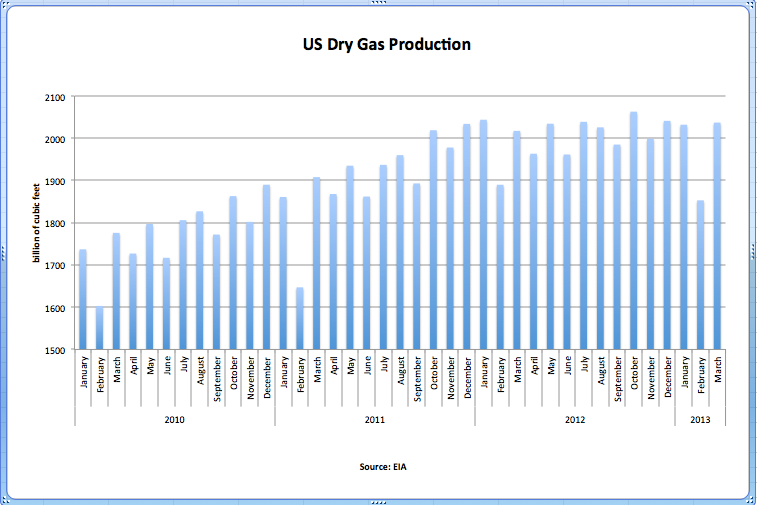
Since the end of 2011, the rate of production increase has levelled off (click chart below for larger image); March saw the year-on-year growth rate move back into positive territory (keeping in mind that negative number in February was distorted by the leap year in 2012), but the 12-month moving average growth rates continues to decline.

US Natural Gas Production March 2013 jpeg

Much recent media attention has centred on a so-called shale-gas revolution in the United States and, in particular, the ability of shale gas to boost overall volume of natural gas production. Many claims are made with respect to the prospective expansion in shale gas production in the coming years including the following:
  • Shale gas will provide a low-cost source of natural gas, and thus cheap energy, for decades to come. This, in turn, will boost the competitiveness of the U.S. economy.
  • The U.S. will move toward an era of energy self-sufficiency, which will help buttress the country’s geopolitical security.
  • The scale of shale gas production will be sufficient to allow the U.S. to commence natural gas exports, thus transforming energy markets outside of the U.S. such as those in Europe.
  • Increased natural gas production in the U.S. will mitigate carbon emissions through displacing coal and so reduce the risk of dangerous climate change.

For these claims to be substantiated, significant year-on-year rises in U.S. natural  gas production will be required over an extended period. Through tracking monthly production of natural gas, a non-specialist can confirm or refute whether large rises in natural gas production are being achieved and, therefore, whether the claims associated with a shale-gas revolution are credible. In short, the monthly numbers allow you to evaluate the hype. Monthly data are currently not showing any material increase in production.

More Gas Out There (But at What Price?)

The important biennial assessment of United States natural gas resources was released last month by the Potential Gas Committee, a grouping of 145 volunteer specialists in the natural gas field. The press release for the report can be found here and the accompanying slides here.

The report always attracts a lot of erroneous claims that the United States has 100-years of natural gas; indeed, President Obama repeated the same mistake in his State of the Union address that I previously blogged on here. The report is principally concerned with “technically recoverable natural gas resources”; that is, those gas resources that can be recovered if price was not an issue. To quote directly from the press release:

Dr. Curtis cautioned, however, that the current assessment assumes neither a time schedule nor a specific market price for the discovery and production of future gas supply. “Assessments of the Potential Gas Committee represent our best understanding of the geological endowment of the technically recoverable natural gas resource of the United States,” he explained.

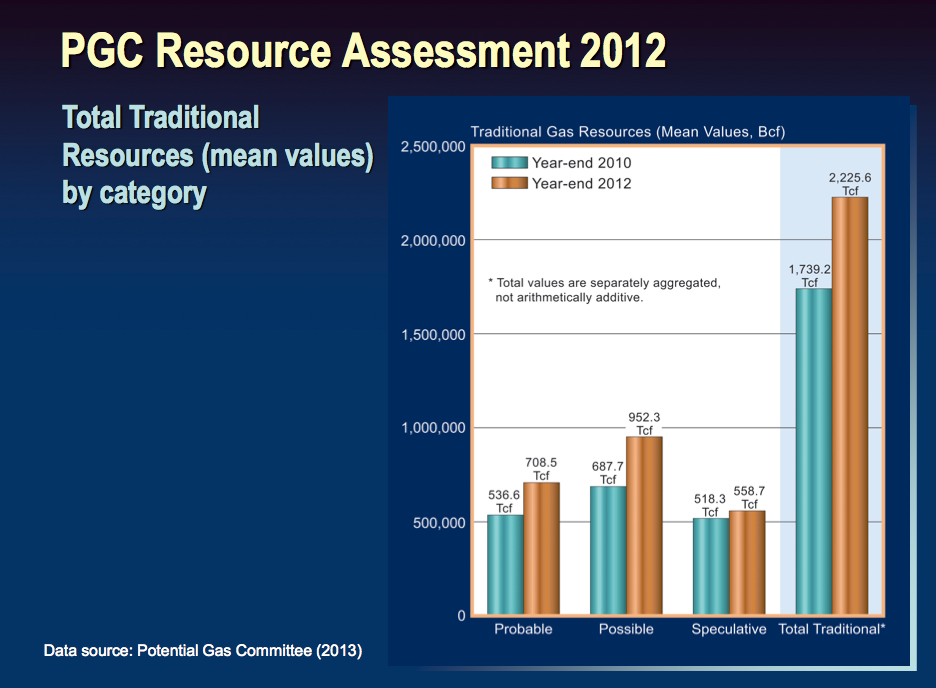
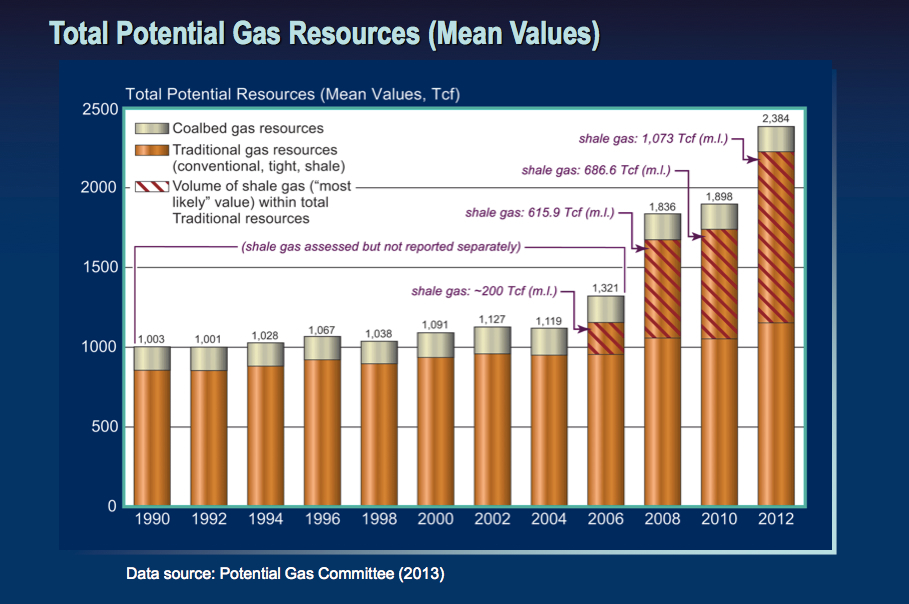
Keeping this caveat in mind, fracking technology has nonetheless led to a boom in gas prospecting, which is clearly visible in the recent uptrend in natural gas resources stated in consecutive biennial reports (click for larger image):

Total Potential Gas Reserves 2013 jpeg

The 2,226 trillion cubic feet of traditional gas resources (traditional by their definition includes shale gas) compares with 305 tcf of proved reserves as published by the Energy Information Administration (EIA).

Natural Gas Assessment 2013 jpeg

The EIA’s proved reserves of  crude oil, natural gas liquids and natural gas can be found here (latest figures are for 2010); moreover, the 305 tcf is for dry natural gas and can be found in this EIA table here. Proved reserves (as opposed to resources) are those known gas reservoirs from which gas can be extracted at existing prices, technology and infrastructure. To put these numbers in context, the U.S. consumed 25.5 tcf in 2012, so proved reserves are sufficient for 12 years of consumption.

Of the three resource categories—probably, possible and speculative—probable resources are equivalent to 28  years of 2012 equivalent consumption. A more thorough treatment of the assessment methodology and category definitions can be found in this this appendix to the MIT 2001 interdisciplinary report entitled “The Future of Natural Gas” which is well worth reading and can be found here.

Resource Assessment by Category jpeg

The migration of speculative, possible and probable resource toward, or into, proved reserve is dependent on two main variables: price and technology. A rising price may move some possible resources into proved reserves, but it may also reduce the competitiveness of natural gas vis a vis coal and renewables and ultimately stymie economic growth. Accordingly, any commentary within the media claiming that fracking technology has removed the energy constraint on the U.S. economy should be taken with a pinch of salt.

Data Watch: US Natural Gas Monthly Production February 2013

The U.S. government agency The Energy Information Administration (EIA) issues data on U.S. natural gas production, including shale gas, on a monthly basis with a lag of roughly two months. The latest data release was made on April 30 and covers the period up until February 2013.

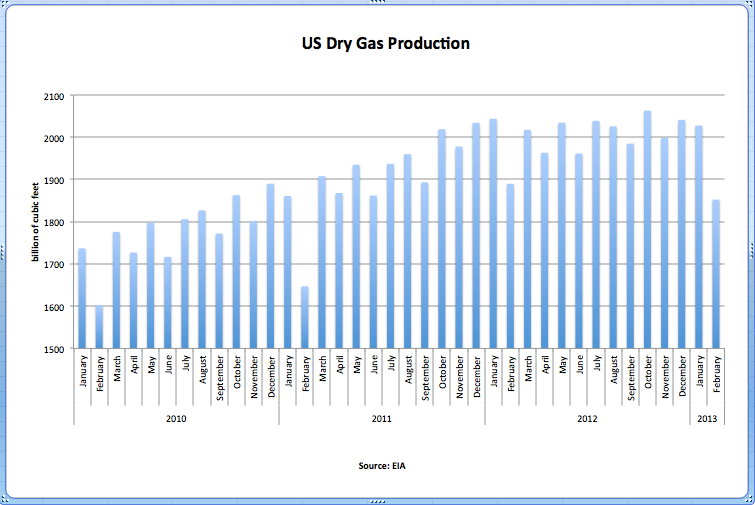
Data is reported in billion cubic feet (bcf). Key points:

  • February 2013 natural gas dry production: 1,852 bcf,  –2.0% year-on-year
  • Average monthly production for the 12 months to February 2013: 2,001 bcf, +2.9% over the same period the previous year

Since the end of 2011, the rate of production increase has levelled off (click chart below for larger image); for the most recent two months of data, we have seen year-on-year declines.

US Dry Gas Production Feb 2013 jpeg

Much recent media attention has centred on a so-called shale-gas revolution in the United States and, in particular, the ability of shale gas to boost overall volume of natural gas production. Many claims are made with respect to the prospective expansion in shale gas production in the coming years including the following:

  • Shale gas will provide a low-cost source of natural gas, and thus cheap energy, for decades to come. This, in turn, will boost the competitiveness of the U.S. economy.
  • The U.S. will move toward an era of energy self-sufficiency, which will help buttress the country’s geopolitical security.
  • The scale of shale gas production will be sufficient to allow the U.S. to commence natural gas exports, thus transforming energy markets outside of the U.S. such as those in Europe.
  • Increased natural gas production in the U.S. will mitigate carbon emissions through displacing coal and so reduce the risk of dangerous climate change.

For these claims to be substantiated, significant year-on-year rises in U.S. natural  gas production will be required over an extended period. Through tracking monthly production of natural gas, a non-specialist can confirm or refute whether large rises in natural gas production are being achieved and, therefore, whether the claims associated with a shale-gas revolution are credible. In short, the monthly numbers allow you to evaluate the hype. Monthly data are currently not showing any increase in production.