Category Archives: Post Growth

Hiding from the Computers Part 1: The 47%

A rather dismal chart to kick off the New Year (click for larger image):

Probability of Computerisation jpeg

It’s taken from a paper by Frey and Osborne of Oxford University entitled “The Future of Employment: How Susceptible Are Jobs to Computerisation?”.

Let’s break this chart down. The total area under the curve is equivalent to aggregate US employment. The bottom x axis is the probability that any given job will be computerised: it ranges from zero, no chance of computerisation, to 1, a 100% chance of computerisation. Further, the authors have lumped these probabilities into three broad categories: 1) low probability, zero to 30% change of computerisation, 2) medium, 30% to 70% chance and 3) high, 70% to 100% chance.

So if you are doing a job in the high probability category, there is a high risk that your job will disappear over the course of time. How many people are in this category. Kindly they give the rather shocking number: 47%. Conversely, around 33% of the working population sit in the low probability category and can sleep easily at night for a little while longer.

Now the eagle-eyed will have noticed that there are no dates given in the chart over which the rise of the computers will take place. This is because the authors have looked at the problem as engineers, disassembling jobs into their component parts to decide which bits can be replaced by computers and which can’t. They don’t try to predict when the technology will reach the necessary maturity. In their words:

According to our estimate, 47 percent of total US employment is in the high risk category, meaning that associated occupations are potentially automatable over some unspecified number of years, perhaps a decade or two. It should be note that the probability axis can be seen as a rough timeline, where high probability occupations are likely to be submitted by computer capital relatively soon.

So, accordingly to their guestimate, computers will munch through the job market—moving from right to left in the chart—arriving in the medium probability category some time around 2030.You can also see where you don’t want to be; for example, the yellow band ‘production’ stinks along with orange ‘office and administration support’.

To arrive at this chart, the authors looked at 702 occupations and analysed them with respect to how susceptible each one was to computerisation. Computerisation here is taken in the broad sense to include machine learning, artificial intelligence and mobile robotics. To do so, they identified cognitive and non-cognitive bottle necks to computerisation and used these as variable to predict the order and extent of future computerisation. The bottleneck variables are given below:

O Net Variable Jan 14 jpeg

Further, a bottleneck such as manual dexterity could be classed as low, such as fitting a light bulb, to high, as for example performing open heart surgery.

Overall, the paper’s analysis suggests that the job market, as we know it, will be blown up over the next two decades, along with all our economic assumptions. Yet I hear not one politician talking about this risk. I will return to this subject in my next post.

The UK’s Bittersweet Recovery

Tom Dolphin, senior economist at the Institute for Public Policy Research, has a Briefing Paper out on the UK’s unbalanced economy which contains a number of charts that give pause for thought.

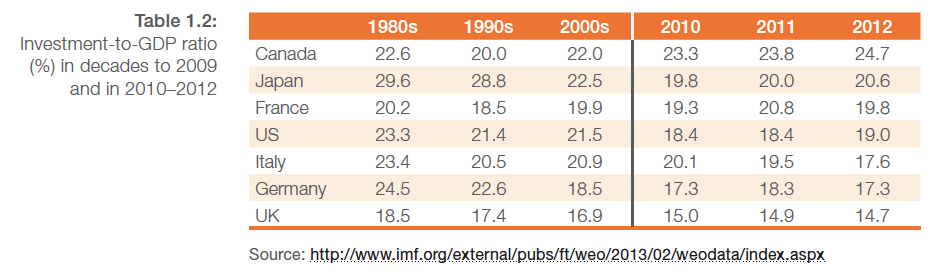
His thesis is that the UK is experiencing the wrong type of growth: growth that is both unsustainable and ‘bittersweet’ in the sense that it benefits only a small portion of Britain’s population. He is particularly concerned over the UK’s dire track record with respect to investment as evidenced by the chart below (click for larger image):

IPPR Dec 13 Investment-to-GDP Ratio jpeg

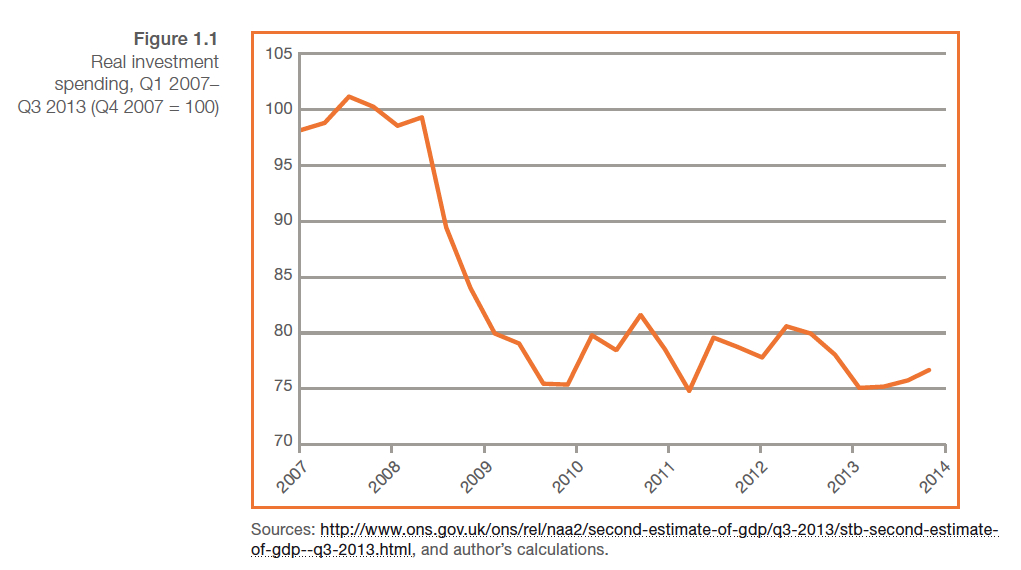
In short, as a percentage of GDP, UK investment has trailed, and continues to trail, all its advanced-country peers. Moreover, since the Great Recession, investment has been moribund despite George Osborne unveiling of the “march of the makers” in his 2011 budget (click for larger image).

IPPR Dec 13 Real Investment Spending jpeg

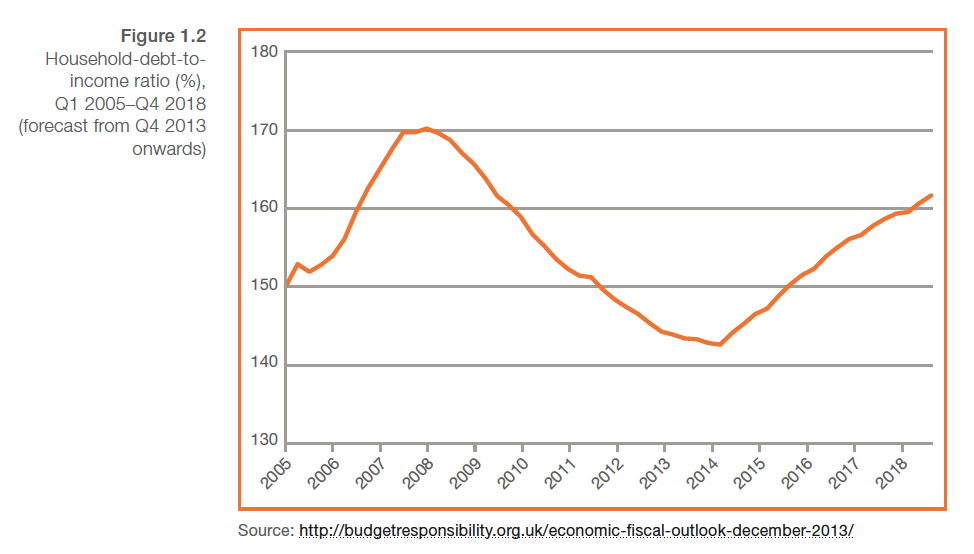
With an election looming, Dolphin believes that the coalition has been forced to stoke up a housing led consumption boom, through such measures as Buy to Let, in order to buttress growth. Accordingly, UK households are leveraging themselves up again to levels not seen since before the crisis (click for larger image):

IPPR Dec 13 Houshold Debt jpeg

Dolphin doesn’t mention the Bank of England’s role in stoking up a new housing bubble, but nonetheless I believe he is correct in terming the recovery ‘bittersweet’ and blaming the government for not carrying through more forward-thinking policies.

Indeed, households are experiencing stagnant or declining real incomes yet are piling on debt back again; the current account deficit remains entrenched, creating the need to finance it by selling off assets to foreigners (most ownership of central London prime housing appears to have already gone abroad); employment has declined but is still far higher than before the crisis; and the new jobs are far more insecure and carry less benefits than those that disappeared in the Great Depression. Welcome to the new normal.

The Haves and the Have Nots

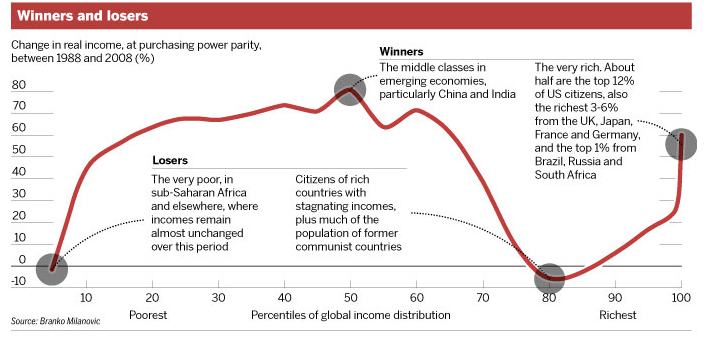
Since I have recently been struggling to find the time for longer posts, I thought it worthwhile to occasionally do a short post on a chart that caught my eye. And here is one taken from an article in The Financial Times by John Gapper (click for larger image):

Winners and losers jpeg

As an aside, the chart is taken from the work of Branko Milanovic, an economist with the World Bank. Branko is one of the world’s leading authorities on global inequality and recently wrote the wonderful book “The Haves and Have Nots“, which I highly recommend.

The chart captures the winners and losers from globalisation and the spread of neoliberal economic thought. For those living in the advanced Western democracies, globalisation over the last two decades or so—which rather simplistically can be reduced to the entry of China and India into the free market capitalist system—has been a mixed bag of benefits. A small minority have seen their income and wealth explode, but the majority have experienced stagnating incomes and far more job insecurity (and for that matter health, pension and education insecurity as well).

Yet the neoliberal claim that globalisation in aggregate is a good thing is undoubtedly true—up to now. Even through the Great Recession started in 2008, global GDP kept motoring along at around 3% on the back of super-charged growth in developing countries led by China. This had continued a trend that stretches back to the rise of the Asian Tigers and the waking of China with Deng Xiaoping’s reforms in the late 70s. And the wealth has not just stuck to a small elite, but has also trickled down to produce an emergent middle class. It is this middle class that occupies the middle hump of the chart above: a hump that has seen its real income rise by 80% between 1988 and 2008.

I often feel the need to add the caveat that GDP and real income growth are not directly translatable into happiness. Nonetheless, they are strong determinants of happiness according to survey data, especially when growth is coming off low levels. Moreover, levels of income and wealth in China and India in the 1960s and the greater part of the 1970s frequently coincided with famine, TV images of which I can still remember from my childhood. Basically, the starving and impoverished aren’t happy. So globalisation has undoubtedly, in aggregate, increased the stock of human happiness.

That is the good news. The bad news is that the technology revolution that allowed globalisation to take place—through, for example, the management of long and complex supply chains and outsourcing abroad—is progressing apace. The same technology trend that destroyed well-paid manufacturing jobs in advanced economies is now replacing workers carrying out similar jobs in developing economies.

Imagine a large technology-driven jackboot crushing the hump in the chart above. That is my forecast for the coming decades unless we move beyond the global neoliberal consensus.

Links for the Week Ending 28 December

Apologies for my absence, but I have been super busy over the holiday period.

  • Liam Halligan in The Daily Telegraph explains why oil prices will likely remain high in 2014. It’s a well-worn story in this blog, but Halligan provides a nice recap on the disappearance of “easy oil”. In his words: “The ‘upstream’ oil industry capital expenditure has risen, in constant dollars, from $250bn in 2000 to $700bn last year – almost a threefold increase. Over the same period, global oil supply rose just 14%.” In sum, shale oil is no free lunch.
  • Staying with The Telegraph, Ambrose Evans-Pritchard gives praise where praise is due with respect to the Fed and QE. I still think that the uber-aggressive version of QE we have witnessed in the US will only be vindicated once it is unwound. The imbalances it is causing are many, but they have manifested themselves in asset inflation not generalised inflation. Nonetheless, with both structural reform and active fiscal policy missing in action during the Great Recession, it was left to the Fed to stop the sky from falling down—which is what the Fed did, so all kudos to them. The next question is: can the US growth without QE? We shall see.
  • Being ‘poorer than your parents’ is  a hot topic on both sides of the Atlantic. Bloomberg has a lovely article comparing a dad and a daughter, but the statistics on US savings and pensions levels are what shocked me most. How will those boomers live through retirement with that amount of money?
  • Over the pond (and less anecdotal), the Institute for Fiscal Studies (IFS) has just published a report looking at the economic circumstances of different cohorts born from the 1940s to 1970s. Conclusion: for the middle-aged, you have little chance of matching your parents prosperity in your later years unless you can nail down a significant inheritance. If you don’t want to read the whole report, you can see a good synopsis in The Guardian here, but almost all the UK national press, whether from the left or right, reported on the IFS study.
  • Previously in the Links, I flagged Larry Summers speech at an IMF symposium. Here he is again talking about long-term economic stagnation in The Financial Times.
  • I frequently mention the thought-provoking work of Tyler Cowen, and have just finished reading his latest book “Average Is Over“. David Brooks has a nice piece in The New York Times expanding on Cowen’s employment theme and thinking about what type of people can thrive as technology upturns the job market.
  • And last but not least, over to climate change. The Carbon Brief has a wonderful post on the five-most important climate change papers of 2013, including the key charts. Required reading for anyone who has bought into the idea that the current temperature hiatus has lowered the risk posed by climate change. But then again, such a reader would be unlikely to stray far from Watts Up with That.

Politics: One Chart to Rule Them All

If I had to choose one chart to frame the political debate in the United States it would be this (click for larger image):

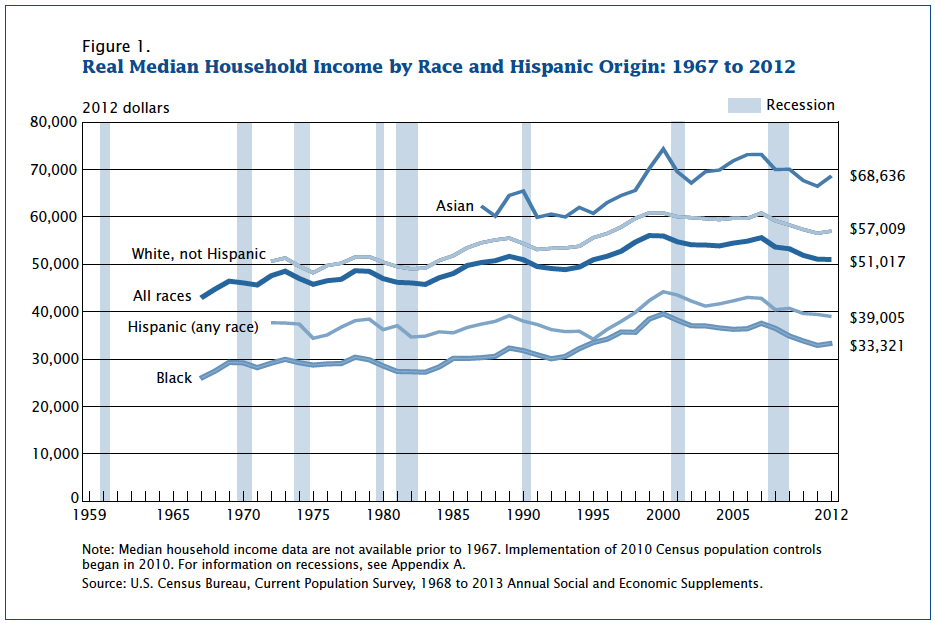
Real Median Household Income US jpeg

The chart shows the trend of real (which means inflation-adjusted) median household income since 1968. If you line up all US households in order from low income to high income, the median household sits exactly at the half-way point.

Median Income jpeg

For ‘All Races’, median incomes rose in the late 60s and early 70s, moved sideways over the two oils crises, jumped again in the 80s and 90s, stagnated in the 00s, slumped back in the Great Recession and have continued to retreat since then.

There are a myriad newspaper articles that chew over this phenomenon, but for those of a sceptical and inquiring disposition you can access the underlying data behind this chart from the U.S. Census Bureau report here. The above chart can be found on page 5 of the report, and the data underlying the chart is in Table A2 starting on page 40.

From Table A2, you can see that the median household earned $51,017 in 2012 compared with $48,557 in 1973 before the impact of the 1st oil crisis was felt (note these are all inflation-adjusted figures calibrated using 2012 as the base year: so called 2012 dollars). That’s a 5% gain over 39 years.

For the 90th percentile (that is, a high income family earning more than 90% of households), income was $104,683 in 1973, but rose to $146,000 in 2012, for a gain of 39.5%. For those at the 40th percentile, they were worse off in 2012 than 1973.

There is an Aladdin’s Cave of statistics at the back of the report, and you can get a real sense of how US incomes are being divided up between high- and low-income households.

Interestingly, the UK experience is slightly different from the US one. The Office for National Statistics (ONS) in the UK published a report on middle-income households in March of this year. The chart below (click for larger image) shows UK households have had a poor recent decade or so, but are still securing median incomes way above those of the 1970s.

UK Median Income jpeg

The report also goes on to adjust median incomes for taxation effects, so emphasising real disposable income trends rather than gross income. Further, the impact of changing households structures is also looked at by the ONS. In other words, smaller households have a higher standard of living than larger households of similar income (the same resource shared among fewer people). This is adjusted for through a process called equivalisation. Moreover, the ONS helpfully puts the UK and US experience side by side, as can be seen in the chart below (click for larger image):

Equivalised Households jpeg

US equivalised median household disposable income data are only available up until 2008, so the chart does not capture the impact of the Great Recession. Nonetheless, the lag between US median income growth and GDP per person growth is vividly illustrated—in contrast to the experience in the UK.

Unfortunately, the OECD suggest that the lag between median income gains and per capital GDP increases (suggesting that richer households are getting most of the benefit from economic growth) is showing up in the data everywhere. The US may be more extreme than the UK, but it is by no means an outlier (click for larger image, source here):

OECD Median jpeg

In conclusion, if we continue down the path of economic growth not translating into higher living standards for the majority of the population in developed countries, support for the post-war economic consensus is bound to collapse, turning politics upside-down. We live in interesting times.

Data Watch: US Natural Gas Monthly Production August 2013 and Long-Term Outlook

This month, I will take a quick look at both the natural gas (including shale) price and production forecasts of the U.S. government’s Energy Information Administration (EIA) going out to 2015 and beyond to 2040.

But first, here is the latest monthly data release made on October 31, which covers the period up until end August 2013. Data is reported in billion cubic feet (bcf) wit a two-month lag. Key points:

  • August 2013 natural gas dry production: 2,080 bcf, plus 2.7% year-on-year
  • Average monthly production for the 12 months to August 2013: 2,018 bcf, +1.3% over the same period the previous year

Since the end of 2011, the rate of production increase has rapidly decreased (click chart below for larger image).

US Dry Gas Production August 2013 jpg

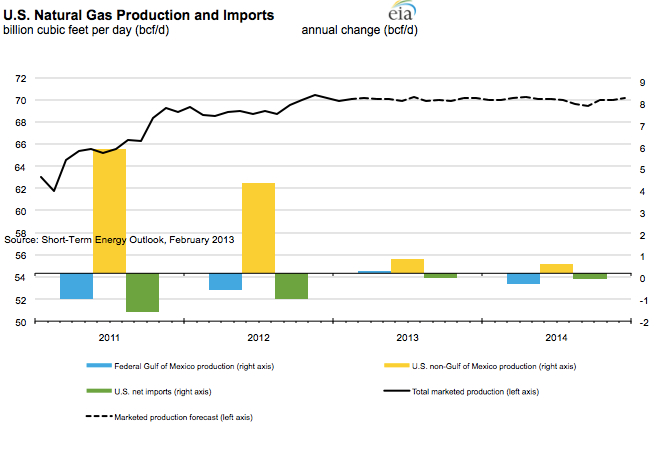
What is more, the EIA, in it’s latest Short Term Energy Outlook publication issued in October, sees no major change in production out to the end of 2014:

EIA Short Term Energy Outlook jpeg

The continuation of the status quo into the near future also applies to price, with respect to which the EIA sees only a marginal upward drift through 2014.

Nat Gas Prices Oct 13 jpeg

Going out far longer into the future, the EIA is a lot more optimistic over production growth. The EIA’s Annual Energy Outlook publication released in April 2013 sees the current hiatus in production growth ending mid-decade and steady growth thereafter. As a result, the US moves from being a net importer of natural gas to being a net exporter.

Nat Gas Production 2040 jpeg

A couple of critical caveats are in order here. First, of the 3.6 trillion cubic feet of natural gas exports forecast for 2040, the majority is predicted to be piped across the border to Mexico. LNG exports, meanwhile, are expected to commence in 2016 and grow to 1.6 trillion cubic feet by 2040.

To put this in perspective, UK LNG imports alone totalled 1 trillion cubic feet in the first six months of 2013 (see here). True, the fact that the US ceases to import natural gas frees up overseas supplies to be redirected elsewhere, but while the net change of around 5 trillion cubic feet from import to export is material, it is not a “game changer”.

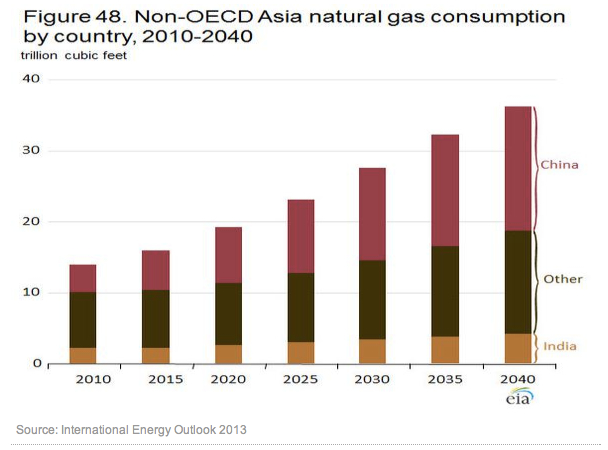
To illustrate this, the EIA sees China’s natural gas consumption expanding from 3.8 trillion cubic feet in 2010 to 17.5 trillion cubic feet in 2040, a large chunk of which will come from imports.

Nat Gas Consumption jpeg

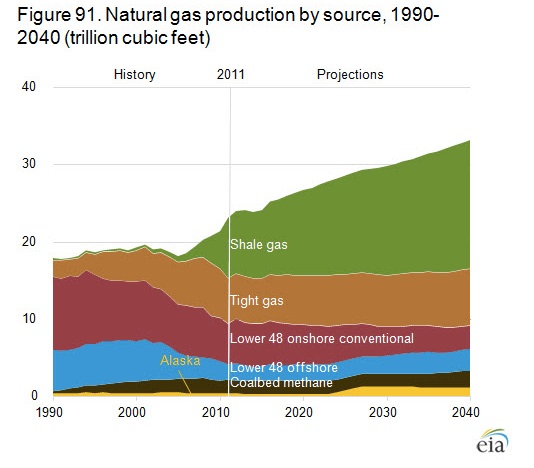
In addition, for the US production growth to materialise, the EIA realises that price has to rise. In short, the US natural gas story is one of cheap-to-produce conventional gas being replaced by expensive-to-produce shale gas.

Nat Gas Production by Type jpeg

And that can only happen if the price of gas goes up, which is what the EIA expects to happen.

Nat Gas Price 2040 jpeg

This merry and complicated dance between price and production is what led to Peter Voser, outgoing CEO of Shell, admitting to The Financial Times that the company’s investment in unconventional oil and gas production had not turned out as planned (see here). However, in order for the EIA’s forecast of a return to production growth around 2015 to come true, investments have to be made. And such investments will only be made if they are predicted to be profitable. That means either one of two things must happen: technology must bring costs down considerably or prices must go up.

As regards technology, we are in rather a ‘Red Queen’ situation in that we must run ever faster just to stand still. The reserves remaining to be exploited grow ever more complex and remote by the day. So we need technological improvements to compensate for the rising inherent costs in the difficult reserves we are next to exploit – let alone bring incremental increases in production.

Meanwhile, price rises require a robust economy. If GDP is expanding, a country can afford to apportion more expenditure to energy. If GDP growth is anaemic, it can’t. (I am putting to one side all the implications for climate change here.)

Of course, the EIA must, by its nature, sound a somewhat optimistic note with respect to the future. Further, it is true that unconventional oil and gas production jumps did stop the Great Recession morphing into a Great Depression Two. Nonetheless, the jury is still very much out over whether shale will disappoint.

The pessimistic scenario is one where we do get energy price rises as the EIA predicts but without production growth. This combination would put the global economy back into recession by decade end. Let’s see which story the incoming numbers support.

Life in a Time of Hiatus and the Off-Grid Movement

Humans aren’t very good at risk. Or rather they are good as long as the future looks a lot like the recent past. In economics, this way of looking toward the future is called “adaptive expectations“, where we change the way we look at the world only when an event comes along that jars with our original working hypothesis of how we thought things work.

For a time, the more sophisticated idea of “rational expectations” ruled the roost in economic circles (and in 1995 the economist Robert Lucas picked up a Nobel prize for his work on this idea). Lucas’ idea was that individuals discounted all known information (not just empirical evidence from the past) so accordingly their expectations over future economic variables should show no discernible bias. Partially on the back of this belief, Lucas made the following statement to the American Economic Association in 2003:

The central problem of depression-prevention has been solved, for all practical purposes, and has in fact been solved for many decades.

The statement contained two components of Lucas’ libertarian philosophy: 1) past recessions came about as a result of governments messing up and 2) private-sector actors act rationally and efficiently if left alone. And then along came the popping of countless irrational bubbles in 2009 and the subsequent Great Recession—out of which we are still struggling to emerge.

What has this got to do with the themes of this blog? Well, if we assume that the expectations of individuals are formed in an adaptive manner, then on the big questions of climate change and resource depletion, secular shifts and step changes will cause populations to consistently make bad decisions. People will cling to the past until their lives are turned upside down.

In other words, if Mark Twain was wrong, and history doesn’t repeat itself or rhyme, then we humans appear to be in trouble;  we are preprogrammed to look for rhymes and find them even when they don’t exist. We all have our life narratives—the work we do, where we live, the lives we wish ourselves and our kids to lead—and we don’t like it when this narrative is questioned.

Confirmation bias is rife in this way of thinking. If a piece of information comes along that supports the narrative, it is emphasised; if it contradicts the narrative, it is discounted. Nonetheless, if a new piece of information hits with sufficient force, it won’t be completely ignored. Or alternatively, a little bit of discomfort if continuously felt will cause us to shift our position.

Climate change, being the wicked problem that it is, fulfils neither of these conditions. The hot years of 1998 and 2009 were just not hot enough to permanently shift the narrative. And the hot years are sufficiently infrequent to allow us to forget. Mother Nature hasn’t helped by putting the globe into a La Nina-dominated phase of the ENSO cycle, thus masking the upward trend in temperature over the last few years.

The statistician Tamino, in  his excellent Open Mind blog, analyses this phenomenon in a recent post (with much of this work building on an article in Nature by Kosaka and Xie in Nature). In his words:

The influence is clear: a pronounced recent ENSO-induced cooling which has cancelled the continued global warming due to man-made CO2, leading to the “hiatus” in the increase of global temperature.

And he includes a chart that shows how much the ENSO cycle is currently subtracting from the overall warming trend:
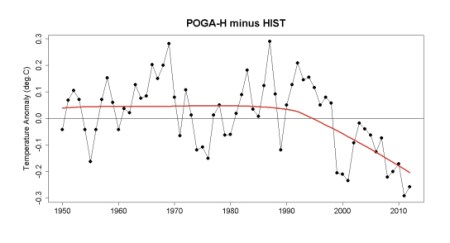
ENSO Effect on Temperature jpeg

Nonetheless, despite the fact we are living in a hiatus period of slow temperature rise, the maximum temperature records are still coming thick and fast. For a state of play, see here. My old home of Japan, for example, posted a new record of 41 degrees Celsius this summer, and new highs also came in Slovenia, Austria and Greenland. When the next strong El Nino rolls round, I expect this records page to explode. In the meantime, however, people are just bored with the unspectacular gradual saw-tooth warming path as encapsulated in Dr Roy Spencer satellite temperature anomaly chart:

UAH Global Mean Temps July 2013 jpeg

This sawtooth is typical of a stochastic process with a trend. Climate change may punch you in the face one year, but it is highly unlikely to punch you in the face two years in a row. Accordingly, all those symptoms of climate change also have a tendency to fade in and out of consciousness year by year. So in 2012, we had an extraordinary collapse in Arctic sea ice extent. And this year?
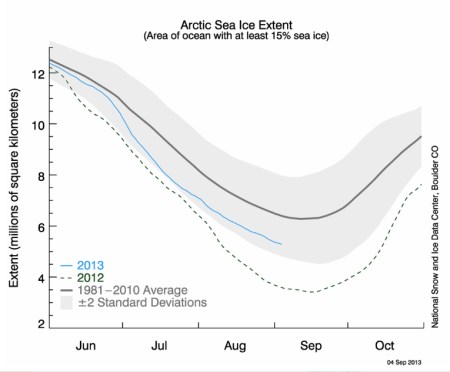
Arctic Sea Ice Extent 2013 jpeg

Of course, the downward trajectory is still intact. The average for September 2013 looks like coming in  at around 5 million square kilometres, which would put it slap bang on trend.

Aveage Monthly Arctic Sea Ice Extent September jpeg

Actually, I think the media was already bored with sea ice extent. Coverage during the shocking collapse last year was patchy at best. Sea ice extent decline can be seen as the canary in the coal mine for climate change, but few actually care that the canary is dying. In 2012, the Financial Times and Wall Street Journal devoted far more space to polar shipping route and oil and gas drilling opportunities arising from receding Arctic sea ice than the greater existential threat the phenomenon of retreating ice represented in itself.

But what about the ‘in your face’ extreme weather events that bring climate change home. When Hurricane Sandy hit at the end of October 2012, for a time climate skeptics were put on the back foot (even though scientists are loathe to attribute any one weather event to climate change). Mayor Michael Bloomberg actually cited Hurricane Sandy and climate change as a catalyst for him supporting Obama in the presidential election (here).

But weather is a fickle friend for those occupying the ramparts and calling for action over climate change, with, for example, this year’s hurricane season proving a spectacular bust; indeed, Bloomberg reports that there have been no Atlantic hurricanes reported as of 4 September. There is a while yet until the end of the hurricane season, but in reality the probability of a few Katrina or Sandy-type hurricanes hitting in quick succession—something that would make an impact on the broader populations adaptive manner of forming expectations—is low.

The same applies to deluge and drought. Both the U.K. and U.S. continue to experience ‘weird weather’. But the record droughts have broken and record floods have receded, and life has moved on. For example, last year the U.S. was gripped with severe drought and this year is still bad—but not quite so bad (click for larger image, chart source here):

Drought Severity US jpeg

Ironically, the resource depletion debate has also followed a similar trajectory. The media has grown bored and skeptics have declared victory. As is typical with such controversies, much of the sturm und drang centres around establishing a straw man in the opposing camp to attack. God forbid we go back to the original sources and read what the influential peak oil theorists of the modern era actually said. For example, here is a high profile article written by  Colin Campbell and Jean H. Laherrere  back in March 1998 for Scientific American. This is what they said:

The world is not running out of oil – at least not yet. What our society does face, and soon, is the end of the abundant and cheap oil on which all industrial nations depend.

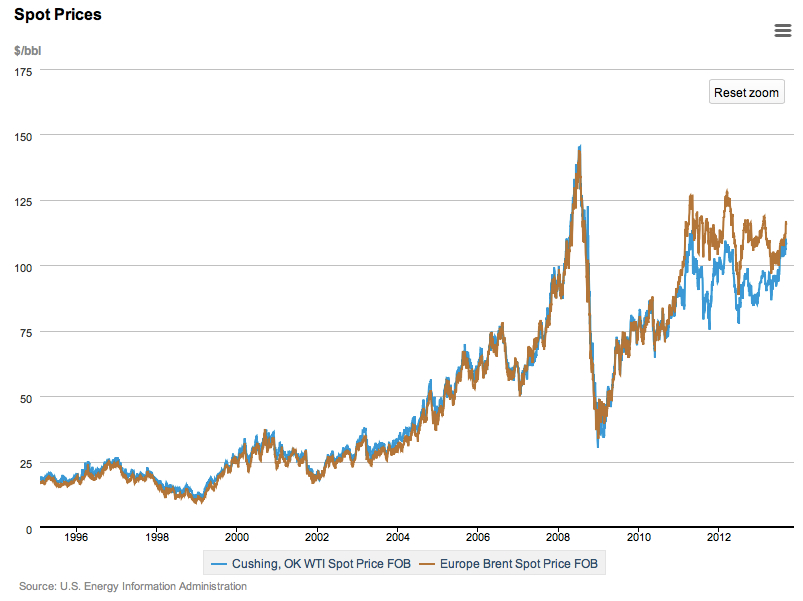
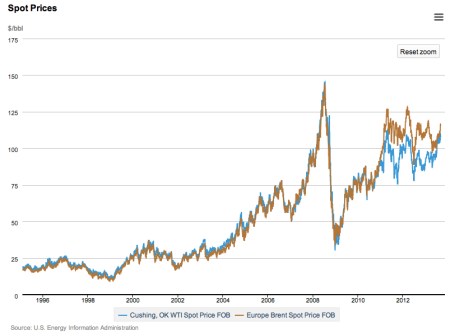
And what was the price of oil when they wrote this article? The annual average cost of crude in the U.S. in 1998 was $11 barrel (see the EIA numbers here). In short, Campbell and Laherrere came out with a big, bold call on rising oil prices in March 1998, and they were absolutely right.
Spot Oil Prices jpeg

Moreover, from the graph above it is difficult to detect any softening of the oil price in recent years. Not to worry, the media tells us that  peak oil is dead, slayed by the white knight of fracking technology. And Daniel Yergin, the high-profile cornucopian who appears to have free rein to write op-ed articles in the Wall Street Journal at will, dances on its dead body. But who has been closer to the truth over the last two decades, Campbell and Laherrere or Yergin? Well here are Yergin’s predictions (taken from a great post at Stuart Staniford’s Early Warning blog):

Daniel Yergin jpeg

Ironically, the only time he was bullish on the oil price was just prior to when the global economy plummeted into the Great Recession (in respect of which high oil prices played no small part). Nonetheless, while the upward trend in oil prices remain intact, we are not currently breaking to new records. At the same time, economic actors are doing just enough in terms of substitution and efficiency that the pain is tolerable. That is, until oil prices break substantially higher some time in the future, so tipping us into a new recession.

For those individuals and organisations that call for a proactive and forward-looking response to global warming and resource depletion, the tendency for humans to stick to their existing life narratives unless violently bashed over the head has proved a challenge, particularly in a period of hiatus. Here is a part of Transition Network‘s mission statement:

Transition Network supports community-led responses 
to climate change and shrinking supplies of cheap energy, building resilience and happiness.

But if most of your audience doesn’t believe that climate change or energy availability is changing sufficiently to impact their lives, then they won’t be receptive to making their lives more sustainable and resilient (and in the process help ensure their children and grandchildren don’t come to live on a planet that has radically changed).

I feel the frustration. A few years ago, I could engage with the agnostic over climate change (the fundamentalist climate skeptics have always been a lost cause). But now most don’t want to know. The Great Recession coupled with the hiatus have led people to return to their comfortable old life narratives.

So what is to be done? I think the way is twofold. First, work with the believers in enhancing sustainability and resilience wherever possible.

Second, and perhaps more controversially, use the off-grid movement as a Trojan Horse to advance sustainability and resilience. Ironically, technology and the information revolution have brought aspects of off-grid living to ever larger segments of the population. And the appeal of the off-grid way of life runs across the political spectrum to encompass a multitude of ways of thinking including:

  • Environmentalism
  • Post-consumerism
  • Down-sizing
  • Survivalism
  • Libertarianism

Over the summer break, I read two books by Nick Rosen, “How to Live Off-Grid” and “Off the Grid” (the former concentrating on the U.K. experience, the latter the U.S.). Rosen is a lukewarm environmentalist. His motive for moving off-grid is more philosophical:

Some of the cosiest-sounding places in the world are off-grid. And I detected that as well as this physical sense of off-grid, there also seemed to be another meaning  – an off-grid attitude that you could take into the local park or your own back yard, a sense of feeling at ease in the world. of reclaiming your independence and individuality. A practical, freewheeling kind of self-sufficiency.

To me, off-grid is synonymous with empowerment. Surprisingly, although technology had created a system of global hyper-capitalism that extols specialisation, supply chain management, outsourcing and the rest, it could allow us to disengage and then deal with the market in our own terms. If you don’t have to worry about the bottom segments of Maslow’s hierarchy of needs (the physiological needs of food, water, temperature control and so on), then you have a better chance to flourish in the higher segments. I will return to this theme in the future.

Data Watch: US Natural Gas Monthly Production May 2013

The U.S. government agency The Energy Information Administration (EIA) issues data on U.S. natural gas production, including shale gas, on a monthly basis with a lag of roughly two months. The latest data release was made on July 31 and covers the period up until end May 2013.

Data is reported in billion cubic feet (bcf). Key points:

  • May 2013 natural gas dry production: 2,051 bcf, plus 0.8% year-on-year
  • Average monthly production for the 12 months to May 2013: 2,006 bcf, +1.9% over the same period the previous year

Since the end of 2011, the rate of production increase has rapidly decreased (click chart below for larger image) and on current trend should go negative over the next few months.

US Dry Gas Production May 2013 jpeg

Much recent media attention has centred on a so-called shale-gas revolution in the United States and, in particular, the ability of shale gas to boost overall volume of natural gas production. Many claims are made with respect to the prospective expansion in shale gas production in the coming years including the following:

  • Shale gas will provide a low-cost source of natural gas, and thus cheap energy, for decades to come. This, in turn, will boost the competitiveness of the U.S. economy.
  • The U.S. will move toward an era of energy self-sufficiency, which will help buttress the country’s geopolitical security.
  • The scale of shale gas production will be sufficient to allow the U.S. to commence natural gas exports, thus transforming energy markets outside of the U.S. such as those in Europe.
  • Increased natural gas production in the U.S. will mitigate carbon emissions through displacing coal and so reduce the risk of dangerous climate change.

I have blogged extensively on these claims (some repeated by President Obama) here, here, here and here.

For these claims to be substantiated, significant year-on-year rises in U.S. natural  gas production will be required over an extended period. Through tracking monthly production of natural gas, a non-specialist can confirm or refute whether large rises in natural gas production are being achieved and, therefore, whether the claims associated with a shale-gas revolution are credible. In short, the monthly numbers allow you to evaluate the hype. Monthly data are currently not showing any material increase in production.

Greece: The Cyclical, the Structural and the IMF

In my last post, I outlined the IMF’s abysmal track record in charting Greece’s GDP growth path. The IMF’s initial Stand-By Arrangement (SBA) programme was expected to produce a single-digit dip in GDP followed by a rapid recovering. In reality, GDP has crashed by over 20% and we see no sign yet of any expansion.

In the Fund’s May 2013 “Greece: Ex Post Evaluation” publication, the IMF admitted some failings in its growth forecasting and its assessment of what would drive the recovery:

Competitiveness improved somewhat on the back of falling wages, but structural reforms stalled and productivity gains proved elusive.

Note that economic recoveries from recessions usually have two components: 1) the gradual removal of the gap between potential output and actual output as idle capital and labour is gradually put back to work, and 2) a pick up from long-term structural productivity gains as new technology becomes available. The former can be thought of as a short-term cyclical component of growth and the latter as a long-term structural component of growth.

The IMF’s biggest forecasting mistake was with respect to Greece’s true potential GDP. In short, as we headed into the Great Recession, Greece was probably in the situation of having actual GDP far in excess of potential GDP. Accordingly, the IMF expected the economy to rebound to an equilibrium that just did not exist. How could this be? Continue reading

Links for the Week Ending 21st July

  • Lots of commentary on whether the bankruptcy of Detroit is emblematic of a post-industrial, post-growth world, or just an exception. This blog post by Juan Cole (via Stuart Staniford’s Early Warning) delves far deeper than most.
  • And from a very different perspective, Raghuram Rajan, who wrote the wonderful book Fault Lines, continues to ask some probing questions as to why we continue to need financial repression by the the central banks to underpin what little growth we have—and where this could all lead.
  • Forbes has been gleefully dancing on the grave of The Oil Drum (here). Of course, they fail to reference the fact that oil prices have remained remarkably high despite a significant slowdown in global growth and that all Daniel Yergin’s predictions (Yergin being the cheerleader for the cornucopians) have been wrong. Like climate change, resource depletion in the form of peak oil is something people have grown bored with. Unfortunately, just because you get bored with something, it doesn’t mean it goes away (as a final post in The Oil Drum points out).
  • Having brought up climate change, it is worth directing you to the World Meteorological Office (WMO)’s state of play for the decade 2001-2010. No sign of climate change going away here. And we have had a record turnaround in this year’s snow and ice melt after a slow start. At this time of year, I check Arctic sea ice extent daily (here) to see how our dying canary is doing.
  • Meanwhile, the wilfully ignorant continue to buy real estate in Miami, which is likely to be the first major advanced city to be lost to climate change. An excellent article in Rolling Stone details the city’s fate here. And no, just because this is likely to happen decades in the future doesn’t mean current prices won’t be impacted. We just need a couple of climate-induced hurricane hits to change the valuation metric from free hold to lease hold as the market suddenly realises that all real estate in the city will ultimately be worth zero at some future date.