Category Archives: Resource Constraints

Data Watch: US Natural Gas Monthly Production February 2013

The U.S. government agency The Energy Information Administration (EIA) issues data on U.S. natural gas production, including shale gas, on a monthly basis with a lag of roughly two months. The latest data release was made on April 30 and covers the period up until February 2013.

Data is reported in billion cubic feet (bcf). Key points:

  • February 2013 natural gas dry production: 1,852 bcf,  –2.0% year-on-year
  • Average monthly production for the 12 months to February 2013: 2,001 bcf, +2.9% over the same period the previous year

Since the end of 2011, the rate of production increase has levelled off (click chart below for larger image); for the most recent two months of data, we have seen year-on-year declines.
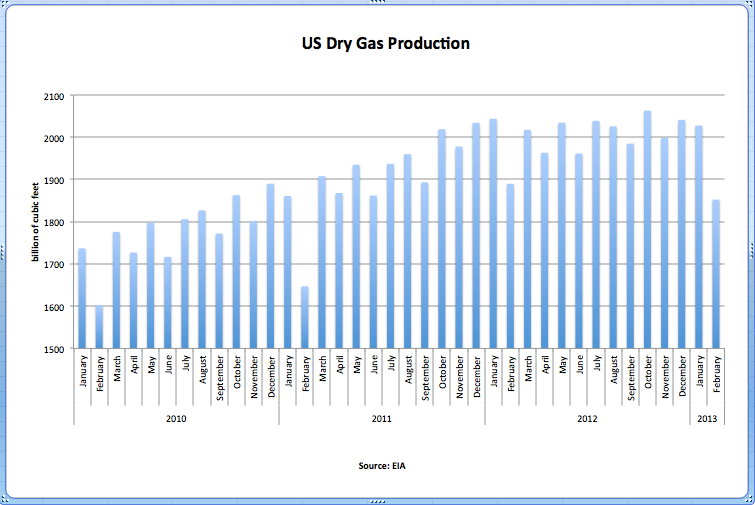
US Dry Gas Production Feb 2013 jpeg

Much recent media attention has centred on a so-called shale-gas revolution in the United States and, in particular, the ability of shale gas to boost overall volume of natural gas production. Many claims are made with respect to the prospective expansion in shale gas production in the coming years including the following:

  • Shale gas will provide a low-cost source of natural gas, and thus cheap energy, for decades to come. This, in turn, will boost the competitiveness of the U.S. economy.
  • The U.S. will move toward an era of energy self-sufficiency, which will help buttress the country’s geopolitical security.
  • The scale of shale gas production will be sufficient to allow the U.S. to commence natural gas exports, thus transforming energy markets outside of the U.S. such as those in Europe.
  • Increased natural gas production in the U.S. will mitigate carbon emissions through displacing coal and so reduce the risk of dangerous climate change.

For these claims to be substantiated, significant year-on-year rises in U.S. natural  gas production will be required over an extended period. Through tracking monthly production of natural gas, a non-specialist can confirm or refute whether large rises in natural gas production are being achieved and, therefore, whether the claims associated with a shale-gas revolution are credible. In short, the monthly numbers allow you to evaluate the hype. Monthly data are currently not showing any increase in production.
Stuart Staniford, Climate Change and Food Production

Over the last few days, one of my favourite bloggers, Stuart Staniford of Early Warning, has done a couple of posts looking at the impact of climate change on food production. I generally agree with most of what Stuart writes, but on this occasion I have a number of major caveats. Indeed, I think his analysis paints a far too rosy picture of agricultural production in an era of climate change.

Before we start, we need to be a little careful about equating extreme weather with climate change. Given that we are in the foothills of global temperature rise, we can’t specifically assign particular events to climate change. The whole question needs to be looked at in probabilistic terms. Here is Bob Corell, Jeff Masters and Kevin Trenberth writing an opinion piece in Politico after Hurricane Sandy.

Overall, we know that climate change has stacked the deck so that this kind of event happens more frequently. That answer, however, prompts a deeper, more unsettling question that many want to know: is climate change worsening some recent extreme weather events like super storm Sandy? The short answer is yes. Climate scientists broadly agree that the extreme weather we’ve seen over the past few years is exactly what we’d expect to see in a changing climate.

So while we can’t definitely say that climate change is responsible for recent extreme weather events that have disrupted food production, we can say that climate change makes such events more likely and more extreme.

Nonetheless, for the sake of argument, let’s just hypothesise for a minute that recent extreme weather events such as the droughts in Australia, the U.S. and Russia are due to climate change. I will run with this assumption because Stuart appears to be claiming that regardless of how we categorise recent extreme weather events, they are not showing up in the agricultural production data—or, ultimately, in people’s stomachs.

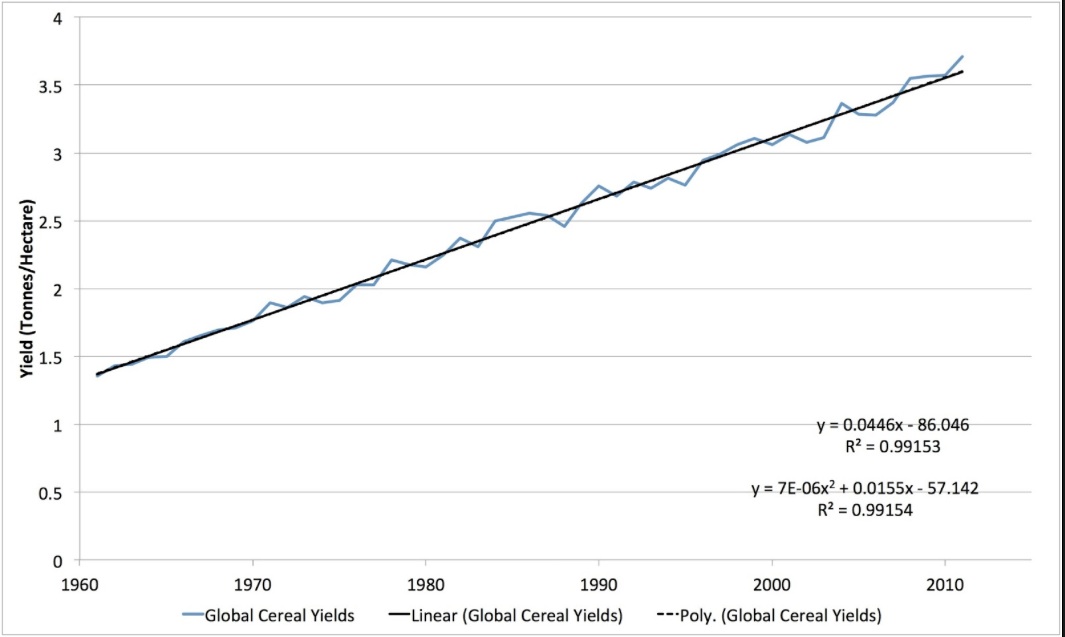
In his first post on the subject, titled “Climate Change Still Not Affecting Global Cereal Yields“, Stuart reiterates a conclusion made two years previously:

So, clearly, the overwhelming story in global agricultural yields is this: improving agricultural technology has increased yields at a steady, reliable pace – they have more than doubled over the last 50 years. There just is absolutely no support in the data for the idea that climate change, or any other negative or scary factor you care to name – eroding soil, depleting aquifers, peaking oil supplies – is causing the agricultural yield curve to start bending downward. Maybe they will in the future, but it sure isn’t happening yet.

And he updates and republishes this chart to reinforce the point:

Global Cereal Yields jpeg

Which allows him to reach this conclusion which does not just cover yields but also overall production:

Climate change is scary, we are clearly melting the north pole, droughts and floods and heat waves are increasing over time. However, so far, it’s not hitting us where it would really hurt: in the stomach.

The chart looks like compelling evidence that climate change is not showing up in food production, but there are a number of problems. Continue reading

The Idiocy of Dieter Helm and Bridge Fuels to Nowhere

In U.K. policy circles, it has become increasingly fashionable to believe that we can rely on natural gas as a bridge fuel to a non-carbon energy nirvana some time in the indeterminate future. In the meantime, let’s dump renewables: just too expensive.

Shale gas has also become a neoclassical wet dream. Here is Dieter Helm, the most vocal supporter of shale gas in the U.K., in The Spectator:

Shale oil and gas were not the result of any radical technological revolution, but rather of a combination of advances in seismic information technologies, horizontal drilling and the ability to split open rocks at depth. Why did it happen? Part of the answer is the incremental process of innovation, combined with rising prices of oil and gas innovation plus markets.

Innovation plus markets: truly the neoclassical saviour of all our ills (and don’t forget that fracking technology was born out of government financed R&D, tax credits and infant industry support; see here). My frustration with this line of argument is that it claims to be based on markets, but makes no reference to actual market prices and volumes. If ‘innovation plus markets’ is our salvation then gas volumes will rise and prices will fall (or at least go sideways). Simple really.

In short, we now have a testable hypothesis: the hypothesis being that the bridge fuel of natural gas  at the right price and volume will part the Red Sea and give us 20 or so years of R&D time to transcend fossil fuels altogether. So, Dieter, give us a price and volume number to test your hypothesis. I search within his book “The Carbon Crunch” in vain. Some solid numbers to buttress his assertions: not a chance!

Meanwhile, Helm also says it would be nice to have a carbon tax (it would be nice if we could have peace on earth too, and the lamb lie down with the lion and….well, you get my drift).

Overall, his argument goes like this: gas should get sort of cheaper and therefore get sort of more plentiful, and therefore we sort of use less coal, and so we sort of don’t need so many renewables (which are expensive anyway), and R&D should sort of possibly come up with non-carbon energy alternatives at some vague time in the future. And meanwhile we sort of manage to introduce a carbon tax.

This must be the most pathetic policy prescription in the history of academia.

So what is actually frigging happening. First, U.S. natural gas production is going sideways. I blog on this each month.

US Dry Gas Production January 2013 jpeg

Continue reading

Data Watch: FAO Food Price Index for March 2013

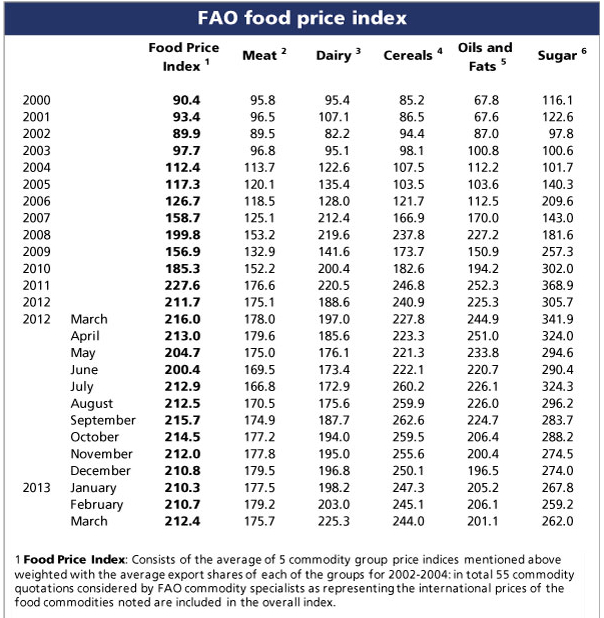
At the beginning of each month, the Food and Agriculture Organisation of the United Nations (FAO) releases a series of price indices for a variety of food commodities (here). The headline FAO Food Price Index is a composite of five food groupings: meat, dairy, cereals, oils and fats and sugar. The base 100 is the indexed averaged price for the 2002-2004 period. The March 2013 index number was released on April 11th. Key points are as follows:

  • The FAO Food Price Index averaged 212.4 for March 2013
  • The index was down 3.6 points from 216.0 for March 2012, or 1.7 in percentage terms
  • In inflation adjusted terms, the Food Price Index stood at 141.0 for March 2013 against the 2002-2004 base of 100

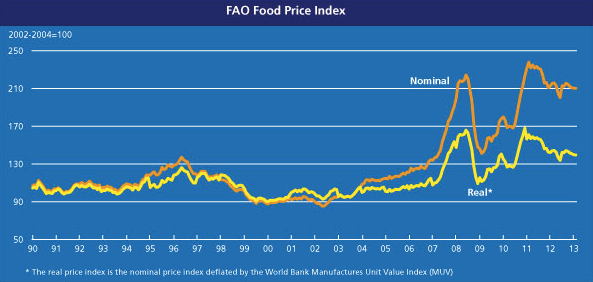
The nominal and real price indices have followed a trajectory not dissimilar to the global oil price (click chart for larger image). Here is food:

FAO March 2013 jpeg

And here is oil:

Spot Oil Prices jpg

Finally, price developments within the five main components of the Food Price Index can be seen below. The most noted change this month is the surge in dairy prices, up 11% in a single month due to dry weather in New Zealand.

FAO Food Price Index jpeg

Links for the Week Ending 7th April

  • The Economist magazine last week carried a long article on climate sensitivity together with a leader article on the same theme here. Skeptical Science’s Dana Nuccitelli posted a rebuttal here, which captures some of my own concerns over The Economist‘s interpretation of the science. It is obvious, however, that Nuccitelli has never read The Economist, since he characterises the magazine as having strayed into the field of climate change commentary almost by accident. This is ridiculous: The Economist has been doing in-depth reporting on climate change issues for many years and has been far more consistent in its coverage than either The Wall Street Journal or The Financial Times. Moreover, The Economist does matter since it has become the house journal of the global corporate, financial and political elite.  Indeed, The Economist‘s coverage of climate change deserves a post all of its own (I am working on one).
  • If I was rather ambivalent on Skeptical Science’s treatment of The Economist, they quickly redeemed themselves with a wonderful post on the history of climate change science. The definitive book on this topic is Spencer Weart’s The Discovery of Global Warming, but John Mason has produced a great condensed version of the history including some wonderful timeline graphics.
  • Professor James Hamilton, one of the world’s top econometricians, is a rare example of an economist who understands the threat posed by oil depletion. In this post on his blog Econbrowser, he evaluates the oil supply and price prediction record (from 2005) of the cornucopians, as represented by Daniel Yergin, and the peak oilers, as represented by Boone Pickens. The conclusion? Pickens won hands down.
  • If you are curious about alternative views on economics, then I recommend having a look at such ecological economists as Herman Daly. Jushua Farley, the co-author with Daly of the iconic textbook Ecological Economics, explains the difference between ecological economics and traditional neoclassical economics here. Farley’s main complaints are with the obsessive quest for economic growth in traditional economics and the inability of neoclassical economics to accept the empirical evidence before their eyes; for example, markets are not taking us toward a stable equilibrium.
  • If you want to understand what could possibly be driving the weird weather in northern European and beyond then read this article by the leading climate scientist Stefan Rahmstorf via Eli Rabett. You reap what you sow.

Data Watch: US Natural Gas Monthly Production January 2013

The U.S. government agency The Energy Information Administration (EIA) issues data on U.S. natural gas production, including shale gas, on a monthly basis with a lag of roughly two months. The latest data release was made on March 27 and covers the period up until January 2013.

Data is reported in billion cubic feet (bcf). Key points:

  • January 2013 natural gas dry production: 2,022 bcf, -1.1% year-on-year
  • Average monthly production for the 12 months to December 2012: 2,002 bcf, +4.1% over the same period the previous year

Since the end of 2011, the rate of production increase has levelled off (click chart above for larger image).

US Dry Gas Production January 2013 jpeg

Much recent media attention has centred on a so-called shale-gas revolution in the United States and in particular the ability of shale gas to boost overall volume of natural gas production. Many claims are made with respect to the prospective expansion in shale gas production in coming years including the following:

  • Shale gas will provide a low-cost source of natural gas, and thus cheap energy, for decades to come. This, in turn, will boost the competitiveness of the U.S. economy.
  • The U.S. will move toward an era of energy self-sufficiency, which will help buttress the country’s geopolitical security.
  • The scale of shale gas production will be sufficient to allow the U.S. to commence natural gas exports, thus transforming energy markets outside of the U.S. such as those in Europe.
  • Increased natural gas production in the U.S. will mitigate carbon emissions through displacing coal and so reduce the risk of dangerous climate change.

For these claims to be substantiated, significant year-on-year rises in U.S. natural  gas production will be required over an extended period. Through tracking monthly production of natural gas, a non-specialist can confirm or refute whether large rises in natural gas production are being achieved and, therefore, whether the claims associated with a shale-gas revolution are credible. In short, the monthly numbers allow you to evaluate the hype.

Does Shale Gas Make You High?

In my weekend links, I highlighted a much-talked-about paper by Texas University’s Bureau of Economic Geography on the Texas Barnett shale. The paper is currently undergoing peer review, so all we have is a well-publicised preview. The Wall Street Journal, for example, ran a column on the paper here.

Let’s start by taking the key graphic that accompanies the Texas University press release:

Barnett Shale jpeg

The granular data supporting the paper goes up to 2010. The most important prediction coming out of the chart for me is that gas production for the Barnett shale has already peaked. True, it has not collapsed—and it is not forecast to collapse, but it is now in a rather gentle decline.You can roughly see from the chart that production peaked at 2 trillion cubic feet (tcf) in 2012 and is forecast to decline to 0.8 tcf in 2030.

Let us now put this in the context of The Energy Information Administration’s Annual Energy Outlook 2013 Early Release forecast for natural gas production through 2035. In short, the Barnett shale reached around 10% of overall U.S. natural gas production at its peak, but is now a net drag on year-on-year growth. And, of course, traditional natural gas production is also a net drag on year-on-year growth.  Continue reading

Data Watch: FAO Food Price Index for February 2013

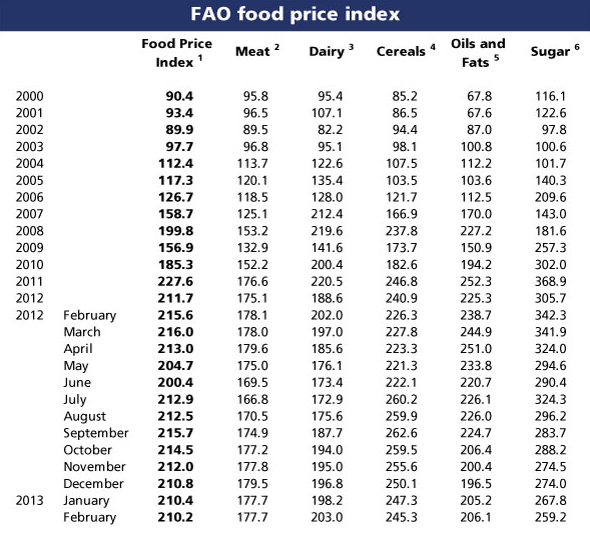
At the beginning of each month, the Food and Agriculture Organisation of the United Nations (FAO) releases a series of price indices for a variety of food commodities (here). The headline FAO Food Price Index is a composite of five food groupings: meat, dairy, cereals, oils and fats and sugar. The base 100 is the indexed averaged price for the 2002-2004 period. The February 2013 index number was released on March 7th. Key points are as follows:

  • The FAO Food Price Index averaged 210.2 for February 2013
  • The index was down 5.4 from 2015.6 for February 2012
  • In inflation adjusted terms, the Food Price Index stood at 139.6 for February 2013 against the 2002-2004 base of 100

The nominal and real price indices have followed a trajectory not dissimilar to the global oil price (click chart for larger image). Here is food:

FAO Food Price Index jpeg

And here is oil:

Spot Oil Prices jpg

Finally, price developments within the five main components of the Food Price Index can be seen below:

FAO Food Price Index Components jpeg

All Liquids Are Not Created Equal (Revisited)

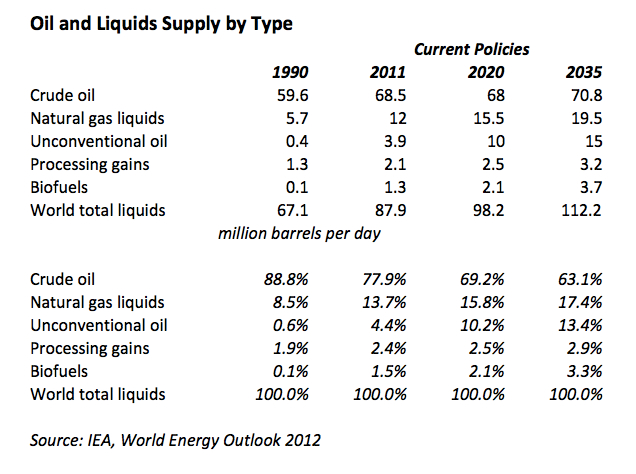
A few weeks ago, I wrote a blog post pointing out some of the difficulties posed by the move away from ‘crude oil’ to ‘all liquids’ reporting by BP, the Energy Information Administration (EIA) and the International Energy Agency (IEA) when they publish their flagship yearly reports (see herehere and here).

I also showed some numbers taken from Table 3.4 in the IEA’s World Energy Outlook 2012 (click for larger image). The declining share of crude oil within the overall ‘all liquids’ mix is obvious.

Oil and Liquids Supply jpg

It’s worth drawing attention to some charts taken from a post by Marco Pagani on Ugo Bardi’s excellent blog Cassandra’s Legacy. Note Pagani’s post is, in turn, a summation of original work done (in Italian) by Antonio Turiel. We start with the IEA’s headline chart that shows ‘all liquids’ on a healthy (in energy terms rather than climate) rising trend:

IEA Predictions jpeg

Turiel then makes two adjustments to the chart. Continue reading

Data Watch: US Crude Oil, Monthly Production December 2012

On February 27th, the U.S. government agency The Energy Information Administration (EIA) announced provisional crude oil production figures for December 2012. The new numbers show U.S. crude oil production topping 7 million barrels per day in both November (following a revision for that month) and December.

U.S. Crude Oil Production jpg

The numbers are good (although less so from a climate change perspective), but far from revolutionary. A look at the U.S. data in a global perspective gives rise to considerable concern. Continue reading