Tag Archives: EIA

Data Watch: US Natural Gas Monthly Production January 2013

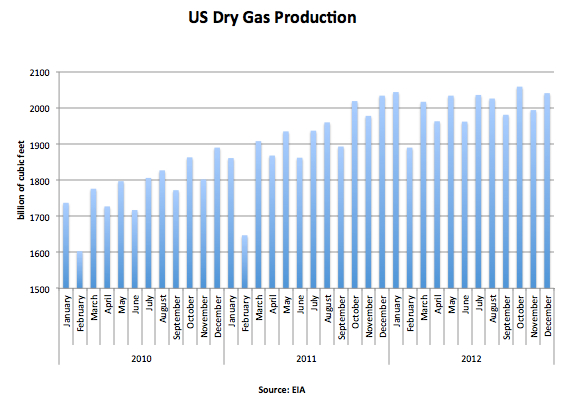
The U.S. government agency The Energy Information Administration (EIA) issues data on U.S. natural gas production, including shale gas, on a monthly basis with a lag of roughly two months. The latest data release was made on March 27 and covers the period up until January 2013.

Data is reported in billion cubic feet (bcf). Key points:

  • January 2013 natural gas dry production: 2,022 bcf, -1.1% year-on-year
  • Average monthly production for the 12 months to December 2012: 2,002 bcf, +4.1% over the same period the previous year

Since the end of 2011, the rate of production increase has levelled off (click chart above for larger image).

US Dry Gas Production January 2013 jpeg

Much recent media attention has centred on a so-called shale-gas revolution in the United States and in particular the ability of shale gas to boost overall volume of natural gas production. Many claims are made with respect to the prospective expansion in shale gas production in coming years including the following:

  • Shale gas will provide a low-cost source of natural gas, and thus cheap energy, for decades to come. This, in turn, will boost the competitiveness of the U.S. economy.
  • The U.S. will move toward an era of energy self-sufficiency, which will help buttress the country’s geopolitical security.
  • The scale of shale gas production will be sufficient to allow the U.S. to commence natural gas exports, thus transforming energy markets outside of the U.S. such as those in Europe.
  • Increased natural gas production in the U.S. will mitigate carbon emissions through displacing coal and so reduce the risk of dangerous climate change.

For these claims to be substantiated, significant year-on-year rises in U.S. natural  gas production will be required over an extended period. Through tracking monthly production of natural gas, a non-specialist can confirm or refute whether large rises in natural gas production are being achieved and, therefore, whether the claims associated with a shale-gas revolution are credible. In short, the monthly numbers allow you to evaluate the hype.

Does Shale Gas Make You High?

In my weekend links, I highlighted a much-talked-about paper by Texas University’s Bureau of Economic Geography on the Texas Barnett shale. The paper is currently undergoing peer review, so all we have is a well-publicised preview. The Wall Street Journal, for example, ran a column on the paper here.

Let’s start by taking the key graphic that accompanies the Texas University press release:

Barnett Shale jpeg

The granular data supporting the paper goes up to 2010. The most important prediction coming out of the chart for me is that gas production for the Barnett shale has already peaked. True, it has not collapsed—and it is not forecast to collapse, but it is now in a rather gentle decline.You can roughly see from the chart that production peaked at 2 trillion cubic feet (tcf) in 2012 and is forecast to decline to 0.8 tcf in 2030.

Let us now put this in the context of The Energy Information Administration’s Annual Energy Outlook 2013 Early Release forecast for natural gas production through 2035. In short, the Barnett shale reached around 10% of overall U.S. natural gas production at its peak, but is now a net drag on year-on-year growth. And, of course, traditional natural gas production is also a net drag on year-on-year growth.  Continue reading

Data Watch: US Natural Gas Monthly Production December 2012

The U.S. government agency The Energy Information Administration (EIA) issues data on U.S. natural gas production, including shale gas, on a monthly basis with a lag of roughly two months. The latest data release was made on February 28 and covers the period up until December 2012.

Data is reported in billion cubic feet (bcf). Key points:

  • December 2012 natural gas dry production: 2,041 bcf, +0.3% year-on-year
  • Average monthly production for the 12 months to December 2012: 2,004 bcf, +5.0% over the same period the previous year

Since the end of 2011, the rate of production increase has levelled off (click chart above for larger image).

US Dry Gas Production Dec 12 jpg

Continue reading

Data Watch: US Crude Oil, Monthly Production December 2012

On February 27th, the U.S. government agency The Energy Information Administration (EIA) announced provisional crude oil production figures for December 2012. The new numbers show U.S. crude oil production topping 7 million barrels per day in both November (following a revision for that month) and December.

U.S. Crude Oil Production jpg

The numbers are good (although less so from a climate change perspective), but far from revolutionary. A look at the U.S. data in a global perspective gives rise to considerable concern. Continue reading

All Liquids Are Not Created Equal

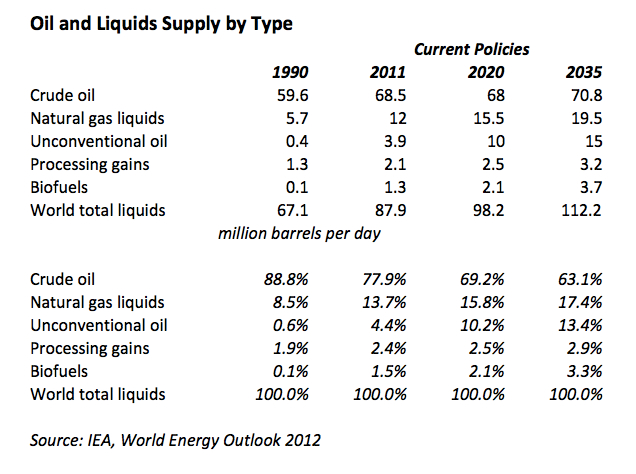
Once upon a time when we talked about oil, the presumption was we were talking about crude oil (or perhaps crude oil plus condensate if you were a petroleum wonk). Nowadays, when BP, the Energy Information Administration (EIA) or the International Energy Agency (IEA) publish their flagship yearly reports (see here, here and here) the lead-in charts highlight ‘All Liquids’ (click for larger image).

I’ve taken the numbers below from Table 3.4 in the IEA’s World Energy Outlook 2012 (click for larger image). Apologies for the lack of a link since the report needs to be ordered and is not freely available on the web.

Oil and Liquids Supply jpg

As can easily be seen, traditional conventional crude oil is making up an ever smaller share of total liquids in percentage terms, falling from 88.8% in 1990 to 63.1% in 2035 under the IEA’s Current Policies scenario (basically business as usual).

This would be irrelevant if all liquids are perfectly substitutable amongst themselves; i.e., they are fungible. Unfortunately, they are not. The EIA released a great graphic yesterday showing two key determinants of fungibility (there are others): energy content per unit volume and energy content per unit weight here (click for larger image):

EIA Energy Density jpg

Continue reading

Data Watch: US Natural Gas Monthly Production November 2012

The U.S. government agency The Energy Information Administration (EIA) issues data on U.S. natural gas production, including shale gas, on a monthly basis with a lag of roughly two months. The latest data release was made on 31 January 2013 and covers the period up until November 2012.

Data is reported in billion cubic feet (bcf). Key points:

  • November 2012 natural gas production: 2,001 bcf, +1.2% year-on-year
  • Average monthly production for 12 months to November 2012: 2,001 bcf, +5.5% year-on-year 

Since the end of 2011, the rate of production increase has levelled off (click chart above for larger image).

US Dry Gas Production jpg

Continue reading

Top 3 Images for 2012: #3 U.S. Monthly Natural Gas Production

If nothing else, 2012 can be noted for the orgy of articles lauding the shale gas revolution. Suddenly, we are supposed to escape the energy constraint, whilst also being able to cut our carbon emissions at the same time. I never thought the numbers added us for such claims (see my posts starting here), but am still surprised how lacklustre U.S. production has been in 2012 (data released so far go up to October). Here is a chart based on the official numbers from the U.S. Energy Information Administration (EIA):

U.S. Dry Gas Production (Monthly) JPG

Obviously, within the aggregate numbers we have shale gas production going up but conventional natural gas production going down; Continue reading

Shale Gas (Part II): Tooth Fairy Economics

In my last post, I noted how a whole host of reports have been trumpeting shale gas as the ultimate ‘get out of jail free’ card from any kind of energy constraint and, indeed, the need to invest in renewables to protect the planet from climate change. Here is Mortimer Zuckerman talking of a shale gas ‘revolution’ in the Wall Street Journal.

America’s soaring natural-gas production has already helped cut our share of oil consumption met by imports to 47% last year from 60% in 2005, according to the Energy Information Administration. The shale-gas revolution, with proper safety practices, can be expected to continue this trend while addressing three longstanding concerns of the energy business: energy scarcity, energy security, and environmental risks. In a word, we have a chance to remake our energy future.

Note that an awful lot is being asked of shale gas if it going to help solve scarcity, security and environmental risks all at once. We are in effect asking it to do three things: 1) allow total energy consumption from all energy sources to grow in order to solve the problem of scarcity, 2) enable us to switch away from coal in the generation of electricity in order to blunt (but not stop) CO2 emission growth and so ameliorate environmental risks, and 3) facilitate a transport revolution that allows us to stop importing oil from geopolitical hotspots. Continue reading