Category Archives: Resource Constraints

World GDP: No Slowdown—Yet

This blog broadly looks at three factors that could usher us into a post-growth world: climate change, resource depletion and diminishing returns to technology. Nonetheless, top-level data suggest that we have yet to arrive in this post-growth world.

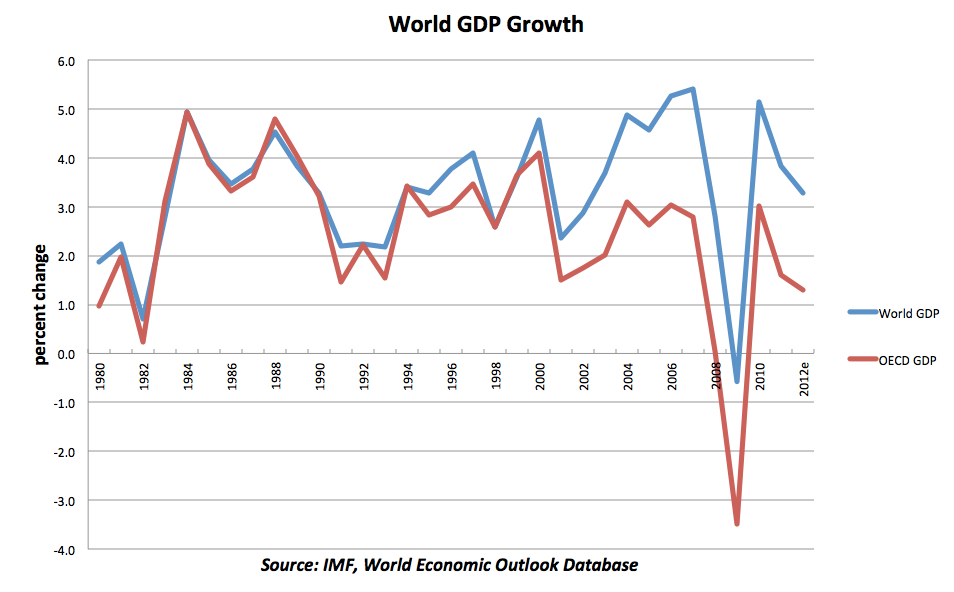
As can be seen in the chart below (click for larger image), global GDP has been robust in recent decades, notwithstanding the slump in 2009. Advanced economy growth appears to be exhibiting a modest downward trend, but from an empirical standpoint it is too early to draw any firm conclusions.

World GDP jpeg

Continue reading

Links for Week Ending 23rd February

  • The Forward on Climate Rally organised by 350.org attracted 40,000 people on 17 February and received wide publicity. This prompted a lively discussion as to whether direct protests make a difference to potential climate change outcomes or not. I think I fall into the camp of David Roberts at Grist who believes that street activism has a strong part to play in countering climate change. An excellent piece by him arguing against the more wonkish incrementalist approach of the NYT’s Andrew Revkin is here, and a follow-up piece on where the movement should go post the Keystone XL pipeline decision is here. The U.S. climate change movement now appears to have last gained some grass roots activist momentum in the U.S. I wish the same were true in the U.K.
  • Stuart Staniford has an update on “All Liquids” volume output  and OECD consumption trends at his Early Warning blog. Output appears to have been on a bumpy plateau for about a year now.  Not surprisingly, oil prices have been creeping up again. As I always say, if the cornucopian belief in technology is to be proved right, and previously inaccessible hydrocarbons can be easily unlocked, we need to see rising oil volumes and falling prices. We are currently seeing flat volumes and flat to rising prices.
  • Given what is happening in the oil markets, I recommend peak oil observers keep abreast of the work of Michael Kumhof, a senior economic modeller at the IMF. I previously blogged on the IMF’s incorporation of geological constraints into its forecasts here. To get a direct insight into Kumhof’s work, take a look at an easily accessible 20-minute presentation he gave here. A more technical IMF paper covering these issues was published in October 2012 here.
  • Via Barry Ritholtz’s The Big Picture, this article in the English edition of Le Monde diplomatique charts the surge in financial investment into agriculture. The article is a bit messy in its arguments but the key, and I think basically correct, point is that more and more people will be shut out of food markets via price. Everyone should think hard about how they can hedge against this.
  • Another horrible and depressing paper about permafrost thaw from Climate Central. This is one of the ‘known unknowns’ that we are gradually ‘knowing’ a lot more about. And it is not good.

Links for Week Ending 16th February

  • Professor Jim Hamilton is one of the few economists to give peak oil considerations a proper hearing. Moreover, as one of the world’s leading econometricians and author of the popular text book “Time Series Analysis” he cannot be accused of not knowing his numbers. This last week he has posted twice on oil (here and here) on his blog Econbrowser that he co-authors with Menzie Chin. Frequently, in any discussion of resource depletion, the standard economics response is that ‘price begets supply’. Hamilton points out that such logic only extends so far for an exhaustible resource
  • Dana Nuccitelli has a good post at Skeptical Science entitled “A Glimpse at Our Possible Future Climate, Best to Worst“. It delves into two of the major climate risk parameters: climate sensitivity and emission paths. Other major determinants of climate risk are changes in the carbon cycle, methane release and the extent of climate-related economic impacts themselves. And that is just the ‘known knowns’ and the ‘known unknowns’.
  • Veteran observer of the Chinese economy Michael Pettis has long argued that China’s supercharged growth rate is unsustainable. Here and here are recent restatements of his belief that we face a great re-balancing. This has major implications for both climate change-related CO2 emissions trajectories and resource depletion rates.
  • The Washington Post asks why monetary policy no longer works and economies fail to grow around the world. Personally, I think the answer is no longer solely to be found in the study of monetary and fiscal policy. Jeremy Grantham, the ever-thoughtful Chief Investment Strategist at GMO is squarely in my camp, with his firm predicating strategy on a U.S. long-term growth rate of 1.5%. Against this background his analogy is “of the Fed beating a donkey (the 1% growing economy) for not being a horse (Bernanke’s 3% growing economy)”. Read his last GMO letter on decelerating growth and the impact on investment here.
  • Grantham references an article by Chris Brightman of Research Affiliates which pegs long-term U.S. growth rates at 1% due to trends in population, employment and productivity. If true, and we then add in the impact of resource depletion and climate change over the next two decades (the pivot decades for me), we could easily be looking at a no-growth U.S. economy by 2030-2040.

Shale and the Ridiculous Talk of Revolution

How do you tell if we have a revolution in either Resource X or Product Y? Simple. Volume goes up and price goes down. Think computing power. Now that’s a revolution.

So do we have a revolution in the production of tight oil in the U.S.? Let’s take a look at the projections of the U.S. government agency the Energy Information Administration (taken from an EIA staffer’s presentation to accompany the publication of the Annual Energy Outlook 2013; click for larger image):

U.Sl Oil Production jpg

So according to the EIA’s numbers, we have a five-year bump in production which puts us back to the level of output in 1990 and then a gentle decline out to the year 2040. Good, but hardly revolutionary.

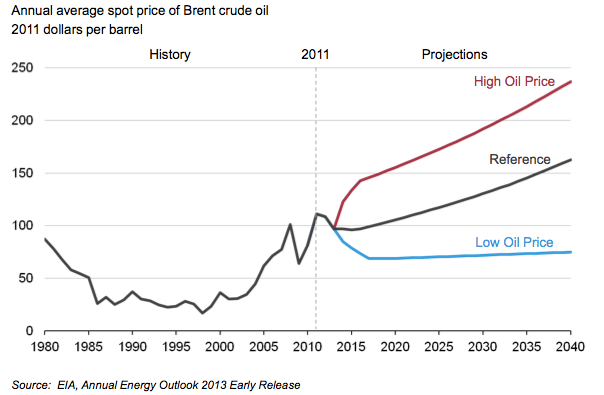
And price (note in inflation-adjusted dollars)? Well, that goes up:

EIA Oil Price jpg

Continue reading

Data Watch: US Natural Gas Monthly Production November 2012

The U.S. government agency The Energy Information Administration (EIA) issues data on U.S. natural gas production, including shale gas, on a monthly basis with a lag of roughly two months. The latest data release was made on 31 January 2013 and covers the period up until November 2012.

Data is reported in billion cubic feet (bcf). Key points:

  • November 2012 natural gas production: 2,001 bcf, +1.2% year-on-year
  • Average monthly production for 12 months to November 2012: 2,001 bcf, +5.5% year-on-year 

Since the end of 2011, the rate of production increase has levelled off (click chart above for larger image).

US Dry Gas Production jpg

Continue reading

How Much Energy Do I Consume?

Being brought up in the economics tradition, I view the world as split into the macro (top down) and micro (bottom up). This blog is principally concerned with the macro, but I think if you engage in the climate change and resource depletion debate then you need to take a long hard look at your own personal micro.

If a caricature of western capitalism could be construed as “he (or she) who dies with the most consumer durables wins” then a caricature of the sustainability movement could be “he (or she) who dies wearing the most uncomfortable hair shirt wins”. But I believe all such absolutes are counterproductive, even the sustainable ones. The object is not to compare oneself with an unobtainable ideal, but rather to move oneself in the right direction.

Nonetheless, you can’t set off in the right direction unless you know where you are starting from. In this connection, the Personal Energy Estimator put together by Christian Gebbe is a huge help. Gebbe’s Estimator is based on the work done by David MacKay, currently the Chief Scientific Advisor to the Department of Energy and Climate Change and author of Sustainable Energy Without the Hot Air.

Within the Estimator, you need to fill in a series of boxes based on your current consumption such as this one for transportation here (click for larger image):

Transportation jpg

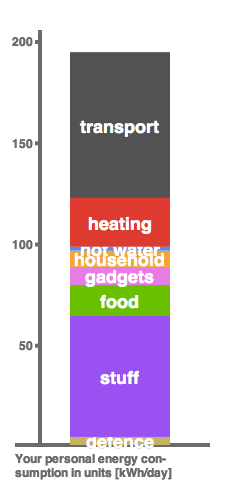
As a result, you eventually generate a Personal Energy Consumption Estimate like this (with the unit of measurement being kilowatt hours per day):

Personal Energy Consumption jpg

Gebbe’s  Personal Energy Estimator is far from perfect but will give you a good idea of where the low-hanging energy saving fruit is to be found.

Links for Week Ending 2nd February

  • This blog covers two subjects that have the potential to morph into existential threats to civilisation if various factors align. The two in question are climate change and resource depletion. Unfortunately, any consideration of existential threats have been viewed as the province of cranks for the last few decades—or at least of fiction authors with a taste for the dystopian. Now at last the topic is getting some respect with the establishment of the Centre for the Study of Existential Risk at Cambridge, England. The NYT has a good introduction here, and CSER’s web site is here (note the impressive line-up of founders and advisors—no cranks!). 
  • To the Financial Times’ credit, the dark side of the shale gas revolution is given some sympathetic coverage; for example, these articles on shale gas flaring here and here. This contrasts sharply with the Wall Street Journal, whose mantra appears to be “drill baby drill”.
  • Photographing Climate Change in the New Yorker show cases a committed few. I am reminded of Bill McKibben’s lament “where are the goddamn operas“. The artistic community often appears missing in action when it comes to climate change, despite the fact that global warming poses a monumental threat to mankind’s artistic endeavour.
  • The New York Times has a lovely article on “The Preppers Next Door“.
  • A thoughtful post by David Altig from the Federal Reserve Bank of Atlanta at his Macroblog on Robert Gordon’s ‘end of growth’ hypothesis.
  • Climate change was directly addressed in President Obama’s inauguration speech (what a contrast with the Presidential debates). But what could really change? Here is the somewhat gloomy view of Harvard’s Robert Stavins.

The Wealth of Households and Existential Threats

Among the plethora of statistics put out by governments around the world, numbers on household wealth are relatively rare. The Office for National Statistics (ONS) in the U.K., however, is an exception through its publication of a detailed household wealth survey. Moreover, the survey size is such that we are able to get a sense of the household wealth of the British nation as a whole.

The lessons that can be drawn from this survey are not limited to the U.K. In short, the survey highlights the link between economic growth and individual wealth worldwide.

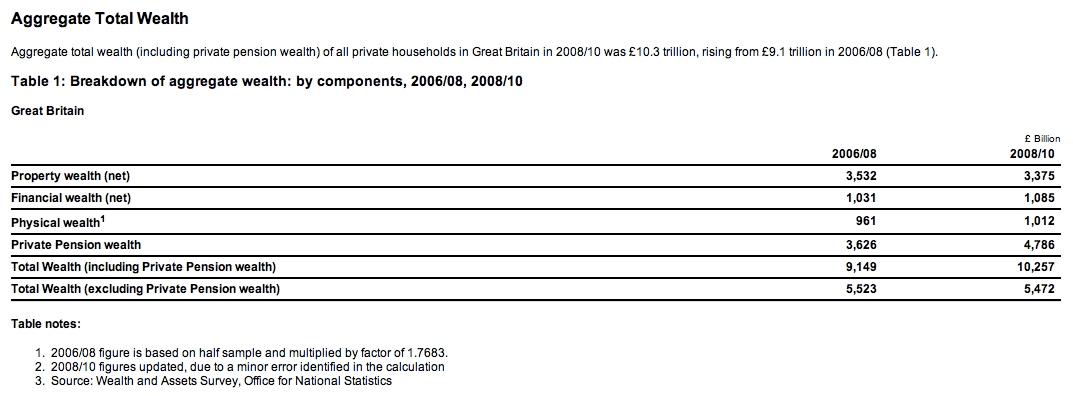
And here is the result. Aggregate total household wealth in the U.K. was £10.3 trillion (click for larger image, original report can be found here) for the most recent survey period.

Aggregate Total Wealth jpg

Interestingly, the greatest component of household wealth today is pensions rather than property (click for larger image).

Breakdown of Aggregate Wealth jpg

The Institute of Actuaries and the Club of Rome

I recently blogged on one of the most durable of myths surrounding resource depletion. It can be encapsulated in the rhetorical question: “Didn’t the Club of Rome predict back in the 1970s that we would already have run out of oil?”

Being a rhetorical question, the speaker is using the question for effect—safe in the knowledge that the audience knows the answer is “yes”. Except, of course, the answer is “no”, the Club of Rome never said that. I have posted the relevant pages from “The Limits to Growth: A Report for Club of Rome’s Project on the Predicament of Mankind” showing what was actually said back in 1972 here. Better still, read the original book which can be bought here.

Nonetheless, the Club of Rome is still a source of mild ridicule. So then imagine my surprise when I discovered the most unlikely supporter of the Club of Rome’s “Limits to Growth” report: the U.K. Institute and Faculty of Actuaries (IFA). Actuaries are professionals who specialise in the financial impacts of risk and uncertainty. The professional exams required to join the institute have a fearsome reputation with respect to their difficulty. Further, my image of an actuary is of a stolid quant who would dismiss the idea of resource depletion out of hand.

However, in a report entitled “Resource Constraints: Sharing a Finite World“, we see this statement:

The Limits to Growth report attracted significant controversy and rejection of its scenarios, however the data available to the present day agrees worryingly well with the projections, as figure 1 below illustrates.

And this chart (click for larger image):

Actuary and Limits to Growth copy

Continue reading

The Club of Rome, Skeptics and Myths We Believe

On Wednesday I attended a Cafe Scientifique talk in my home town of Henley. The presentation was on peak oil theory and given by Professor Chris Rhodes (who blogs at Energy Balance).

While the talk was of interest itself, what jumped out at me the most was one of the questions within the Q&A session. It went along the lines:

We have seen forecasts of future resource scarcity before, but in reality technology and the market have shown such forecasts to have been ridiculous. Didn’t the Club of Rome predict that the oil would run out 50 years ago?

At the mention of the Club of Rome, there was a general nodding of heads and murmur of approval.

At this point, I need to give a bit of an explanation of what Cafe Scientifique does and the kind of people attending (for those unfamiliar with the organisation). Its aim is to foster debate on the scientific and technological issues of the day within a non-academic context. Cafe Scientifique, and its sister organisation Skeptics in the Pub, attract a certain kind of person: highly educated, numerate and questioning. Many of them view themselves as “skeptics” (or “sceptics” if you like) in the original sense of the word (before the rise of the “climate skeptic”); that is, individuals who will not accept a proposition as a fact until it is subject to analytically robust evidence-based testing. Accordingly, I believe that few in the room didn’t have a science or numerate-based degree, and many had advanced degrees.

With this is mind, the statement within the Q&A session that the Club of Rome had predicted the world would soon run out of oil and other resources appeared to be taken as a fact by all those highly educated and very “skeptical” people. Except, of course, it isn’t a fact—it is pure fiction. Continue reading