Category Archives: Peak Oil

Data Watch: US and Global Crude Oil Monthly Production

On April 29th, the U.S. government agency The Energy Information Administration (EIA) announced provisional crude oil production figures for February 2013. Key points:

  • February crude oil production 217.1 million barrels, equivalent to 7.2 million barrels per day
  • Change over previous month, + 2.4% on barrels per day (bpd) basis; year-on-year change, +10.9% on bpd basis
  • February total crude oil plus natural gas liquids 269.6 million barrels, equivalent to 9.6 bpd

As can be seen from the chart below (click for larger image, link to original data here), the fracking of tight oil formations in the U.S. has made a significant impact on U.S. crude production. The critical question is whether the current large year-on-year percentage growth rates in oil production can be sustained (click for larger image).
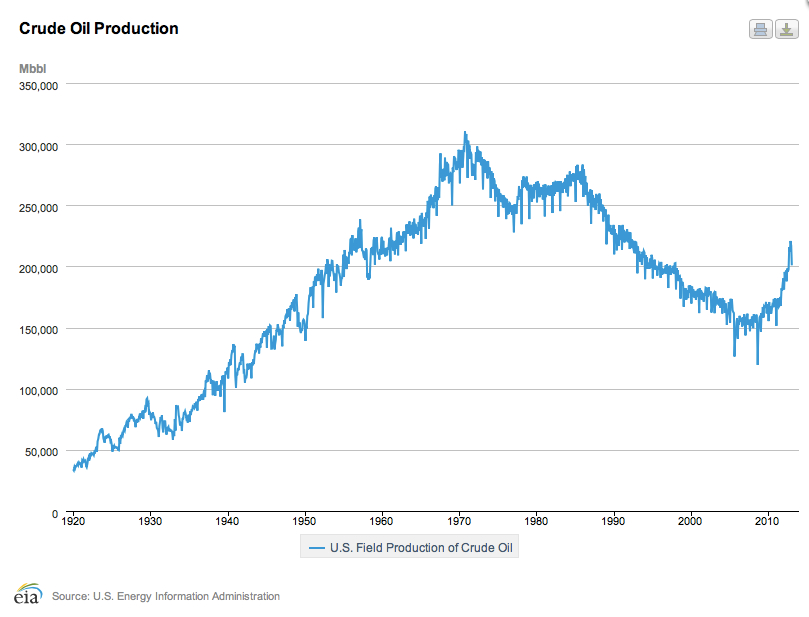
U.S. Crude Oil Production jpeg

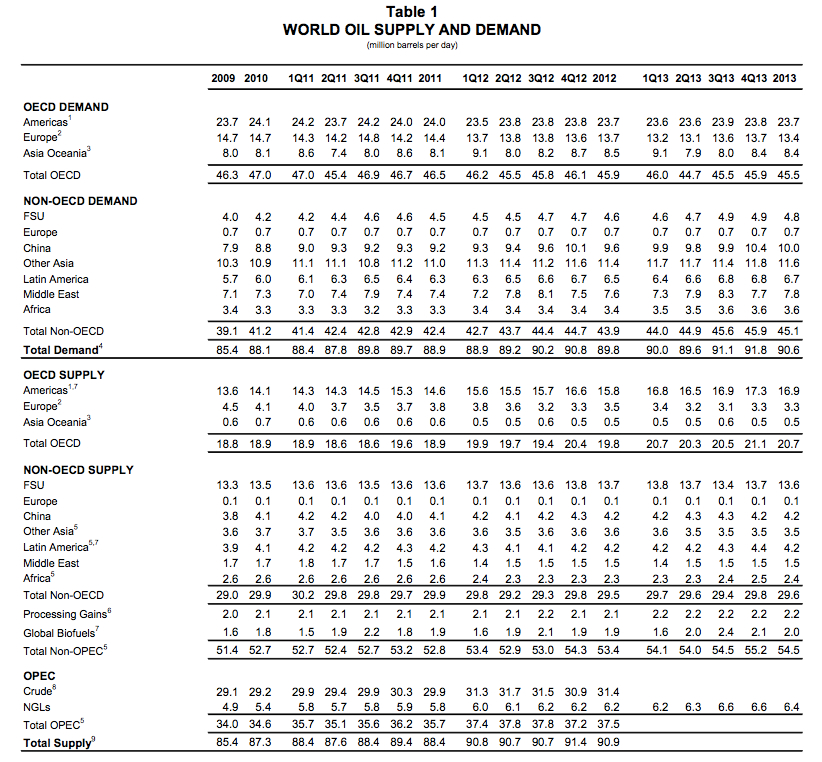
Crude oil is a globally traded commodity, and U.S. production numbers need to be placed in the context of world supply and demand. In its April 2013 Oil Market Report, the International Energy Agency (IEA)  records global ‘all liquids’ production as averaging 90.6 million bpd in Q1 2013, flat over the same period the previous year.

For March 2013, global supply was 90.7 million bpd (here). Over the last 3 months, rises in non-OPEC supplies have been offset by falls within OPEC. The degree to which this is due to supply constraints or deliberate production cuts by Saudi Arabia to maintain the oil price above $100 per barrel in the face of a slowing global economy is difficult to tell.

World Oil Monthly Supply jpeg

Full quarterly IEA world supply-and-demand figures, including Q3 2013 estimates, can be found here. Click for larger image to see the summary table.

World Supply and Demand IEA copy

Links for the Week Ending 7th April

  • The Economist magazine last week carried a long article on climate sensitivity together with a leader article on the same theme here. Skeptical Science’s Dana Nuccitelli posted a rebuttal here, which captures some of my own concerns over The Economist‘s interpretation of the science. It is obvious, however, that Nuccitelli has never read The Economist, since he characterises the magazine as having strayed into the field of climate change commentary almost by accident. This is ridiculous: The Economist has been doing in-depth reporting on climate change issues for many years and has been far more consistent in its coverage than either The Wall Street Journal or The Financial Times. Moreover, The Economist does matter since it has become the house journal of the global corporate, financial and political elite.  Indeed, The Economist‘s coverage of climate change deserves a post all of its own (I am working on one).
  • If I was rather ambivalent on Skeptical Science’s treatment of The Economist, they quickly redeemed themselves with a wonderful post on the history of climate change science. The definitive book on this topic is Spencer Weart’s The Discovery of Global Warming, but John Mason has produced a great condensed version of the history including some wonderful timeline graphics.
  • Professor James Hamilton, one of the world’s top econometricians, is a rare example of an economist who understands the threat posed by oil depletion. In this post on his blog Econbrowser, he evaluates the oil supply and price prediction record (from 2005) of the cornucopians, as represented by Daniel Yergin, and the peak oilers, as represented by Boone Pickens. The conclusion? Pickens won hands down.
  • If you are curious about alternative views on economics, then I recommend having a look at such ecological economists as Herman Daly. Jushua Farley, the co-author with Daly of the iconic textbook Ecological Economics, explains the difference between ecological economics and traditional neoclassical economics here. Farley’s main complaints are with the obsessive quest for economic growth in traditional economics and the inability of neoclassical economics to accept the empirical evidence before their eyes; for example, markets are not taking us toward a stable equilibrium.
  • If you want to understand what could possibly be driving the weird weather in northern European and beyond then read this article by the leading climate scientist Stefan Rahmstorf via Eli Rabett. You reap what you sow.

One Reason We Struggle to Grow: Energy Return on Investment (EROI)

This week’s edition of Scientific American has a couple of great infographics put together by Mason Inman on Energy Return on Investment (EROI). Strangely, these graphics are behind a paywall on Scientific American’s web site but are available open access on the site of Nature, the sister publication, here (click for larger image).

Liquid Fuels EROI jpeg

The infographics show that we are needing to use an ever-larger amount of energy in order to harvest energy from liquid fossil fuels. From a world in which we used to invest one unit of energy in conventional land-based oil production and get perhaps 50 units out, we are moving to a world where we now invest one unit of energy in unconventional fossil fuels but only get five or six units out.

For those interested in the source of the numbers that sit behind this graphic, then Inman has done us a service by listing them all here. As would be expected in any piece on energy extraction efficiency, he also references Professor Charles Hall, the father of EROI and, indeed, conducts a Q&A with Hall here. If you want to understand the implications of a low EROI, Hall explains it this way: Continue reading

Data Watch: US and Global Crude Oil Monthly Production, January 2013

On March 28th, the U.S. government agency The Energy Information Administration (EIA) announced provisional crude oil production figures for January 2013. Key points:

  • January crude oil production 217.1 million barrels, equivalent to 7 million barrels per day
  • Change over previous month, -1.3%; year-on-year change, +14.5%
  • January total crude oil plus natural gas liquids 290.3 million barrels, equivalent to 9.4 million barrel per day

As can be seen from the chart below (click for larger image, link to original data here), the fracking of tight oil formations in the U.S. has made a significant impact on U.S. crude production. The critical question is whether the current large year-on-year percentage growth rates in oil production can be sustained.

US Crude OIl Production jpeg

In addition, crude oil is a globally traded commodity, and U.S. production numbers need to be placed in the context of world supply and demand. In its March 2013 Oil Market Report, the International Energy Agency (IEA)  shows global ‘all liquids’ production averaging 91.4 million barrels per day in Q4 2002, up 2.2% year on year (click for larger image). February 2013 production was 90.8 million barrels per day (here).

IEA Oil Supply and Demand copy

Data Watch: US Natural Gas Monthly Production January 2013

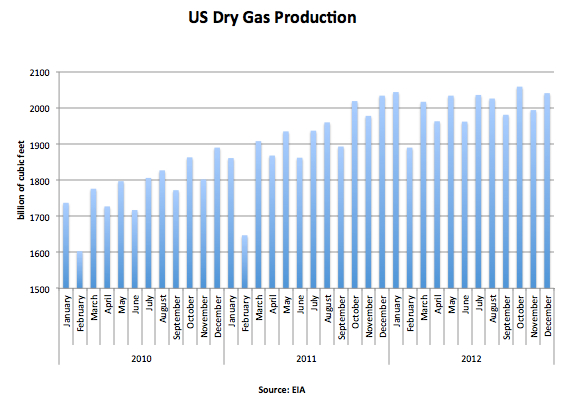
The U.S. government agency The Energy Information Administration (EIA) issues data on U.S. natural gas production, including shale gas, on a monthly basis with a lag of roughly two months. The latest data release was made on March 27 and covers the period up until January 2013.

Data is reported in billion cubic feet (bcf). Key points:

  • January 2013 natural gas dry production: 2,022 bcf, -1.1% year-on-year
  • Average monthly production for the 12 months to December 2012: 2,002 bcf, +4.1% over the same period the previous year

Since the end of 2011, the rate of production increase has levelled off (click chart above for larger image).

US Dry Gas Production January 2013 jpeg

Much recent media attention has centred on a so-called shale-gas revolution in the United States and in particular the ability of shale gas to boost overall volume of natural gas production. Many claims are made with respect to the prospective expansion in shale gas production in coming years including the following:

  • Shale gas will provide a low-cost source of natural gas, and thus cheap energy, for decades to come. This, in turn, will boost the competitiveness of the U.S. economy.
  • The U.S. will move toward an era of energy self-sufficiency, which will help buttress the country’s geopolitical security.
  • The scale of shale gas production will be sufficient to allow the U.S. to commence natural gas exports, thus transforming energy markets outside of the U.S. such as those in Europe.
  • Increased natural gas production in the U.S. will mitigate carbon emissions through displacing coal and so reduce the risk of dangerous climate change.

For these claims to be substantiated, significant year-on-year rises in U.S. natural  gas production will be required over an extended period. Through tracking monthly production of natural gas, a non-specialist can confirm or refute whether large rises in natural gas production are being achieved and, therefore, whether the claims associated with a shale-gas revolution are credible. In short, the monthly numbers allow you to evaluate the hype.

All Liquids Are Not Created Equal (Revisited)

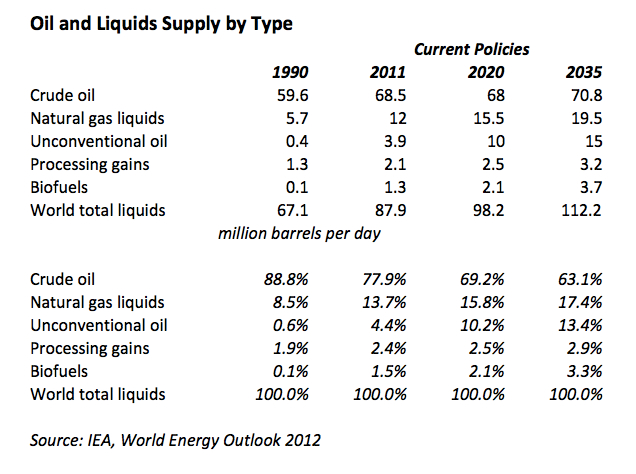
A few weeks ago, I wrote a blog post pointing out some of the difficulties posed by the move away from ‘crude oil’ to ‘all liquids’ reporting by BP, the Energy Information Administration (EIA) and the International Energy Agency (IEA) when they publish their flagship yearly reports (see herehere and here).

I also showed some numbers taken from Table 3.4 in the IEA’s World Energy Outlook 2012 (click for larger image). The declining share of crude oil within the overall ‘all liquids’ mix is obvious.

Oil and Liquids Supply jpg

It’s worth drawing attention to some charts taken from a post by Marco Pagani on Ugo Bardi’s excellent blog Cassandra’s Legacy. Note Pagani’s post is, in turn, a summation of original work done (in Italian) by Antonio Turiel. We start with the IEA’s headline chart that shows ‘all liquids’ on a healthy (in energy terms rather than climate) rising trend:

IEA Predictions jpeg

Turiel then makes two adjustments to the chart. Continue reading

Data Watch: US Natural Gas Monthly Production December 2012

The U.S. government agency The Energy Information Administration (EIA) issues data on U.S. natural gas production, including shale gas, on a monthly basis with a lag of roughly two months. The latest data release was made on February 28 and covers the period up until December 2012.

Data is reported in billion cubic feet (bcf). Key points:

  • December 2012 natural gas dry production: 2,041 bcf, +0.3% year-on-year
  • Average monthly production for the 12 months to December 2012: 2,004 bcf, +5.0% over the same period the previous year

Since the end of 2011, the rate of production increase has levelled off (click chart above for larger image).

US Dry Gas Production Dec 12 jpg

Continue reading

Data Watch: US Crude Oil, Monthly Production December 2012

On February 27th, the U.S. government agency The Energy Information Administration (EIA) announced provisional crude oil production figures for December 2012. The new numbers show U.S. crude oil production topping 7 million barrels per day in both November (following a revision for that month) and December.

U.S. Crude Oil Production jpg

The numbers are good (although less so from a climate change perspective), but far from revolutionary. A look at the U.S. data in a global perspective gives rise to considerable concern. Continue reading

World GDP: No Slowdown—Yet

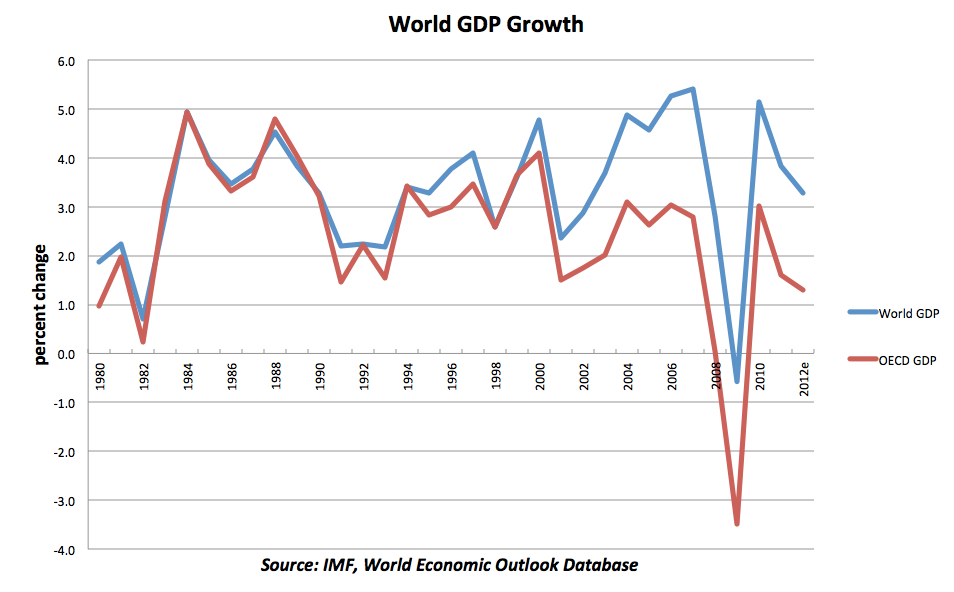
This blog broadly looks at three factors that could usher us into a post-growth world: climate change, resource depletion and diminishing returns to technology. Nonetheless, top-level data suggest that we have yet to arrive in this post-growth world.

As can be seen in the chart below (click for larger image), global GDP has been robust in recent decades, notwithstanding the slump in 2009. Advanced economy growth appears to be exhibiting a modest downward trend, but from an empirical standpoint it is too early to draw any firm conclusions.

World GDP jpeg

Continue reading

Links for Week Ending 23rd February

  • The Forward on Climate Rally organised by 350.org attracted 40,000 people on 17 February and received wide publicity. This prompted a lively discussion as to whether direct protests make a difference to potential climate change outcomes or not. I think I fall into the camp of David Roberts at Grist who believes that street activism has a strong part to play in countering climate change. An excellent piece by him arguing against the more wonkish incrementalist approach of the NYT’s Andrew Revkin is here, and a follow-up piece on where the movement should go post the Keystone XL pipeline decision is here. The U.S. climate change movement now appears to have last gained some grass roots activist momentum in the U.S. I wish the same were true in the U.K.
  • Stuart Staniford has an update on “All Liquids” volume output  and OECD consumption trends at his Early Warning blog. Output appears to have been on a bumpy plateau for about a year now.  Not surprisingly, oil prices have been creeping up again. As I always say, if the cornucopian belief in technology is to be proved right, and previously inaccessible hydrocarbons can be easily unlocked, we need to see rising oil volumes and falling prices. We are currently seeing flat volumes and flat to rising prices.
  • Given what is happening in the oil markets, I recommend peak oil observers keep abreast of the work of Michael Kumhof, a senior economic modeller at the IMF. I previously blogged on the IMF’s incorporation of geological constraints into its forecasts here. To get a direct insight into Kumhof’s work, take a look at an easily accessible 20-minute presentation he gave here. A more technical IMF paper covering these issues was published in October 2012 here.
  • Via Barry Ritholtz’s The Big Picture, this article in the English edition of Le Monde diplomatique charts the surge in financial investment into agriculture. The article is a bit messy in its arguments but the key, and I think basically correct, point is that more and more people will be shut out of food markets via price. Everyone should think hard about how they can hedge against this.
  • Another horrible and depressing paper about permafrost thaw from Climate Central. This is one of the ‘known unknowns’ that we are gradually ‘knowing’ a lot more about. And it is not good.