Tag Archives: shale gas

Global Trends 2030: Futurology Fit for a President? (Part 2 Energy Constraints)

This is my second post on the  National Intelligence Council (NIC) briefing for the  U.S. president called “Global Trends“, a report that looks at potential risks to the United States 20 years ahead. The first post (here) dealt with climate change, but in this post I want to take a look at how the Intelligence Community views the potential threat of a future energy constraint on the U.S. and world economy.

The quick answer: not much of a threat at all.

In a likely tectonic shift, the United States could become energy-independent. The US has regained its position as the world’s largest natural gas producer and expanded the life of its reserves from 30 to 100 years due to hydraulic fracturing technology.
The one-hundred-years-of-gas refrain was also a feature of President Obama’s State of the Union address back in January 2012. I blogged about the authenticity of the claim then. Enough to say that both the President and the NIC appear to be confusing resources with reserves. The industry association Naturalgas.org has a good explanation of the difference here, including the following  component chart (click for larger image):
.
Total Oil & Gas Resource Base copy

Top 3 Images for 2012: #3 U.S. Monthly Natural Gas Production

If nothing else, 2012 can be noted for the orgy of articles lauding the shale gas revolution. Suddenly, we are supposed to escape the energy constraint, whilst also being able to cut our carbon emissions at the same time. I never thought the numbers added us for such claims (see my posts starting here), but am still surprised how lacklustre U.S. production has been in 2012 (data released so far go up to October). Here is a chart based on the official numbers from the U.S. Energy Information Administration (EIA):

U.S. Dry Gas Production (Monthly) JPG

Obviously, within the aggregate numbers we have shale gas production going up but conventional natural gas production going down; Continue reading

Shale Gas (Part IV): Obama and the (Pipe) Dreams of Presidents

For a politician, optimism sells. As a student of history, President Obama appears painfully aware that the tired-looking doom of Jimmy Carter turned off a whole generation of US voters.

In February 1977, two weeks into his presidency, Carter told the American people in a fireside chat that “we must face the fact that the energy shortage is permanent”. In April 1977, in another address to the nation, Carter’s opening words were “Tonight I want to have an unpleasant talk with you”. Carter then went on to talk about the potential of the energy crisis to “overwhelm us” and that if the country didn’t act on energy “the alternative may be a national catastrophe”. Over 30 years later, to hear a politician deliver such an unrelenting stream of bad news appears almost shocking.

Fast forward a mere seven year, and the Carter gloom had the character of a long-forgotten bad dream. Ronald Reagan played against it constantly, most blatantly in his “It’s morning again in America” campaign. Continue reading

Shale Gas (Part III): A Brave New World?

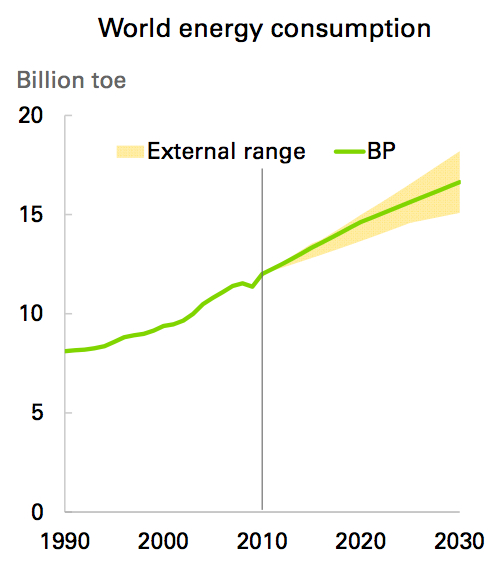
In this post, we will switch from a look at the shale gas outlook in the US to that globally. Again, the starting point is a forecast of total energy consumption out into the future, and then a discussion of what amount of gas would be needed to produce a true energy transformation. The latest set of forecasts we have are those from BP’s Energy Outlook 2012, just released this January. The report can be found here.

Interestingly, there is not that much difference between the aggregate energy numbers produced by the major organisations that predict energy supply and demand into the future (IEA, EIA, OPEC, BP and Exxon Mobile). I think that this is because they generally start with a GDP growth (and energy intensity) assumption and then work backwards to produce supply and demand forecasts. (The question of whether growth drives energy or energy drives growth is a topic for another post.)

Continue reading

Shale Gas (Part II): Tooth Fairy Economics

In my last post, I noted how a whole host of reports have been trumpeting shale gas as the ultimate ‘get out of jail free’ card from any kind of energy constraint and, indeed, the need to invest in renewables to protect the planet from climate change. Here is Mortimer Zuckerman talking of a shale gas ‘revolution’ in the Wall Street Journal.

America’s soaring natural-gas production has already helped cut our share of oil consumption met by imports to 47% last year from 60% in 2005, according to the Energy Information Administration. The shale-gas revolution, with proper safety practices, can be expected to continue this trend while addressing three longstanding concerns of the energy business: energy scarcity, energy security, and environmental risks. In a word, we have a chance to remake our energy future.

Note that an awful lot is being asked of shale gas if it going to help solve scarcity, security and environmental risks all at once. We are in effect asking it to do three things: 1) allow total energy consumption from all energy sources to grow in order to solve the problem of scarcity, 2) enable us to switch away from coal in the generation of electricity in order to blunt (but not stop) CO2 emission growth and so ameliorate environmental risks, and 3) facilitate a transport revolution that allows us to stop importing oil from geopolitical hotspots. Continue reading

Shale Gas (Part I): Energy Cornucopia's Great Fight Back?

The idea that resource constraints pose a limit to growth (one version of which is Peak Oil thoery) is subject to constant attack, with economists of a neo-classical persuassion frequently leading the charge. As such, those who believe in resource cornucopia, or at least that resources pose no impediment to economic growth, deserve a close reading since the victors of this debate will define how our world evolves over the next 50 years.

As I mentioned in my last past, it adds nothing to the debate when many mainstream economists begin their analysis by misconstruing the arguments of their opponents. Take a careful note of three things that modern Peak Oil theorists are not suggesting: they emphatically are not stating that 1) price doesn’t matter, 2) there are no more reserves to be found and 3) technological advances are irrelevant. If you don’t believe this statement, then I urge you to actually read the landmark article by Campbell and Laherrere in Scientific America (here) that brought the topic of Peak Oil back into the public domain. Or, at the very least, read the excellent summation of Peak Oil thought that ends their article:

The world is not running out of oil—at least not yet. What our society does face, and soon, is the end of the abundant and cheap oil on which all industrial nations depend.

Continue reading