Category Archives: Uncategorized

The Coal Monster: China

The U.S. Energy Information Administration (EIA) has just put out a horrible chart on Chinese coal consumption (here, click for larger image):

China's Coal Consumption  jpg

Current consumption translates into a 150% increase in 11 years (a per annum growth rate of nearly 9%), putting China close to consuming half of global coal. Much has been talked of the miracle of compound interest; China’s coal consumption shows the tyranny of compounding. Even if you slash the growth rate by half, what happens in another 10 years? Chinese coal consumption would still hit 6.2 billion tons, dwarfing non-Chinese consumption today.

Accordingly, if you wish to know what the climate will look like in 2050, you need to know who much China will grow by the year 2050—and how it will power that growth. Not easy.
Links for Week Ending 19th of January

  • The theory that developed countries (and soon developing countries) are going post growth is a tentative hypothesis at present. The growth economist Robert Gordon is the latest person to give it some support (here). Regardless, it presents a significant risk (remembering risk = probability times effect). Global economic, political and social institutions have been built around the assumption of 2 or 3% annual growth. If growth disappoints, then those institutions will come under severe pressure. The Economist magazine gave the subject its cover, the main leader and a full briefing  last week.
  • Meanwhile, here is a good critique of the Robert Gordon hypothesis by Roger Pilke Jnr. We will likely need a couple more business cycles before we are better able to separate the trend of economic growth from mere short-term fluctuations. 
  • Economist’s View has become the undisputed clearing house for tracking the economics profession. Given how climate change has the potential to alter everything in the economic sphere, I am always surprised over how few links address the topic. And often when they do, their treatment of the subject is appallingly ill-informed, like here.
  • Stuart Staniford at Early Warning has a couple of excellent posts (here and here) covering CO2 emissions paths.
  • In Slate, Phil Plait doesn’t pull any punches: about the climate skeptic machine: “And instead of doing something about it (climate change), we have to tie up all our time fighting denialist propaganda. It’s shameful. So let this be clear: There is no scientific controversy over this. Climate change denial is purely, 100 percent made-up political and corporate-sponsored crap.” I couldn’t put it better myself.

Arctic Snow Cover: Another Shock

The number one climate surprise for 2012 was the unprecedented decline in Arctic sea ice extent. The shock, for me, was the extent to which the models tracked by the Intergovernmental Panel on Climate Change (IPCC) have failed to forecast the pace of decline (see my post here). The IPCC is frequently accused of alarmism in its climate predictions. A much more accurate criticism would be to accuse it of excessive conservatism and an underplaying of risk.

The direct impact of Arctic sea ice decline on humanity is limited (even if it isn’t limited for the Arctic circle flora and fauna). Indeed, in what I see as a breathtaking piece of short-sightedness by the human race, summer ice free Arctic is being viewed as an opportunity to drill for oil in virgin territory. Unfortunately, there exist a number of indirect impacts from less Arctic ice, including a loss of reflectivity to sunlight (the albedo effect). So warming begets warming.

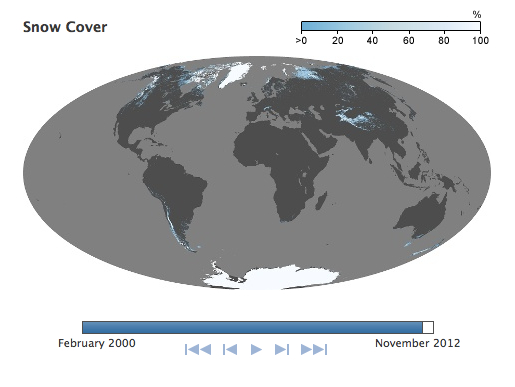
If sea ice is retreating, it would appear logical to expect land-based snow cover to also decline over time in northern latitudes. NASA, among others, collects the data and has an excellent animation showing the seasonal shift in snow from February 2000 to November 2012 here. A snap shot of what June 2012 snow cover looked like can be seen in this chart (click for larger image):

June 2012 Snow Cover jpg

Continue reading

2012 Declared Hottest Year on Record for U.S.

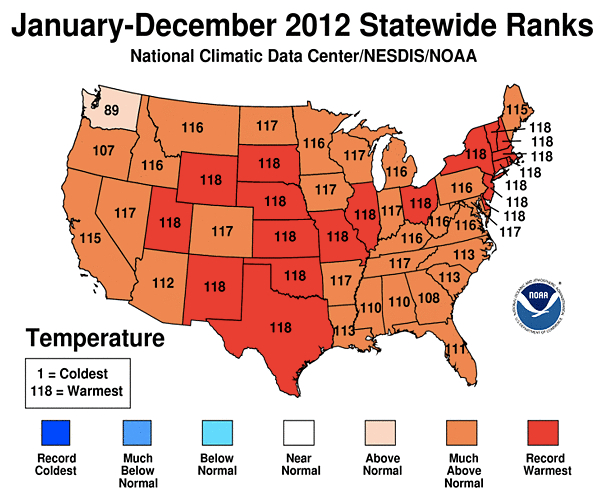
The U.S. federal agency the National Oceanic and Atmospheric Administration (NOAA) released its State of the Climate National Overview on 8 January 2012. This document declared 2012 the hottest year over the recorded period (1895 to 2012). The chart below shows temperature records on a statewide basis (click for larger image).

U.S. Statewide Temperature 2012 jpg

Continue reading

US Monthly Shale Gas Watch: Jan 2013 Release

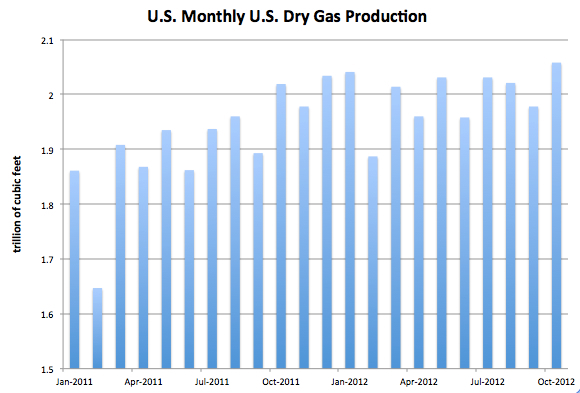
The U.S. government agency The Energy Information Administration issues data on U.S. natural gas production, including shale gas, on a monthly basis. The latest data release was made on 7 January 2013 and covered October 2012 production in billion cubic feet (bcf). Key points:

  • October 12 natural gas production: 2,058 bcf, +1.9% year-on-year
  • Average monthly production for 12 months to October 12: 1,999 bcf, +6.2% year-on-year

U.S Monthly Dry Gas Production to Oct 12 jpg

Since the beginning of 2012, the rate of production increase has slowed substantially (click chart above for larger image). Continue reading

Long-Term Interest Rates and Growth

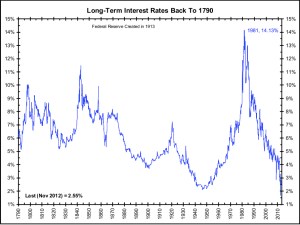
Barry Ritholtz over at The Big Picture recently posted the chart below (click for larger image) detailing U.S. long-term interest rates (here). He then went on to draw the conclusion that it must be a golden time to make infrastructure investment at these yields.

Long-Term Interest Rates jpg

For myself, the chart calls forth an entirely different question: Why are long-term interest rates at their lowest level since the industrial revolution took off in America? Continue reading

Top 3 Images for 2012: #3 U.S. Monthly Natural Gas Production

If nothing else, 2012 can be noted for the orgy of articles lauding the shale gas revolution. Suddenly, we are supposed to escape the energy constraint, whilst also being able to cut our carbon emissions at the same time. I never thought the numbers added us for such claims (see my posts starting here), but am still surprised how lacklustre U.S. production has been in 2012 (data released so far go up to October). Here is a chart based on the official numbers from the U.S. Energy Information Administration (EIA):

U.S. Dry Gas Production (Monthly) JPG

Obviously, within the aggregate numbers we have shale gas production going up but conventional natural gas production going down; Continue reading

Top 3 Images for 2012: #1 Arctic Sea Ice Extent

1. Arctic Sea Ice Extent for Summer Melt Season

By far the most disturbing image of any I saw in 2012 was that for Arctic sea ice minimum summer extent. Indeed, the chart below is nothing short of shocking. Sea ice extent plummeted to 3.4 million square kilometres compared with the previous low of 4.2 million square kilometres in 2007, an 18% decline.

Arctic Sea Ice Extent

In the Intergovernmental Panel on Climate Change’s Assessment Report 4 published in 2007 we saw this statement: Continue reading

Links for Week Ending 29 Dec 12

Articles and posts that caught my eye over the last week:

  • John Mason over at Skeptical Science gives us a current state of play with respect to climate change and food production. The mid-term outlook here looks horrible and rising food prices will tell the story. 
  • Ugo Bardi, author of the excellent book “The Limits to Growth Revisited”, reflects on the threat of climate change vis a vis peak oil. This is a topic close to my heart and one I have posted on regularly including here.
  • Dr Jeff Masters puts in perspective another year of weather extremes in the U.S. on his excellent blog here.
  • In the NYT, Tom Friedman looks at the disastrous anti-science stance that has been adopted by the Republican party and much else: “It can’t win with a base that is at war with math, physics, human biology, economics and common-sense gun laws all at the same time.”   In my humble opinion, climate change should not be a wedge issue. I am glad that I live in a country where you can adhere to either the right or left in politics but still believe in climate change. This used to be true in the USA, and I hope one day will be true again.
  • Much chatter about leaked drafts of the new Intergovernmental Panel on Climate Change (IPCC) report suggesting a bigger role for the solar cycle. Real Climate sees this as nothing but a storm in a teacup.
  • Prof Hamilton highlights a Post Carbon Institute presentation that questions the hype surrounding shale oil production at his Econbrowser blog  here.
  • The “end of economic growth” has been a major concern of many non-economists for decades but only a heretical few in the economics profession have given the idea much serious thought. Recently, the famed, and very much mainstream, growth economist Robert Gordon came out with a paper supporting the idea. We now have a lively debate on the subject that can be easily followed on Economist’s View, such as this contribution from Paul Krugman here.
  • Chris Giles in the FT addresses the collapse in UK productivity since 2007 (here).   Not sure if his advocacy of the German model to restore growth makes any sense though.

Blog is Back (Soon)

After a hiatus of around six months, I aim to restart the blog in the New Year. This is the successor blog to Climate and Risk. The aim of The Rational Pessimist is to cover a wider range of risk issues than just climate change in a more explicit manner. Watch this space.