Category Archives: Technology

Hiding from the Computers Part 2: To the Glue Factory?

‘Fools, Fools!’ shouted Benjamin, prancing around them and stamping the earth with his small hoofs. ‘Fools! Do you not see what is written on the side of the van?’

That gave the animals pause, and there was a hush. Muriel began to spell out the words. But Benjamin pushed her aside and in the midst of a deadly silence he read:

“Alfred Simmonds. Horse Slaughterer and Glue Boiler, Willingdon. Dealer in Hides and Bone Meal. Kennels supplied.” Do you not understand what that means? They are taking Boxer to the knacker’s!’

George Orwell, Animal Farm

But why did Napoleon, in George Orwell’s allegory of Animal Farm, send the horse Boxer to be killed and made into glue and dog food?

Napoleon was, of course, based on Joseph Stalin, and, being an unsentimental creature, he made the perfectly logical economic calculation that a weakened Boxer had come to cost more in feed than could be earned from his labour; ironically, this decision was true capitalism ‘red in tooth and claw’.

So how does this relate to the impact of technology on jobs and wages? Well, orthodox economists generally push back against the job destruction I outlined in Hiding from the Computers Part 1 by a) waving the theory of comparative advantage and b) looking at the historical wage record for unskilled workers since the industrial revolution.

For example, in an article in The New York Times entitled “Computers Jump to Head of the Class” earlier this week we see this:

Kazumasa Oguro, professor of economics at Hosei University in Tokyo, argues that smart machines should increase employment. “Most economists believe in the principle of comparative advantage,” he said. “Smart machines would help create 20 percent new white-collar jobs because they expand the economy. That’s comparative advantage.”

As an aside, the theory of comparative advantage is generally attributed to the English economist David Ricardo, but he was rather ambivalent about its impact on unskilled labour. He struggled with what he called ‘the machinery question’ and fluctuated from seeing technological advances benefiting all of society (divided into capitalists, land owners and workers)  to a position whereby such advances could be detrimental to the working class. See, for example, here.

Comparative advantage is not as intuitive as absolute advantage. It is easy to see that if Napoleon is good at providing governance and security, and Boxer hard manual labour, then they should trade. Each has an absolute advantage in one area. The pig Napoleon is not as strong as the horse Boxer, but he is cleverer. However, as Boxer ages and becomes enfeebled, Napoleon becomes both cleverer and stronger than Boxer. Yet, at first, they should still keep trading despite Boxer’s weakened state. This is because Napoleon is still better at ruling than he is at working manually. Although he may be able to do manual work far better than the aged Boxer, this would require the opportunity cost of him giving up time ruling (and exploiting) the other animals on the farm.

Unfortunately for Boxer, there is a limit to this comparative advantage. Boxer requires a minimum calorific input to survive. As Boxer progresses toward senility, he saves Napoleon less and less time. At some point, a full day’s work by Boxer only saves, say, 10 minutes of Napoleon time. And that 10 minutes time spent ruling (exploiting) by Napoleon is worth less than Boxer’s feed—at that point, sorry Boxer: you are glue.

Too abstract for you? Well actually this is exactly what happened to Britain’s population of working horses early in the 20th century. The peak in horse numbers took place at 3.25 million in 1901 long after the industrial gathered pace. The economic historian Gregory Clark in his excellent book “A Farewell to Arms” explains what happened next: Continue reading
The Haves and the Have Nots

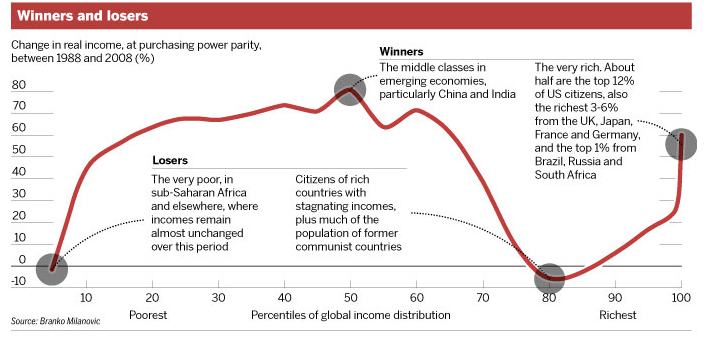
Since I have recently been struggling to find the time for longer posts, I thought it worthwhile to occasionally do a short post on a chart that caught my eye. And here is one taken from an article in The Financial Times by John Gapper (click for larger image):

Winners and losers jpeg

As an aside, the chart is taken from the work of Branko Milanovic, an economist with the World Bank. Branko is one of the world’s leading authorities on global inequality and recently wrote the wonderful book “The Haves and Have Nots“, which I highly recommend.

The chart captures the winners and losers from globalisation and the spread of neoliberal economic thought. For those living in the advanced Western democracies, globalisation over the last two decades or so—which rather simplistically can be reduced to the entry of China and India into the free market capitalist system—has been a mixed bag of benefits. A small minority have seen their income and wealth explode, but the majority have experienced stagnating incomes and far more job insecurity (and for that matter health, pension and education insecurity as well).

Yet the neoliberal claim that globalisation in aggregate is a good thing is undoubtedly true—up to now. Even through the Great Recession started in 2008, global GDP kept motoring along at around 3% on the back of super-charged growth in developing countries led by China. This had continued a trend that stretches back to the rise of the Asian Tigers and the waking of China with Deng Xiaoping’s reforms in the late 70s. And the wealth has not just stuck to a small elite, but has also trickled down to produce an emergent middle class. It is this middle class that occupies the middle hump of the chart above: a hump that has seen its real income rise by 80% between 1988 and 2008.

I often feel the need to add the caveat that GDP and real income growth are not directly translatable into happiness. Nonetheless, they are strong determinants of happiness according to survey data, especially when growth is coming off low levels. Moreover, levels of income and wealth in China and India in the 1960s and the greater part of the 1970s frequently coincided with famine, TV images of which I can still remember from my childhood. Basically, the starving and impoverished aren’t happy. So globalisation has undoubtedly, in aggregate, increased the stock of human happiness.

That is the good news. The bad news is that the technology revolution that allowed globalisation to take place—through, for example, the management of long and complex supply chains and outsourcing abroad—is progressing apace. The same technology trend that destroyed well-paid manufacturing jobs in advanced economies is now replacing workers carrying out similar jobs in developing economies.

Imagine a large technology-driven jackboot crushing the hump in the chart above. That is my forecast for the coming decades unless we move beyond the global neoliberal consensus.

Links for the Week Ending 28 December

Apologies for my absence, but I have been super busy over the holiday period.

  • Liam Halligan in The Daily Telegraph explains why oil prices will likely remain high in 2014. It’s a well-worn story in this blog, but Halligan provides a nice recap on the disappearance of “easy oil”. In his words: “The ‘upstream’ oil industry capital expenditure has risen, in constant dollars, from $250bn in 2000 to $700bn last year – almost a threefold increase. Over the same period, global oil supply rose just 14%.” In sum, shale oil is no free lunch.
  • Staying with The Telegraph, Ambrose Evans-Pritchard gives praise where praise is due with respect to the Fed and QE. I still think that the uber-aggressive version of QE we have witnessed in the US will only be vindicated once it is unwound. The imbalances it is causing are many, but they have manifested themselves in asset inflation not generalised inflation. Nonetheless, with both structural reform and active fiscal policy missing in action during the Great Recession, it was left to the Fed to stop the sky from falling down—which is what the Fed did, so all kudos to them. The next question is: can the US growth without QE? We shall see.
  • Being ‘poorer than your parents’ is  a hot topic on both sides of the Atlantic. Bloomberg has a lovely article comparing a dad and a daughter, but the statistics on US savings and pensions levels are what shocked me most. How will those boomers live through retirement with that amount of money?
  • Over the pond (and less anecdotal), the Institute for Fiscal Studies (IFS) has just published a report looking at the economic circumstances of different cohorts born from the 1940s to 1970s. Conclusion: for the middle-aged, you have little chance of matching your parents prosperity in your later years unless you can nail down a significant inheritance. If you don’t want to read the whole report, you can see a good synopsis in The Guardian here, but almost all the UK national press, whether from the left or right, reported on the IFS study.
  • Previously in the Links, I flagged Larry Summers speech at an IMF symposium. Here he is again talking about long-term economic stagnation in The Financial Times.
  • I frequently mention the thought-provoking work of Tyler Cowen, and have just finished reading his latest book “Average Is Over“. David Brooks has a nice piece in The New York Times expanding on Cowen’s employment theme and thinking about what type of people can thrive as technology upturns the job market.
  • And last but not least, over to climate change. The Carbon Brief has a wonderful post on the five-most important climate change papers of 2013, including the key charts. Required reading for anyone who has bought into the idea that the current temperature hiatus has lowered the risk posed by climate change. But then again, such a reader would be unlikely to stray far from Watts Up with That.

Are Our Problems Purely Short Term (Or Bernanke’s Contradiction)?

Last weekend, I posted a link to a speech given by Fed Governor Ben Bernanke entitled  “Economic Prospect for the Long Term”. The speech is interesting because Bernanke rarely touches on the topic of long-term growth, but on this occasion he addressed the fears of many young graduates (at least those graduates of a reflective disposition) that they face a difficult future:

Now here’s a question–in fact, a key question, I imagine, from your perspective. What does the future hold for the working lives of today’s graduates? The economic implications of the first two waves of innovation, from the steam engine to the Boeing 747, were enormous…..

…… some knowledgeable observers have recently made the case that the IT revolution, as important as it surely is, likely will not generate the transformative economic effects that flowed from the earlier technological revolutions. As a result, these observers argue, economic growth and change in coming decades likely will be noticeably slower than the pace to which Americans have become accustomed. Such an outcome would have important social and political–as well as economic–consequences for our country and the world.

To counter this rational pessimism (which this blog espouses), Bernanke gave three main counter arguments.

  1. We can’t predict the technological future
  2. The IT revolution has barely started and its best fruit, in terms of economic growth, may yet to be harvested
  3. Globalisation allows the generation, transmission and adaption of new ideas to take place on an unprecedented scale

The only problem with this rose-tinted spectacle view of the world is that it flies in the face of the market’s own evidence. In a speech just two months earlier, Bernanke tackled the question of why interest rates were so low. The collapse of nominal interest rates is visible everywhere, as one of the charts accompanying his speech shows (click for larger image):

10-Year Government Bond Yield jpeg

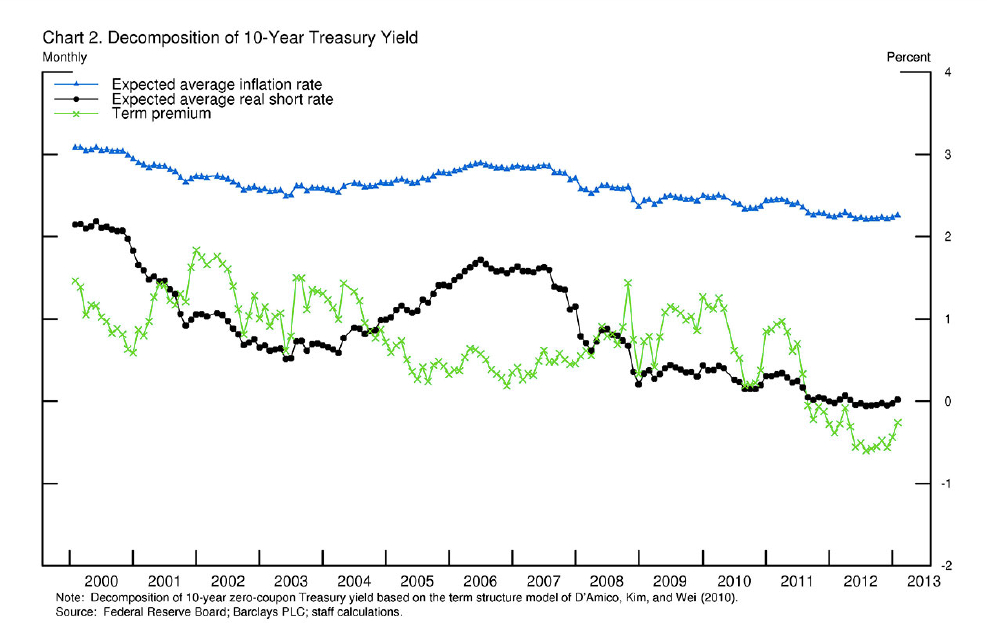
Bernanke then described a nominal interest rate as being composed of three components: a) expected inflation, b) expected short-term real interest rates and c) the term premium (risk associated with a longer maturity bond). A chart from his speech disaggregating the U.S. nominal rate into these three components can be seen here (click for larger image):

Decomposition of 10 Year Treasury jpeg

Note that the expected average short-term real interest rate has come down from around 2% in the year 2000 to essentially zero now. And what does this mean in economic terms. Bernanke provides the answer:

In the longer term, real interest rates are determined primarily by nonmonetary factors, such as the expected return to capital investments, which in turn is closely related to the underlying strength of the economy. The fact that market yields currently incorporate an expectation of very low short-term real interest rates over the next 10 years suggests that market participants anticipate persistently slow growth and, consequently, low real returns to investment. In other words, the low level of expected real short rates may reflect not only investor expectations for a slow cyclical recovery but also some downgrading of longer-term growth prospects.

The disjoint between the two speeches is obvious. In the first, Bernanke’s message—when talking to a class of fresh-faced new graduates—is a relatively upbeat one: don’t give up on growth. In the second, a speech given at a macroeconomic conference, Bernanke suggests that the market is signalling that we have a growth problem.

This also has huge implications for fiscal and monetary policy. If growth has slowed in recent years due to underlying technological factors and not just due to the credit crisis, then it will be exceedingly difficult to kick start the economy through unconventional monetary policy and aggressive fiscal injections. The policy of quantitative easing, which monetary authorities are pursuing in most advanced countries, is premised on the idea that there exists a gap between what the economy could be producing and what it is actually producing (the so called output gap). Should that gap prove a mirage then current policies will be ineffectual.

The Absurdity of ‘Abenomics’ and the PM’s ‘Three Bendy Arrows’ (Part 3: Monetary Policy and a Fictitious Can)

In my two previous posts on Abenomics (here and here), I argued that Japan is a post-growth economy. As the OECD explains in its Compendium of Productivity Indicators 2012, growth can be achieved in only three ways:

Economic growth can be increased either by raising the labour and capital inputs used in production, or by improving the overall efficiency in how these inputs are used together, i.e. higher multifactor productivity (MFP). Growth accounting involves decomposing GDP growth into these three components, providing an essential tool for policy makers to identify the underlying drivers of growth.

Therefore, if I am to be proved wrong in my declaration that Japan is post-growth, Abenomics must be able to boost labour inputs, and/or increase capital inputs and/or improve multifactor productivity (innovation and efficiency). By definition, the Abe agenda must encompass one or more of the three—there are no other means of achieving growth.

Against this background, Prime Minister Abe has given top billing to monetary stimulus within his ‘three arrow’ policy agenda. He campaigned and won a general election on a pledge to force Japan’s central bank, the Bank of Japan, to adopt a binding 2% inflation target through unlimited monetary easing and thus slay deflation. Moreover, to execute such a strategy, he backed a new BOJ governor, Haruhiko Kuroda, who took office in March. Kuroda, in turn, has executed Abe’s monetary policy agenda with gusto. (For a fascinating article on how Kuroda deftly manoeuvred the BOJ board into unanimously support the policy shift, see this Reuters’ article here).

In contrast with the speeches of his predecessor, Masaaki Shirakawa, Kuroda’s early utterances have been accompanied by a very thin chart pack dominated by the now famous ‘all the twos’ slide (click for larger image):

BOJ Quantitative Easing jpeg

These measures will give rise to an extraordinary jump in the monetary base over a two-year period from ¥138 trillion at the end of 2012 to ¥270 trillion at the end of 2014. In fiscal 2012, Japan’s GDP was estimated at approximately ¥475 trillion in nominal terms, so the monetary base is targeted to rise from around 30% of GDP to 55% of GDP.

Monetary Base Target jpeg

By contrast, the action by the Federal Reserve Board in the U.S. looks positively cautious (here), with the monetary base a modest 17% of GDP. Continue reading

Data Watch: US Crude Oil, Monthly Production December 2012

On February 27th, the U.S. government agency The Energy Information Administration (EIA) announced provisional crude oil production figures for December 2012. The new numbers show U.S. crude oil production topping 7 million barrels per day in both November (following a revision for that month) and December.

U.S. Crude Oil Production jpg

The numbers are good (although less so from a climate change perspective), but far from revolutionary. A look at the U.S. data in a global perspective gives rise to considerable concern. Continue reading

Links for Week Ending 2nd February

  • This blog covers two subjects that have the potential to morph into existential threats to civilisation if various factors align. The two in question are climate change and resource depletion. Unfortunately, any consideration of existential threats have been viewed as the province of cranks for the last few decades—or at least of fiction authors with a taste for the dystopian. Now at last the topic is getting some respect with the establishment of the Centre for the Study of Existential Risk at Cambridge, England. The NYT has a good introduction here, and CSER’s web site is here (note the impressive line-up of founders and advisors—no cranks!). 
  • To the Financial Times’ credit, the dark side of the shale gas revolution is given some sympathetic coverage; for example, these articles on shale gas flaring here and here. This contrasts sharply with the Wall Street Journal, whose mantra appears to be “drill baby drill”.
  • Photographing Climate Change in the New Yorker show cases a committed few. I am reminded of Bill McKibben’s lament “where are the goddamn operas“. The artistic community often appears missing in action when it comes to climate change, despite the fact that global warming poses a monumental threat to mankind’s artistic endeavour.
  • The New York Times has a lovely article on “The Preppers Next Door“.
  • A thoughtful post by David Altig from the Federal Reserve Bank of Atlanta at his Macroblog on Robert Gordon’s ‘end of growth’ hypothesis.
  • Climate change was directly addressed in President Obama’s inauguration speech (what a contrast with the Presidential debates). But what could really change? Here is the somewhat gloomy view of Harvard’s Robert Stavins.

Links for Week Ending 5th January 2013

  • NYT dates the start of the Great Recession from Q4 2007 and 5 years on has a great graphic showing the current state of play. No recovery to pre-recession levels in Britain, Japan, France, Italy and Spain. Has the end of growth already arrived in these countries?
  • The knock-on effect of earlier-than-expected Arctic sea ice melt will be greater-than-expected absorption of sunlight and, therefore, higher Arctic circle temperatures and faster-than-expected permafrost thaw. NYT highlights a study (here) confirming the first part of this causation chain.
  • National Geographic has a nice piece all about methane.
  • Since the economist Robert Gordon came out with his technological stagnation thesis earlier in the year, the flood gates have opened for economic comment in this area. The FT’s Izabella Kaminska has put together a wonderful linkfest on the subject at her blog Towards a Leisure Society.
  • The Oil Drum (TOD) is reposting its top 10 articles for 2012. Among them, I recommend Art Berman’s take on shale here and Ron Rapier on tight oil, shale oil and oil shale here.

Technology: Singularity or Collapse? (Part 3: Something Going on Around Here)

Apologies for a an absence of blogging for around two months. My father passed away in March, and for some time I couldn’t summon the concentration that blogging requires. The world, however, moves on and we do certainly appear to be living in ‘interesting times’ (the Chinese curse of living in ‘interesting times’ again appears to be something of a myth, but Wikipedia suggests here that it may actually come from the rather wonderful proverb  “It’s better to be a dog in a peaceful time than be a man in a chaotic period”).

The ‘interesting time’ that we are witnessing in Europe is the unstitching of postwar political and economic institutions in the face of austerity. And actually it is not ‘austerity’ per se that is the problem in Europe, but rather a structural lack of growth. A libertarian would argue that this death of growth in Europe is the result of the continent’s over-regulation, excessive taxation and sclerotic labour markets. Unfortunately, this argument appears lacking since the downward trajectory in economic growth seems an OECD phenomenon; for example, while the US is no Italy, it currently appears incapable of growing enough to absorb the natural rate of increase in its labour force, and its GDP is expanding at a far slower rate than in previous decades.

True, global growth as measured by the IMF is still humming along at a handsome pace. If we ignore the 2009 credit crisis aberration, then GDP expansion has recently been above the post-War long term average and is projected to push up above 4% over the next few years (here). However, just as OECD growth appeared to be have been artificially propped by the accumulation of debt in the 2000s, it is an open question as to whether the developing market behemoths of China, India and Brazil have also been binging on mal-investment post the credit crisis to keep their economic miracles on track. As countries as diverse as the Soviet Union and Japan show, this particular type of industrial policy has a tendency to suddenly come up against a brick wall with the passage of time (read Michael Pettis on China for this sort of critique). Continue reading

Technology: Singularity or Collapse? (Part 2: The Ozone Hole)

In my last post, I made the point that techno-optimists, such as Ray Kurweil, see technological change transforming economies through the exponential growth of productivity as the present century progresses. Critically, the analysis of Kurweil and his fellow travellers makes no mention of societal costs—so called externalities in the language of economics. Each innovation or invention is basically self-contained—overcoming a particular problem but without creating any secondary problems in another part of the system.

Unfortunately, this tunnel vision of the benefits of technology does, on many occasions, not correspond to the actual historical record. One technology I have in mind is Thomas Midgley Jr.’s creation of a compound known as chlorofluorocarbon (CFC-12), better know as Freon. CFCs are a classic Kurzweil type solution to a particular problem, in this case the need for a substitute for the highly poisonous gases used up until the 1930s for refrigeration. At the time of their creation and for many years later, CFCs were believed to be inert and totally harmless to human health. In reality, as the CFCs accumulated in the upper atmosphere, they led to the creation of the Antarctic ozone hole. The journalist and author Dianne Dumanoski in her book “The End of the Long Summer” described the ozone hole phenomenon as the most important single event of the 2oth century, even eclipsing Neil Armstrong’s first steps on the moon, since it symbolised “the arrival of a new and ominous epoch when human activity began to disrupt the essential but invisible planetary systems that sustain a dynamic, living Earth.” Even more telling, the environmental historian J.R. McNeill described Midgley himself as having “had more impact on the atmosphere than any other single organism in earth’s history.” Continue reading